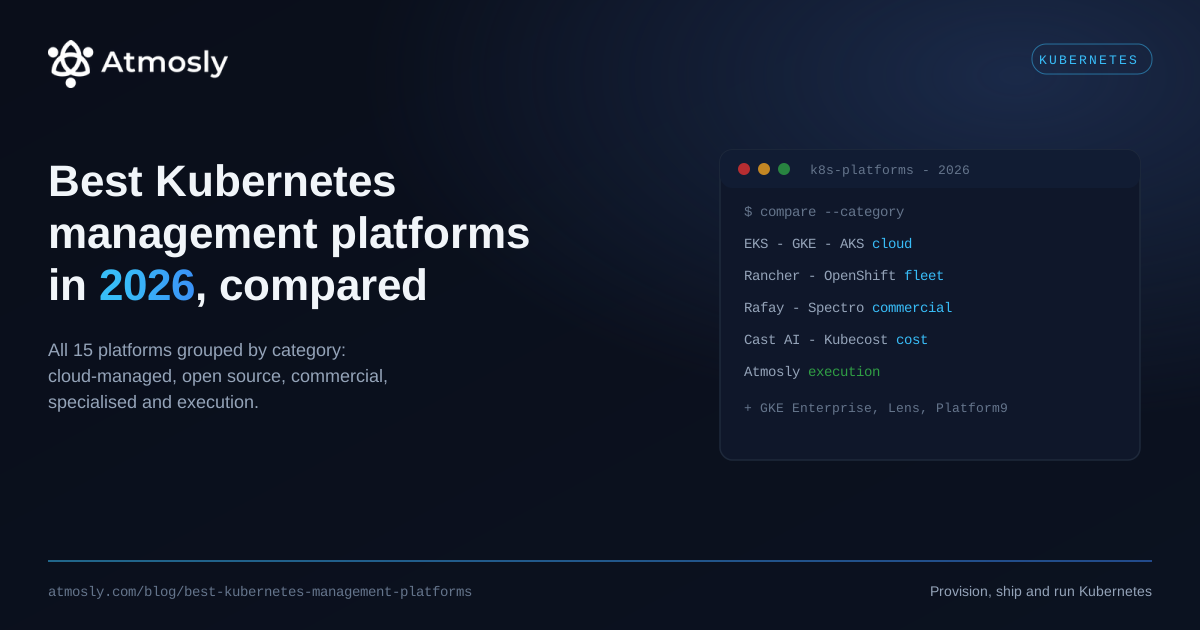
Short answer: the right Kubernetes management platform depends on which job you are buying. Cloud-managed services (EKS, GKE, AKS) run the control plane. Open-source and commercial platforms (Rancher, OpenShift, Rafay, Spectro Cloud) manage fleets of clusters. Specialised tools (Cast AI, Spot.io, Kubecost) attack one problem, usually cost. Execution platforms (Atmosly) cover delivery, security, cost and day-2 operations on one control plane. The table below groups all 15 by category so you can shortlist before reading 6,000 words.
| Platform | Category | Primary job | Best for |
|---|---|---|---|
| Amazon EKS | Cloud-managed | Managed control plane | AWS-native estates |
| Google GKE | Cloud-managed | Managed control plane | Teams wanting the most automated K8s experience |
| Azure AKS | Cloud-managed | Managed control plane | Microsoft-centric enterprises |
| Rancher (SUSE) | Open source | Multi-cluster fleet management | Hybrid and edge fleets, no licence lock-in |
| Red Hat OpenShift | Commercial OSS | Opinionated enterprise K8s | Regulated enterprises wanting a supported full stack |
| KubeSphere | Open source | All-in-one cluster UI | Teams wanting a free unified console |
| Portainer Business | Commercial | Lightweight cluster UI | Smaller teams and mixed Docker/K8s estates |
| Rafay Systems | Commercial | Enterprise fleet operations | Platform teams standardising many clusters |
| Spectro Cloud Palette | Commercial | Declarative cluster profiles | Edge and highly heterogeneous fleets |
| Nirmata | Commercial | Policy and governance | Kyverno-based policy enforcement at scale |
| D2iQ | Commercial | Enterprise K8s distribution | Regulated and air-gapped deployments |
| Cast AI | Specialised | Cost and autoscaling | Teams whose dominant waste is node-layer |
| Spot.io | Specialised | Spot orchestration | Aggressive spot adoption across clouds |
| Kubecost | Specialised | Cost visibility | Teams needing per-namespace cost reporting |
| Atmosly | Execution platform | Delivery, security, cost and day-2 on one plane | Kubernetes-first teams wanting one control plane |
Introduction to Kubernetes Management Platforms: Simplifying Container Orchestration
Kubernetes management platforms are comprehensive software solutions that simplify the deployment, operation, monitoring, security, and cost optimization of Kubernetes clusters and containerized applications, providing centralized interfaces, automation tools, and enterprise-grade features that reduce the operational complexity of running production Kubernetes infrastructure at scale. While Kubernetes itself is a powerful container orchestration platform, managing it effectively requires expertise across cluster provisioning, networking configuration, storage management, security hardening, monitoring and observability, cost optimization, disaster recovery, multi-cluster operations, and continuous maintenance — creating operational overhead that overwhelms small platform teams and becomes a significant barrier to Kubernetes adoption for many organizations.
The Kubernetes management platform market has exploded since 2020 as organizations moved from "we're experimenting with Kubernetes" to "we're running production workloads on 50+ clusters serving millions of users." This transition exposed a critical gap: vanilla Kubernetes provides orchestration primitives but lacks many capabilities required for production operations. Cloud providers (AWS EKS, Google GKE, Azure AKS) offer managed control planes but still require significant operational expertise. Open-source projects (Rancher, OpenShift, KubeSphere) provide additional capabilities but require infrastructure and maintenance. Commercial platforms (Rafay, Palette, D2iQ, Atmosly) offer complete management solutions but vary widely in features, complexity, and cost.
Organizations selecting Kubernetes management platforms face overwhelming choices with insufficient clarity on trade-offs: Should we use our cloud provider's managed service and build tooling ourselves? Should we deploy open-source management platforms and maintain them? Should we purchase commercial platforms and pay licensing fees? Which capabilities matter most — multi-cluster management, cost optimization, security compliance, developer experience, GitOps workflows, observability, or all of the above? How do we evaluate total cost of ownership including licensing, infrastructure, operational overhead, and required expertise?
This guide compares the top 15 Kubernetes management platforms in 2026: managed cloud services (EKS, GKE, AKS), open-source platforms (Rancher, OpenShift, KubeSphere, Portainer), commercial management platforms (Rafay, Palette, Nirmata, D2iQ), specialized solutions (Cast AI, Spot.io, Kubecost), and AI-native execution platforms. For each, we give strengths, limitations, and ideal use cases.
Disclosure: Atmosly is our product. We've included it in this comparison because it belongs in the category, and we've given it the same treatment as everything else here — including an honest limitations section. If another platform on this list fits you better, we say so.
Management Platform, Portal, or Execution IDP?
One distinction cuts through most of the confusion in this market, and it's worth settling before you read the comparisons below.
- A Kubernetes management platform gives operators a control plane for clusters — lifecycle, policy, RBAC, upgrades.
- A portal IDP (Backstage, Port, Cortex) gives developers a catalog and dashboard layered on top of tools you still build and operate yourself. It shows you things; it doesn't do them.
- An execution IDP does the work itself — provisions the clusters, ships the code, runs the workloads, catches security drift, and cuts cost, on one control plane.
Most teams shopping for "Kubernetes management" actually need the third thing and don't know the category exists. We break the difference down in Portal IDP vs Execution IDP, and cover the full picture on the internal developer platform page.
Kubernetes Management Platform Evaluation Criteria
Before comparing specific platforms, establish evaluation criteria matching your needs:
1. Cluster Lifecycle Management
- Cluster provisioning: Create clusters on multiple cloud providers (AWS, GCP, Azure), on-premises, edge locations
- Kubernetes version management: Automated upgrades, rollback capability, multi-version support
- Node management: Auto-scaling, automated patching, node pool configuration, spot instance support
- Disaster recovery: Backup and restore for cluster state, persistent data, configurations
- Multi-cluster orchestration: Manage 10s to 1000s of clusters from a central control plane
2. Application Deployment and GitOps
- GitOps workflows: Declarative infrastructure managed through Git (Flux, ArgoCD integration)
- Application catalogs: Pre-packaged applications and Helm charts ready to deploy
- CI/CD integration: Seamless connection with Jenkins, GitLab CI, GitHub Actions
- Progressive delivery: Canary deployments, blue-green, feature flags, automated rollback
- Multi-tenancy: Isolated namespaces, resource quotas, network policies per team
3. Observability and Monitoring
- Cluster monitoring: Node health, control plane metrics, cluster capacity
- Application monitoring: Request rates, error rates, latency, custom metrics
- Log aggregation: Centralized logging across all clusters and applications
- Distributed tracing: Request flows across microservices
- Alerting: Intelligent alerts minimizing noise, integration with PagerDuty, Slack
4. Security and Compliance
- RBAC management: Fine-grained access control, integration with enterprise identity providers
- Policy enforcement: OPA, Kyverno, admission controllers for security policies
- Security scanning: Container image vulnerabilities, IaC misconfigurations
- Compliance reporting: CIS benchmarks, PCI-DSS, HIPAA, SOC 2 compliance
- Secret management: HashiCorp Vault, AWS Secrets Manager integration
5. Cost Management and Optimization
- Cost visibility: Real-time costs per cluster, namespace, application, team
- Resource optimization: Right-sizing recommendations, idle resource detection
- Spot instance management: Automated spot provisioning, graceful fallback
- Budget alerts: Notifications before exceeding allocated budgets
- Showback/chargeback: Cost allocation for internal billing — see Kubernetes cost allocation
6. Developer Experience
- Self-service portals: Developers deploy without DevOps intervention
- Environment management: Easy creation of dev, staging, production environments
- Troubleshooting tools: Logs, metrics, shell access in unified interface
- Documentation integration: API docs, runbooks, troubleshooting guides
- CLI and API access: Programmatic access for power users
Cloud-Managed Kubernetes Services
Amazon EKS (Elastic Kubernetes Service)
Overview: AWS's managed Kubernetes service handling control plane operations, integrated deeply with the AWS ecosystem.
Key Strengths:
- AWS integration: Native support for ALB, EBS, EFS, IAM, Secrets Manager, CloudWatch
- EKS Anywhere: Run EKS on-premises with a consistent experience
- Fargate support: Serverless pods without managing nodes
- Enterprise features: Private cluster endpoints, pod security groups, IRSA
- Stable and reliable: Proven at massive scale
Limitations:
- AWS lock-in: Deep integration makes multi-cloud difficult
- Cost adds up: Per-cluster control plane fee plus node costs
- Limited multi-cluster: No native multi-cluster management beyond basic tools
- Operational overhead: Still requires expertise for networking, storage, monitoring
- No cost optimization built-in: Must use external tools
Best For: Organizations heavily invested in AWS, requiring deep AWS service integration, with expertise to manage Kubernetes operations.
Google GKE (Google Kubernetes Engine)
Overview: Google's managed Kubernetes service, often considered the most mature as Google created Kubernetes.
Key Strengths:
- Kubernetes expertise: Google created Kubernetes; GKE typically gets features first
- Autopilot mode: Fully managed nodes, automatic scaling, hands-off operations
- Excellent networking: VPC-native networking, advanced load balancing, multi-cluster gateways
- Cost optimization: Cluster autoscaling, pod autoscaling, node auto-provisioning built-in
- Free control plane: No cluster management fees on the standard tier
Limitations:
- GCP ecosystem: Best with Google Cloud services, less common than AWS
- Autopilot trade-offs: Less control, specific workload restrictions
- Multi-cloud complexity: Primarily GCP-focused
- Enterprise adoption: Smaller enterprise customer base than AWS/Azure
Best For: Organizations on GCP, prioritizing ease of operations, wanting the most Kubernetes-native experience.
Azure AKS (Azure Kubernetes Service)
Overview: Microsoft's managed Kubernetes service, tightly integrated with the Azure ecosystem.
Key Strengths:
- Azure integration: Native support for Azure AD, Key Vault, Container Registry, Monitor
- Windows containers: Best platform for running Windows Server containers
- Hybrid capabilities: Azure Arc enables consistent management on-premises
- Enterprise features: Private clusters, confidential computing
- Free control plane: No cluster management fees on the standard tier
Limitations:
- Azure dependency: Tightly coupled to Azure services
- Operational maturity: Historically more breaking changes than EKS/GKE
- Limited multi-cluster: Basic multi-cluster management
- Regional limitations: Feature availability varies by region
Best For: Organizations on Azure, Microsoft-centric technology stacks, requiring Windows container support.
For a deeper head-to-head, see EKS vs GKE vs AKS.
Open-Source Kubernetes Management Platforms
Rancher (SUSE Rancher)
Overview: Open-source multi-cluster Kubernetes management platform, acquired by SUSE in 2020.
Key Strengths:
- Multi-cluster management: Manage unlimited clusters from a single pane of glass
- Cloud agnostic: Works with any Kubernetes distribution (EKS, GKE, AKS, RKE, k3s)
- Robust RBAC: Enterprise-grade access control at project/cluster/namespace levels
- Application catalog: Curated Helm charts ready to deploy
- Active community: Large user base, extensive documentation
- Commercial support: SUSE provides enterprise support and additional features
Limitations:
- Operational overhead: You deploy and maintain the Rancher infrastructure itself
- Complexity at scale: Managing 100+ clusters can become challenging
- Limited cost visibility: No built-in cost optimization or tracking
- Security responsibility: You manage Rancher security, upgrades, high availability
- UI performance: Can be slow with many clusters/workloads
Best For: Organizations running Kubernetes on-premises or multi-cloud, needing an open-source solution, with expertise to manage platform infrastructure.
Red Hat OpenShift
Overview: Enterprise Kubernetes platform with opinionated security, developer experience, and operational features.
Key Strengths:
- Security hardened: SELinux, built-in container scanning, strict admission controls
- Developer experience: Built-in CI/CD, source-to-image builds, developer console
- Enterprise support: Red Hat's renowned enterprise support and ecosystem
- Hybrid cloud: Consistent experience on-premises, AWS, Azure, GCP
- Operator ecosystem: Rich catalog of certified Operators
- Compliance: FedRAMP, FIPS, common criteria certifications
Limitations:
- Expensive: Premium enterprise pricing
- Opinionated: The OpenShift way, with less flexibility
- Resource heavy: Higher resource requirements than vanilla Kubernetes
- Learning curve: OpenShift-specific concepts beyond standard Kubernetes
- Vendor lock-in: Difficult to migrate away from OpenShift
Best For: Large enterprises, regulated industries (finance, healthcare, government), organizations requiring a certified platform with premium support.
KubeSphere
Overview: Open-source distributed operating system managing Kubernetes with a focus on multi-tenancy and observability.
Key Strengths:
- Comprehensive observability: Logging, monitoring, alerting, auditing built-in
- Multi-tenancy: Workspace → Project → Namespace hierarchy
- Application lifecycle: CI/CD, GitOps, image registry, service mesh integration
- Modern UI: Clean, intuitive interface for developers and operators
- Pluggable components: Enable only the features you need
Limitations:
- Smaller ecosystem: Less mature than Rancher/OpenShift
- Documentation quality: Some documentation only in Chinese
- Enterprise features limited: Less robust than commercial alternatives
- Multi-cluster immature: Multi-cluster federation relatively new
- Support options limited: Primarily community support
Best For: Organizations wanting a comprehensive platform with strong observability, comfortable with a relatively newer open-source project.
Portainer Business
Overview: Simple Kubernetes management UI, evolved from a Docker management tool.
Key Strengths:
- Extremely simple UI: Easiest learning curve of any platform
- Quick deployment: Running in minutes, minimal configuration
- Docker + Kubernetes: Manage both environments
- Affordable: Competitive pricing for small/medium teams
- Edge computing: Good support for edge deployments
Limitations:
- Feature limitations: Less comprehensive than enterprise platforms
- Scalability concerns: Best for smaller fleets
- No cost optimization: No cost tracking or optimization features
- Basic monitoring: Limited observability compared to alternatives
- Security features basic: Less robust than enterprise platforms
Best For: Small teams, organizations transitioning from Docker to Kubernetes, edge computing use cases.
Commercial Kubernetes Management Platforms
Rafay Systems
Overview: Enterprise Kubernetes operations platform focused on multi-cluster management, security, and cost governance.
Key Strengths:
- Zero-trust security: Security model with no cluster credentials stored
- GitOps at scale: Enterprise-grade GitOps for thousands of clusters
- Cost optimization: Built-in cost tracking, optimization recommendations
- Cluster lifecycle: Automated Day 2 operations across cloud and on-premises
- Compliance: Built-in compliance frameworks, policy enforcement
- Multi-cloud excellence: True multi-cloud without vendor lock-in
Limitations:
- Premium pricing: Enterprise-focused, expensive for small teams
- Developer experience: More operator-focused than developer-friendly
- Learning curve: Comprehensive features require training
- Market presence: Less brand recognition than some competitors
Best For: Large enterprises managing 50+ clusters across multiple clouds, prioritizing security and compliance.
Spectro Cloud Palette
Overview: Kubernetes management platform with cluster profiles enabling declarative cluster specifications.
Key Strengths:
- Cluster profiles: Declarative cluster templates (K8s version, OS, CNI, CSI, add-ons)
- Edge excellence: Best-in-class edge Kubernetes management (Palette Edge)
- Bare metal support: Strong support for on-premises bare metal clusters
- Virtual clusters: Multi-tenancy through vClusters
- Customization: Deep customization of Kubernetes distributions
Limitations:
- Newer platform: Less track record than established vendors
- Cost intelligence limited: Basic cost visibility, not comprehensive optimization
- AI capabilities: No intelligent automation or ML-based optimization
- Developer portal: Operator-focused more than developer self-service
Best For: Organizations with complex cluster requirements, edge computing deployments, bare metal infrastructure.
Nirmata
Overview: Enterprise Kubernetes policy management and governance platform.
Key Strengths:
- Policy focus: Deep policy management with Kyverno integration (Nirmata maintains Kyverno)
- Governance excellence: Best-in-class policy enforcement across clusters
- Multi-cluster management: Manage hundreds of clusters
- GitOps workflows: Strong GitOps support
- Compliance: Built-in compliance reports and remediation
Limitations:
- Narrow focus: Primarily policy/governance, less comprehensive than alternatives
- Cost management: No cost optimization features
- Observability basic: Limited monitoring compared to comprehensive platforms
- Developer experience: More governance-focused than developer-friendly
Best For: Organizations prioritizing policy enforcement and governance over comprehensive management.
D2iQ (formerly Mesosphere)
Overview: Enterprise Kubernetes platform focused on Day 2 operations and multi-cluster fleet management.
Key Strengths:
- Day 2 operations: Strong automation for ongoing cluster operations
- Fleet management: Manage large cluster fleets
- Operational maturity: Years of experience managing Kubernetes at scale
- Support: Strong enterprise support organization
- Government sector: Strong presence in government/defense
Limitations:
- Pricing: Premium enterprise pricing
- Developer experience: Operator-centric, less developer-friendly
- Modern features: Some features feel dated compared to newer platforms
- Market momentum: Less growth momentum than some competitors
Best For: Large enterprises, government sector, organizations managing very large cluster fleets.
Specialized Kubernetes Management Solutions
These tools deliberately solve one problem well rather than managing the whole cluster lifecycle. Cost dominates the category, but troubleshooting is the other common specialisation — Komodor is the best-known example, focusing on change tracking and incident triage rather than provisioning or cost. Evaluate specialised tools against the specific pain you can name, not as replacements for a management platform.
Cast AI
Overview: AI-powered Kubernetes automation platform focused exclusively on cost optimization and autoscaling.
Key Strengths:
- Cost optimization focus: Strong, measurable cost reduction
- AI-powered autoscaling: ML algorithms optimize node selection and scaling
- Multi-cloud spot orchestration: Intelligent spot instance management
- Quick ROI: Cost savings often exceed licensing costs
- Easy integration: Non-invasive, works with existing clusters
Limitations:
- Single purpose: Only cost optimization, not comprehensive management
- No developer portal: Operator tool, not developer-facing
- Limited observability: Basic monitoring focused on costs
- Cloud only: Requires cloud environments
Best For: Organizations with high cloud Kubernetes costs needing dedicated cost optimization.
Spot.io (NetApp Spot)
Overview: Cloud cost optimization platform with strong Kubernetes spot instance management (Ocean).
Key Strengths:
- Spot instance excellence: Best-in-class spot management and fallback
- Cost visibility: Detailed cloud cost analytics
- Right-sizing: Continuous resource optimization recommendations
- Multi-cloud: Works across AWS, GCP, Azure
- NetApp backing: Enterprise support and stability
Limitations:
- Cost-focused only: Not comprehensive Kubernetes management
- Pricing model: Can be costly for high-spend customers
- No developer experience: Operator tool, not a self-service portal
- Limited beyond compute: Primarily compute cost optimization
Best For: Organizations with significant cloud spend and heavy spot instance usage.
Kubecost
Overview: Cost monitoring for Kubernetes, built on the OpenCost engine (which the Kubecost team created and donated to the CNCF). Acquired by IBM in 2024.
Key Strengths:
- Cost visibility excellent: Detailed cost breakdown by namespace, pod, and label
- Multi-cluster support: Aggregate costs across many clusters
- Open-source core: OpenCost is Apache 2.0 and CNCF-governed
- Cloud agnostic: Works anywhere including on-premises
- Alerting: Budget alerts, anomaly detection
Limitations:
- Visibility only: Shows costs but stops short of applying the fix — acting on findings still takes engineering time
- No comprehensive management: Cost monitoring only, not a full platform
- Operational overhead: Self-hosted deployments mean Prometheus retention, storage, and upgrades are yours
- Free-tier limits: Scale and metric-retention caps
Best For: Organizations needing detailed Kubernetes cost visibility, comfortable with separate tools for different capabilities. For a full head-to-head, see Kubecost vs Atmosly.
AI-Native Execution Platforms
The newest category, and the one that behaves differently from everything above: platforms that don't just manage and report on clusters, but act on them — applying fixes, opening pull requests, and remediating incidents rather than handing the work back to you.
Atmosly
Overview: Atmosly combines cluster management, developer self-service, cost intelligence, security posture, and AI-assisted operations on a single control plane — an execution platform rather than a portal layered over tools you still have to run. (Disclosure: this is our product.)
Key Strengths:
- AI SRE that acts, not just alerts: Astra groups related failures into one incident, infers the root cause, and opens the GitOps pull request that fixes it — reviewed and merged by a human, with a full audit trail.
- One control plane instead of tool sprawl: Cluster management, developer self-service and environment cloning, visual and GitOps pipelines, continuous security scanning of the live cluster, and cost intelligence — rather than five tools you integrate yourself.
- Cost optimization that lands: Real spend from live usage reconciled against cloud billing; p95 right-sizing applied via pull request; a savings ledger tracking potential → in progress → realized. Most customers see 20–40% off Kubernetes costs in the first three months.
- Adoption without a rebuild: Ingests existing workloads, GitOps, and Helm — nothing gets ripped out. Read-only agent; customer data stays in the cluster.
Limitations:
- Not open source. If open source at the core is a hard requirement or a procurement constraint, Rancher or KubeSphere are the honest answers, not Atmosly.
- Smaller market presence. Less brand recognition and a shorter track record than Rancher, OpenShift, or the hyperscaler services. If "nobody gets fired for buying Red Hat" governs your procurement, that's a real consideration.
- Kubernetes-only — it won't cover your whole cloud bill. Atmosly manages what's inside the cluster. It does not govern account-wide, non-Kubernetes spend: your RDS instances, S3 buckets, Lambda functions, and data-transfer charges are outside its scope. That's genuinely a different layer needing a different tool — in our case a separate product, SpendZero. If you want one platform for your entire cloud bill, Atmosly alone is not it.
- Higher-trust system by design. A platform that holds credentials and can open PRs against your manifests carries more responsibility than a read-only dashboard. It's read-only by default with every action reversible and a human merging every change — but if your policy forbids any platform having that reach, a pure monitoring tool is the safer fit.
- Compliance in progress. ISO 27001 certified; SOC 2 Type II is in progress, not complete. If you need a completed SOC 2 attestation today, factor that in.
- Overkill for narrow needs. If all you want is a service catalog, or purely cost visibility, this is more platform than you need — use Backstage or Kubecost.
Best For: Teams whose bottleneck is execution rather than visibility — who already know roughly what's broken and expensive, and don't have the people to fix it. Strongest fit for startups and scale-ups without a platform team, and for organizations tired of integrating five tools to get one workflow.
Also worth evaluating (outside the ranked 15)
Three platforms come up regularly in shortlists without fitting cleanly into the categories above. They are worth knowing about even though they sit outside the ranked fifteen.
- GKE Enterprise (formerly Anthos). Google rebranded Anthos as GKE Enterprise in 2023, so older comparisons still using the Anthos name are describing the same product. It extends GKE-style management to on-premises clusters and other clouds, with fleet management, config sync and a managed service mesh included. The natural choice for hybrid estates already anchored on Google Cloud — and priced for that buyer.
- Lens. Lens is a Kubernetes IDE — a desktop client for inspecting and operating clusters — rather than a management platform in the sense used above. Mirantis maintains it commercially. The open-source OpenLens fork is no longer actively maintained, and community forks have taken up that role; we cover the current state of that in the OpenLens alternatives guide. Useful alongside a platform, not instead of one.
- Platform9. Managed Kubernetes delivered as a service on infrastructure you already own — Platform9 operates the control plane remotely while clusters run in your data centre or cloud account. It suits teams that want managed operations without moving workloads onto a public-cloud managed service.
Compliance-driven selection is a related but separate question. Data residency requirements, SOC 2 evidence and audit trails often narrow a platform shortlist faster than feature comparisons do — that is covered properly in Kubernetes compliance: frameworks, controls and evidence.
Platform Selection Framework: Which Is Right for You?
Decision Tree by Organization Profile
Scenario 1: Startup / Small Team (5–20 engineers, 1–5 clusters)
- Best overall: Atmosly — comprehensive, quick setup, no platform team required
- Budget-conscious: Cloud-managed (EKS/GKE/AKS) + open-source tools
Avoid: OpenShift (too expensive), Rancher (operational overhead too high for team size)
Scenario 2: Mid-Market (50–200 engineers, 10–30 clusters, multi-cloud)
- Best overall: Atmosly — unified platform, scales well, cost optimization ROI
- Open-source preference: Rancher — mature, proven at scale
- Cost focus only: Cast AI + separate management
Avoid: DIY solutions (operational burden too high), basic tools (lack enterprise features)
Scenario 3: Enterprise (200+ engineers, 30+ clusters, complex requirements)
- Security/compliance first: OpenShift or Rafay — certified, hardened, and the safer procurement story
- Multi-cloud complex: Rafay or Spectro Cloud Palette
- Edge deployments: Palette Edge
- AI/cost focus: Atmosly
Avoid: Tools designed for smaller scale, platforms without enterprise support
Decision by Primary Need
Cost Optimization: Cast AI (pure cost play) · Spot.io (spot focus) · Kubecost (visibility) · Atmosly (visibility and applies the fix)
Developer Experience: Atmosly (self-service + golden paths) · OpenShift (built-in dev tools, if budget allows)
Multi-Cluster Management: Rafay (zero-trust, scales to 1000s) · Rancher (open source, proven) · Atmosly
Security/Compliance: OpenShift (certified, hardened) · Rafay (zero-trust) · Nirmata (policy focus)
Open Source Mandate: Rancher · KubeSphere · Portainer — Atmosly is not the answer here
Whole-Account Cloud Spend (beyond Kubernetes): A dedicated cloud cost platform such as SpendZero — not a Kubernetes management tool. None of the platforms above, including Atmosly, governs your full cloud bill. See cloud cost management vs Kubernetes cost optimization for why these are different layers.
Edge Computing: Palette Edge (purpose-built) · Rancher · Portainer
Total Cost of Ownership: What to Actually Count
Licensing is the number everyone compares, and it's usually the smallest line. Count all four:
- Licensing: Free for open source; five to six figures annually for enterprise platforms
- Infrastructure: The control plane, metrics storage, and retention you run yourself
- Operations: The FTE cost of maintaining it — usually the dominant term. Open source is free to license and expensive to run
- Opportunity cost: A DIY internal developer platform typically means four to six engineers and roughly twelve months before developers see real golden paths — then it's a permanent cost centre
"Free" platforms with a 2 FTE maintenance burden routinely cost more than commercial platforms that need 0.25 FTE. Model the total, not the invoice.
Implementation Best Practices
Phase 1: Proof of Concept (2–4 weeks)
- Select 2–3 platforms based on requirements and budget
- Deploy to non-production: Test with dev/staging clusters
- Involve developers: Get feedback on developer experience
- Measure metrics: Deployment time, troubleshooting ease, cost visibility
- Evaluate support: Responsiveness, documentation quality
Phase 2: Pilot Production (1–2 months)
- Select the winning platform based on POC results
- Deploy to 1–2 production clusters: Low-risk workloads first
- Train the team: Platform engineers and developers
- Establish processes: Deployment workflows, approval gates, incident response
- Monitor closely: Issues, performance, costs
Phase 3: Full Rollout (2–6 months)
- Migrate remaining clusters incrementally with validation
- Optimize configurations based on real usage
- Document standards: Runbooks and best practices
- Measure success: Deployment frequency, MTTR, cost savings, developer satisfaction
- Iterate continuously with regular feedback cycles
Common Platform Selection Mistakes
Mistake 1: Choosing Based on Brand Recognition Alone
Problem: "We'll use OpenShift because Red Hat is a known brand" — without evaluating fit or budget.
Solution: Evaluate against requirements, not brand.
Mistake 2: Ignoring Total Cost of Ownership
Problem: "Rancher is free" — ignoring the infrastructure and FTE time to maintain it.
Solution: Calculate TCO including licensing, infrastructure, and operational overhead. Commercial platforms are often cheaper in total.
Mistake 3: Over-Optimizing for Current Scale
Problem: Choosing a tool perfect for 5 clusters today that won't scale to 50 next year.
Solution: Choose a platform that scales 2–3x beyond current needs without re-architecture.
Mistake 4: Neglecting Developer Experience
Problem: The platform team chooses a tool they like; developers hate it; adoption fails.
Solution: Include developers in the evaluation. Developer satisfaction is critical to adoption.
Mistake 5: Buying a Portal When You Need a Platform
Problem: "We'll use Rancher for management, Kubecost for costs, Grafana for monitoring, and a custom portal on top" — five tools, and an integration layer you now own forever. Adding a catalog on top of infrastructure you're struggling to manage doesn't make the infrastructure easier to manage; it just makes the struggle more visible.
Solution: Prefer a platform that executes over a portal that visualizes. See Portal IDP vs Execution IDP.
Conclusion: Selecting the Right Kubernetes Management Platform
The Kubernetes management platform landscape in 2026 offers unprecedented choice — from cloud-managed services to open-source solutions to commercial platforms to AI-native execution platforms. The "right" platform depends entirely on your organization's requirements, constraints, and strategic goals; there is no universal best choice, and any vendor telling you otherwise is selling.
Key decision factors:
- Organization size and maturity: Startups need quick time-to-value; enterprises need comprehensive features
- Budget constraints: Balance licensing costs against operational overhead and FTE requirements
- Primary pain points: Cost optimization? Developer experience? Security? Multi-cluster management?
- Cloud strategy: Single cloud, multi-cloud, hybrid, or on-premises?
- Team expertise: Kubernetes experts can manage complex platforms; smaller teams need simplicity
If open source is a mandate, choose Rancher or KubeSphere. If you need a certified platform with premium enterprise support, OpenShift or Rafay. If your need is narrow — pure cost visibility, or edge — a specialized tool will serve you better than a broad platform. And if your real bottleneck is execution rather than visibility, an AI-native execution platform closes that gap by turning findings into merged changes.
Whatever you choose, follow a structured process: define requirements clearly, evaluate 2–3 finalists with proof-of-concept deployments, involve developers in the decision, calculate total cost of ownership including operational overhead, and pilot production before full rollout. The right platform accelerates your Kubernetes journey; the wrong one becomes an expensive obstacle requiring a costly migration later.
Where to Go Next
- Portal IDP vs Execution IDP — the distinction that decides whether your platform does the work.
- Kubecost vs Atmosly — a fair, detailed look at the cost-tooling decision.
- Cloud Cost Management vs Kubernetes Cost Optimization — why the whole-account layer and the cluster layer are different problems.
- The Atmosly Internal Developer Platform — provision, ship, and run Kubernetes on one control plane.
Want to see where your clusters actually stand before you commit to anything? Connect a cluster read-only for a free audit — nothing changes in your cluster, no sales call.