Every Kubernetes cost cleanup project has the same aftermath. The team runs an audit, finds tens of thousands of dollars of monthly waste, ships the fixes, celebrates the savings, and moves on to the next thing. Six months later, another audit finds roughly the same amount of waste. Nothing was maliciously wrong — new services deployed with the same copy-pasted resource blocks, teams inherited orphaned resources from projects that shipped or died, autoscalers ran uncapped and occasionally misbehaved. Kubernetes cost governance is the discipline of stopping that loop by moving the controls upstream, so that waste never lands in production in the first place instead of getting cleaned up quarterly.
Governance is not the same as optimization, and treating them as one is the reason most cost programs stall after their first success. Optimization is what you do to the waste that exists today; governance is what stops new waste from being deployed tomorrow. The two are complementary — you need both — but they use different tools, live in different parts of the delivery pipeline, and are owned by different people. Optimization is usually a project owned by the platform team. Governance is a system that everyone who deploys to the cluster interacts with, and that survives changes in the platform team.
This guide covers what a working cost governance program actually contains: the policies that pay for themselves quickly, the enforcement mechanics that make policies stick without becoming an obstacle to shipping, the ownership rules that keep cost visible to the people who can act on it, and the monitoring that catches when policies drift out of alignment with reality. Most of the mechanics are portable across cloud providers and cluster distributions; the policies are not, and they need to be sized to your organization's tolerance for both risk and friction.
The largest lever in governance is deploy-time enforcement — a policy that prevents a wasteful deployment from ever running is worth ten policies that report on wasteful deployments after the fact. Teams that would rather have both the policy engine and the drift monitoring integrated into one workflow, instead of stitching together admission controllers and dashboards themselves, can layer a Kubernetes Cost Optimization platform that ships the recommendations, the guardrails, and the reporting from the same pipeline. Either way, what follows explains what the guardrails actually need to do.
What Is Kubernetes Cost Governance?
Kubernetes cost governance is the set of policies, controls, and processes that shape how workloads consume resources across a cluster or a fleet, so that cost stays predictable, attributable, and defensible. It is the operating system for cost — not the tools that measure or reduce spend, but the rules that determine what can be deployed, who owns what runs, and what triggers a review.
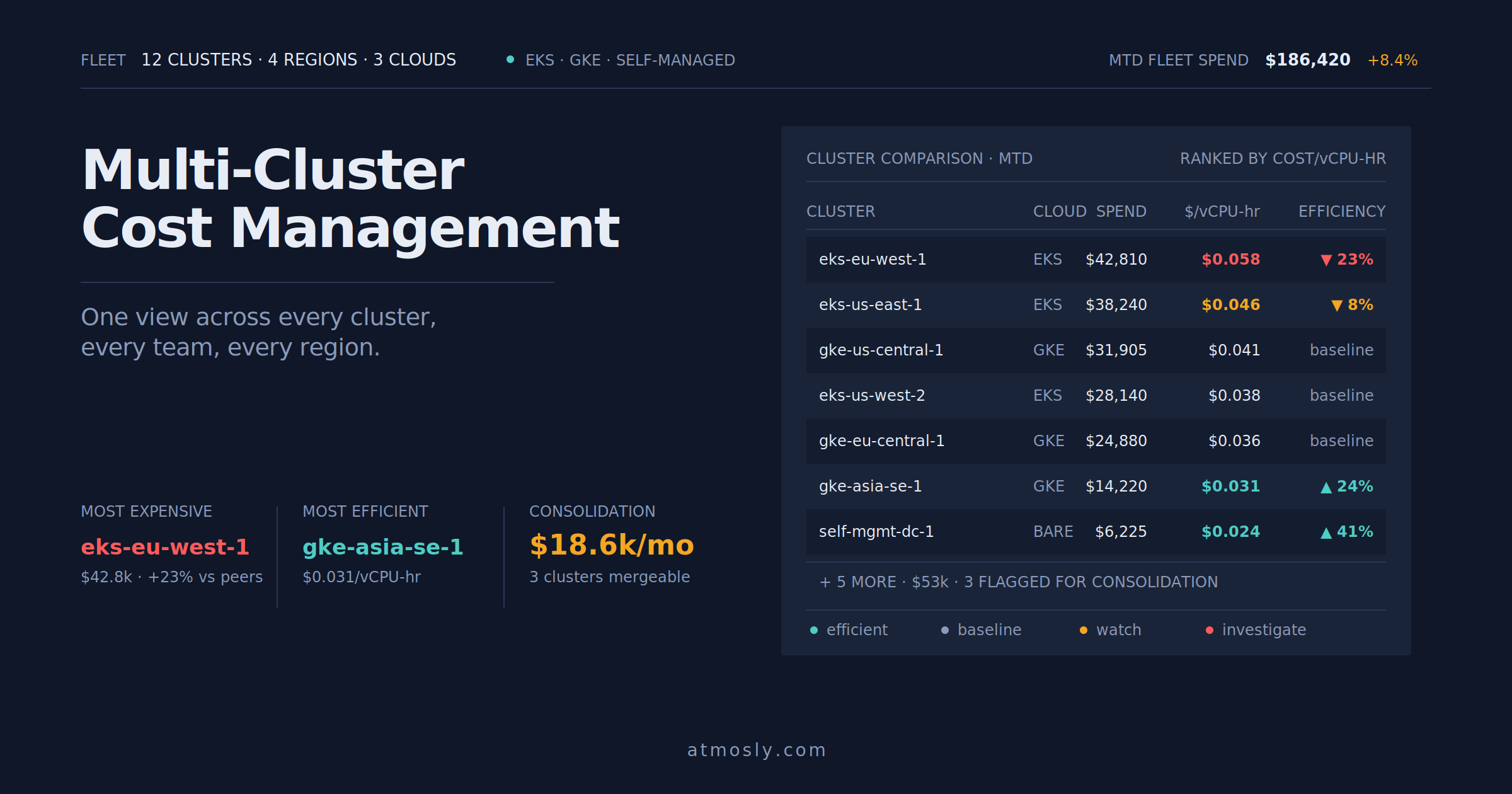
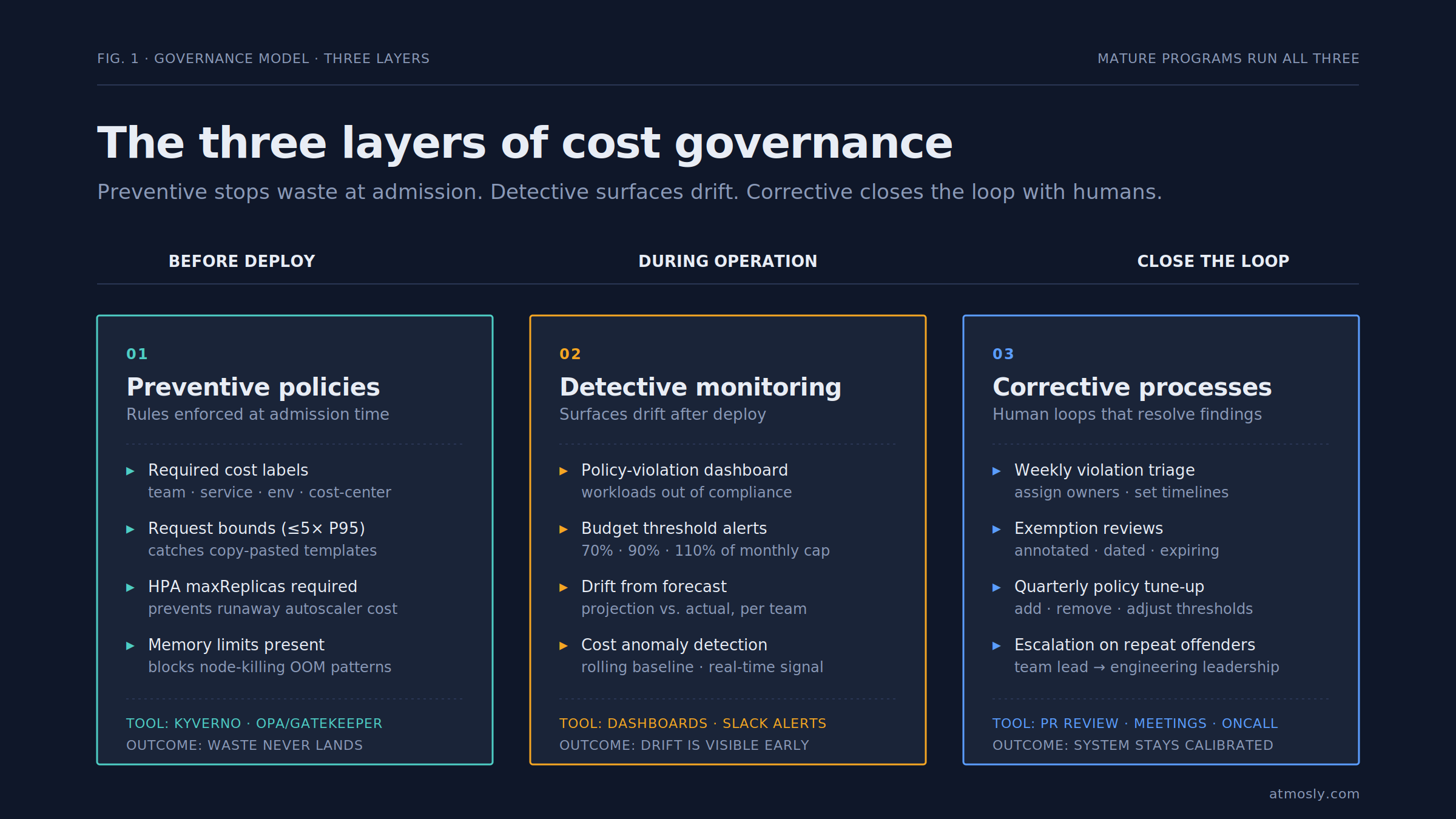
A useful mental model has three layers. Preventive policies stop problematic configurations from ever entering the cluster — admission controllers that reject Deployments requesting more than N× the namespace's historical usage, policies that require cost allocation labels on every workload, guardrails that cap max replica counts for HPAs. Detective policies monitor for drift — dashboards that surface workloads violating policy, reports on which namespaces are approaching budget, alerts when a cluster's cost trajectory deviates from its forecast. Corrective processes are the human loops that resolve findings — the weekly review that assigns owners to flagged workloads, the escalation path when a team ignores repeated warnings, the exemption process for legitimate outliers.
All three layers matter. Preventive policies alone create friction without visibility; detective policies alone report on problems that keep happening; corrective processes without either are just meetings. A mature program has all three, and the ratio between them shifts over time — early governance leans heavily on detection because you do not yet know what is normal, and mature governance leans heavily on prevention because most of what is normal has been encoded into policy.
Governance also is not about micro-managing every workload. The best programs enforce a small number of high-value policies rigorously and leave the long tail of small decisions to the teams that own the workloads. Trying to encode every possible cost consideration into policy produces an unenforceable rulebook that engineers work around; encoding the five or ten policies that catch the majority of expensive mistakes produces a governance program that actually holds.
Why Kubernetes Teams Need Cost Policies
Kubernetes clusters accumulate waste faster than teams clean it up, and the reasons are structural rather than cultural. Understanding why is the case for policies specifically, rather than more meetings or more dashboards.
The first structural reason is that the default resource request is almost always wrong. When a team ships a new service, someone types 2Gi memory and 1 CPU into a Helm chart because those numbers were in the last chart they wrote. There is no forcing function for setting requests based on actual usage; the pod will schedule, appear healthy, and pass every review even if it uses 5% of what it reserves. Absent a policy that catches this, the default becomes the ceiling.
The second is that the incentives face away from cost. Application teams are measured on shipping features and keeping services reliable; nobody's OKR includes "reduce your namespace's monthly spend by 20%." A team that over-provisions gets no penalty and slightly lower on-call load from reduced OOMKill risk. A team that rightsizes aggressively takes on some marginal reliability risk for a savings number they do not personally benefit from. Governance policies shift this incentive by making cost visible at the moment of the deploy, not at the end of the quarter.
The third is that the platform team cannot review every change. Even a modest microservices setup has dozens of deploys per day. A platform team of five cannot review every pod spec, catch every over-provisioning, verify every autoscaler configuration. Policies scale where humans do not — an admission controller reviews every deploy in milliseconds and never gets tired of asking whether requests are reasonable.
The fourth is that waste compounds across the fleet. One service over-requesting 500Mi does not matter. Thirty services over-requesting 500Mi each is a full node's worth of memory that is paid for and never used. Governance policies catch waste at the individual workload level, but their real value is preventing the accumulation across the fleet — a policy that limits requests to 3× historical usage per workload keeps the fleet-wide waste bounded regardless of how many workloads land.
The fifth is that cleanup does not scale, but prevention does. A cleanup project cuts 20% of waste this quarter and requires 20% of a platform engineer's time. A well-designed policy cuts 20% of new waste for as long as it runs and requires 0% of anyone's time after it is deployed. Every organization eventually notices this asymmetry; the ones that act on it early avoid the cleanup treadmill entirely.
Essential Kubernetes Cost Governance Policies
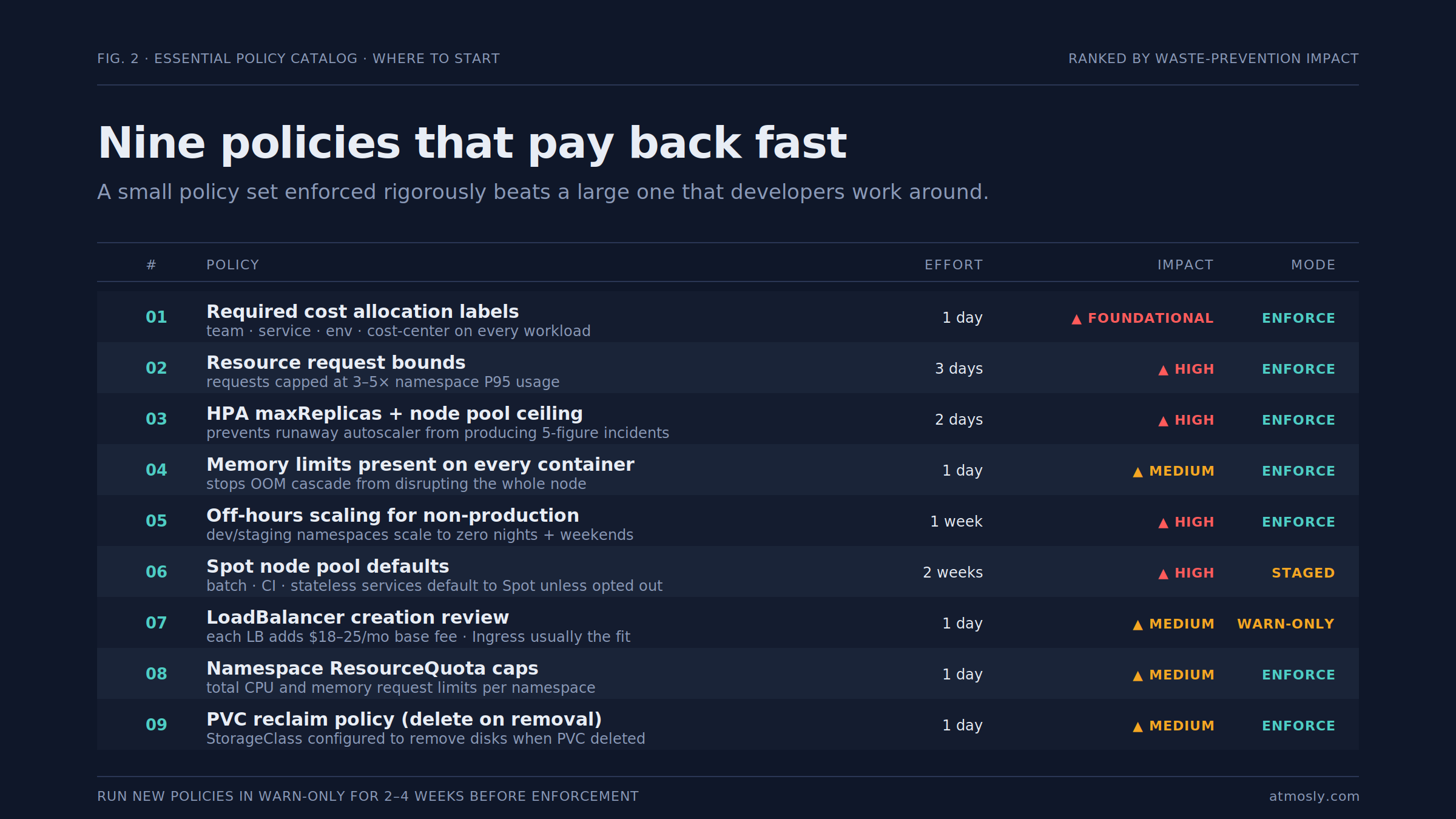
A working governance program does not need dozens of policies. Five to ten well-chosen ones catch the majority of preventable waste. The specific set that pays back fastest for most teams:
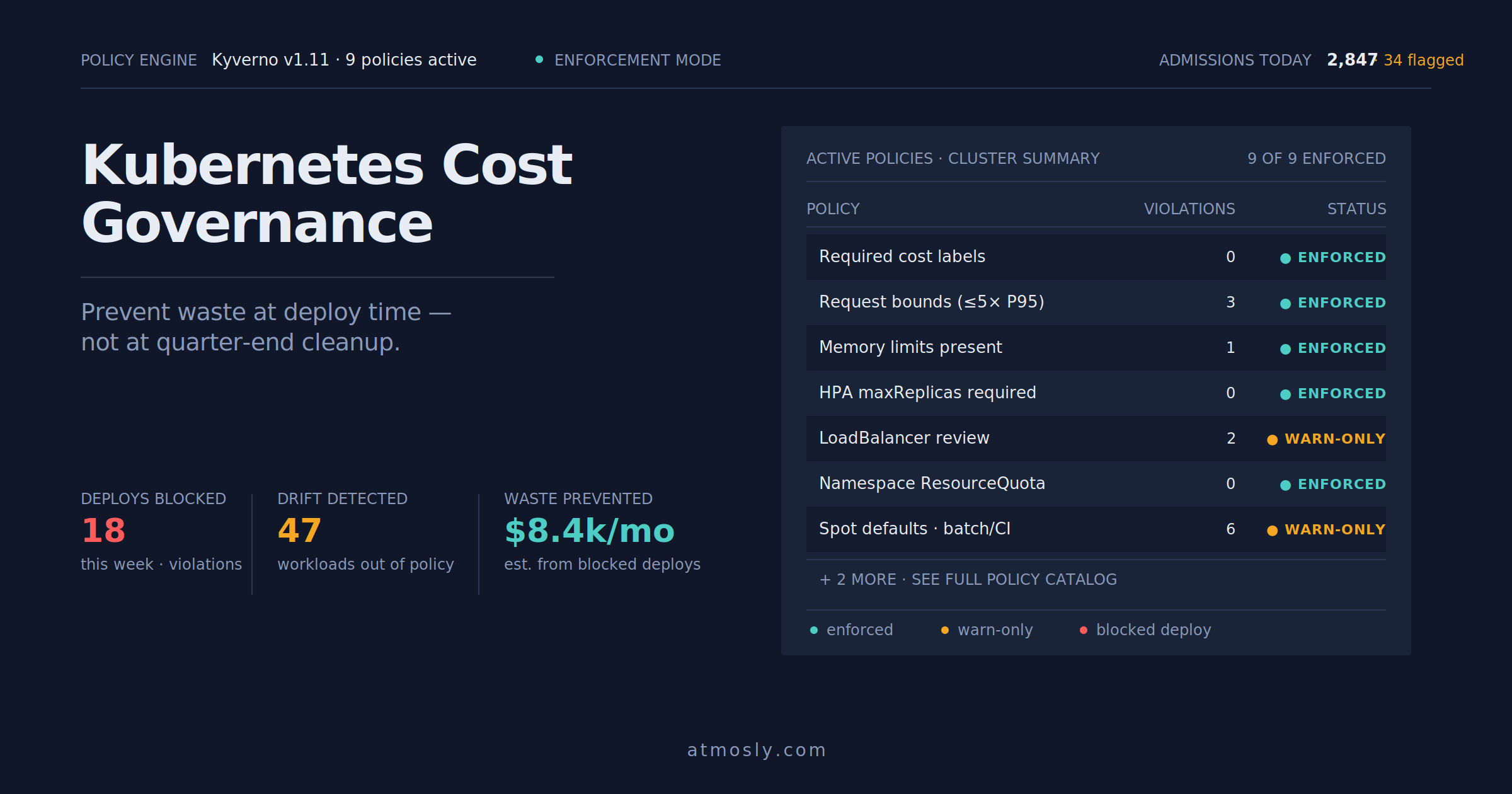
Required cost allocation labels. Every workload must carry team, service, environment, and cost-center labels (or whatever schema your organization uses). Admission is rejected if any required label is missing. Without this policy, the entire cost allocation pipeline breaks silently — spend shows up as "unattributed" and no one owns it. This is the foundational policy every other one depends on, and it costs nothing to enforce beyond a one-time schema decision.
Resource request bounds. Requests cannot exceed N× the namespace's rolling P95 usage for the same workload category, where N is typically 3-5. This catches copy-pasted-from-a-template requests without blocking legitimate large workloads. The tricky part is defining "same workload category" — usually it is close enough to compare against other workloads with the same service label, or fall back to namespace-wide P95 if the service is new.
Resource limits present. Every container must declare memory limits (CPU limits are more contentious — some teams enforce them, others explicitly disable them for latency-sensitive workloads because CPU throttling can cause worse problems than the runaway itself). Missing memory limits means a runaway workload can OOM the node and disrupt everything scheduled on it.
HPA and node count ceilings. Every HorizontalPodAutoscaler must declare maxReplicas. Every node pool has a maximum node count set at the infrastructure level. This is the single most important policy for preventing runaway cost incidents — an HPA that scales unbounded on a misbehaving metric can burn thousands of dollars per day, and the ceiling turns that into a much smaller, self-limiting incident.
LoadBalancer creation review. LoadBalancer-type Services get an admission review because each one provisions a cloud load balancer at $18-25/month base cost. For most workloads, an Ingress under a shared LoadBalancer is the right choice, and requiring a review before creating a new dedicated LB catches the accidents where someone reached for LoadBalancer because it was the first example in the docs.
PVC lifecycle policies. StorageClass definitions include reclaim policies that actually delete Persistent Disks when PVCs are removed. This is a one-time policy decision that prevents the "orphaned PVC still charging six months later" pattern that shows up in every audit.
Namespace-level budgets and quotas. ResourceQuota objects on each namespace cap total CPU and memory requests. This does not directly manage cost, but it prevents a single misbehaving namespace from consuming disproportionate cluster capacity and pushing other workloads onto new nodes.
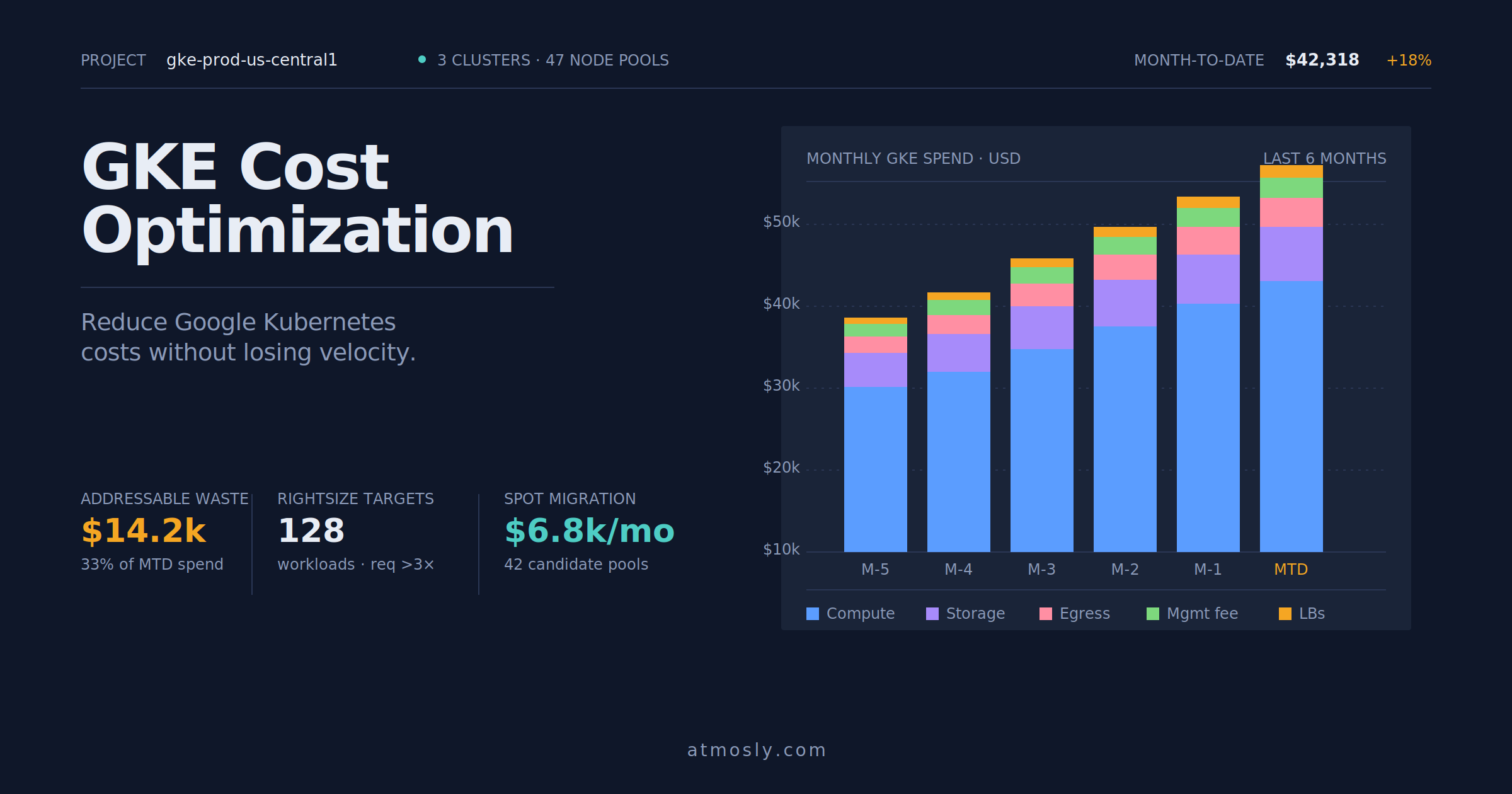
Spot node pool defaults. Certain workload categories (batch jobs, CI runners, stateless services with multiple replicas) are policy-defaulted to Spot node pools unless explicitly opted out with a justification. Making Spot the default rather than the exception is where most of the compute savings come from on GKE and EKS.
Off-hours scaling for non-production. Dev and staging namespaces scale to zero (or to a minimum baseline) outside working hours, enforced via CronJob or a scheduled controller. This is the single largest optimization for non-production environments and requires no per-workload configuration if implemented at the namespace level.
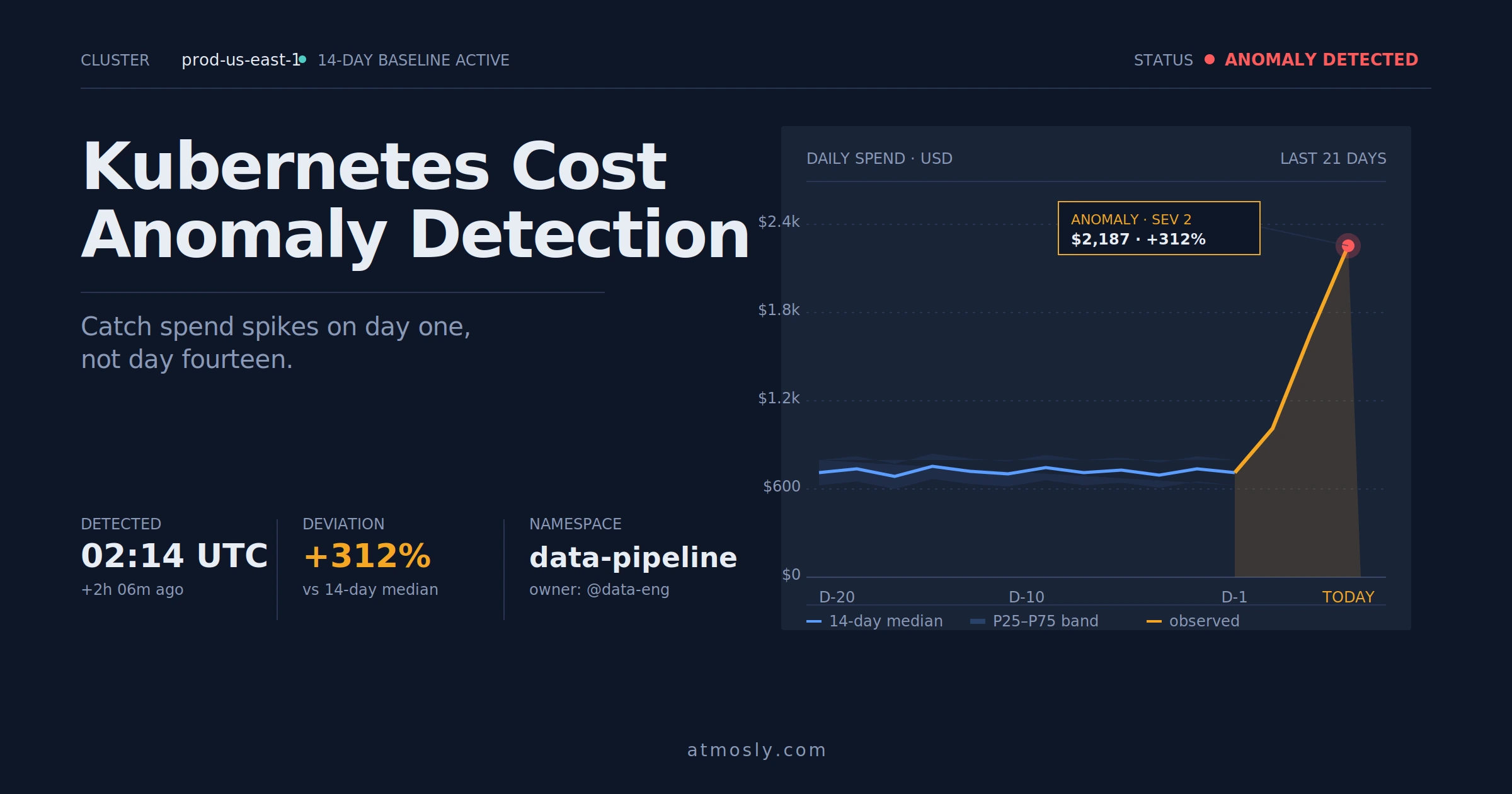
The pattern across all of these is that they are enforced at deploy time or configuration time, not caught after the fact. The one-time cost of writing the policy pays back on every deploy that would have added new waste. The mechanics of catching runaway spend in real time, once policies are in place, is covered in the guide to Kubernetes cost anomaly detection — governance stops most incidents from happening; anomaly detection catches the ones that get through.
Setting Resource Limits, Budgets, and Ownership Rules
The three most important governance categories are resource limits, budgets, and ownership. Each answers a distinct question and each has a specific pattern that works better than the alternatives.
Resource limits answer the question "how much can any single workload consume before something intervenes." The right pattern is a tiered set of thresholds. First tier: a soft warning at admission time when requests exceed the namespace's P95 historical usage by 2×, letting the deploy through with a flag. Second tier: a hard rejection at admission time when requests exceed 5× P95 without a justification annotation. Third tier: a namespace-level ResourceQuota that caps total request across all workloads regardless of individual sizing. This tiered approach catches unusual configurations without blocking legitimate outliers — a workload that genuinely needs a large allocation can annotate why, and the annotation becomes documentation for the next review.
Limits also matter beyond CPU and memory. Storage class defaults, load balancer creation, ingress rule counts, and API rate limits all have runaway modes that a small policy prevents. The pattern is the same: figure out what the P95 legitimate use looks like, set the hard limit at 3-5× that, and require a justification annotation to exceed it.
Budgets answer the question "how much is any team or namespace allowed to spend before someone talks about it." Unlike compute quotas, budgets are usually implemented as reporting and alerting rather than hard blocks — cutting off a production namespace at midnight because it exceeded its monthly budget produces worse outcomes than the overage itself. The useful pattern is a namespace or team-level budget with three thresholds: 70% of monthly budget triggers a heads-up notification, 90% triggers a review meeting, 110% triggers an escalation to leadership. The teams that use this well are the ones where the budget review actually happens; the ones where the budget is set once and never referenced treat it as decoration.
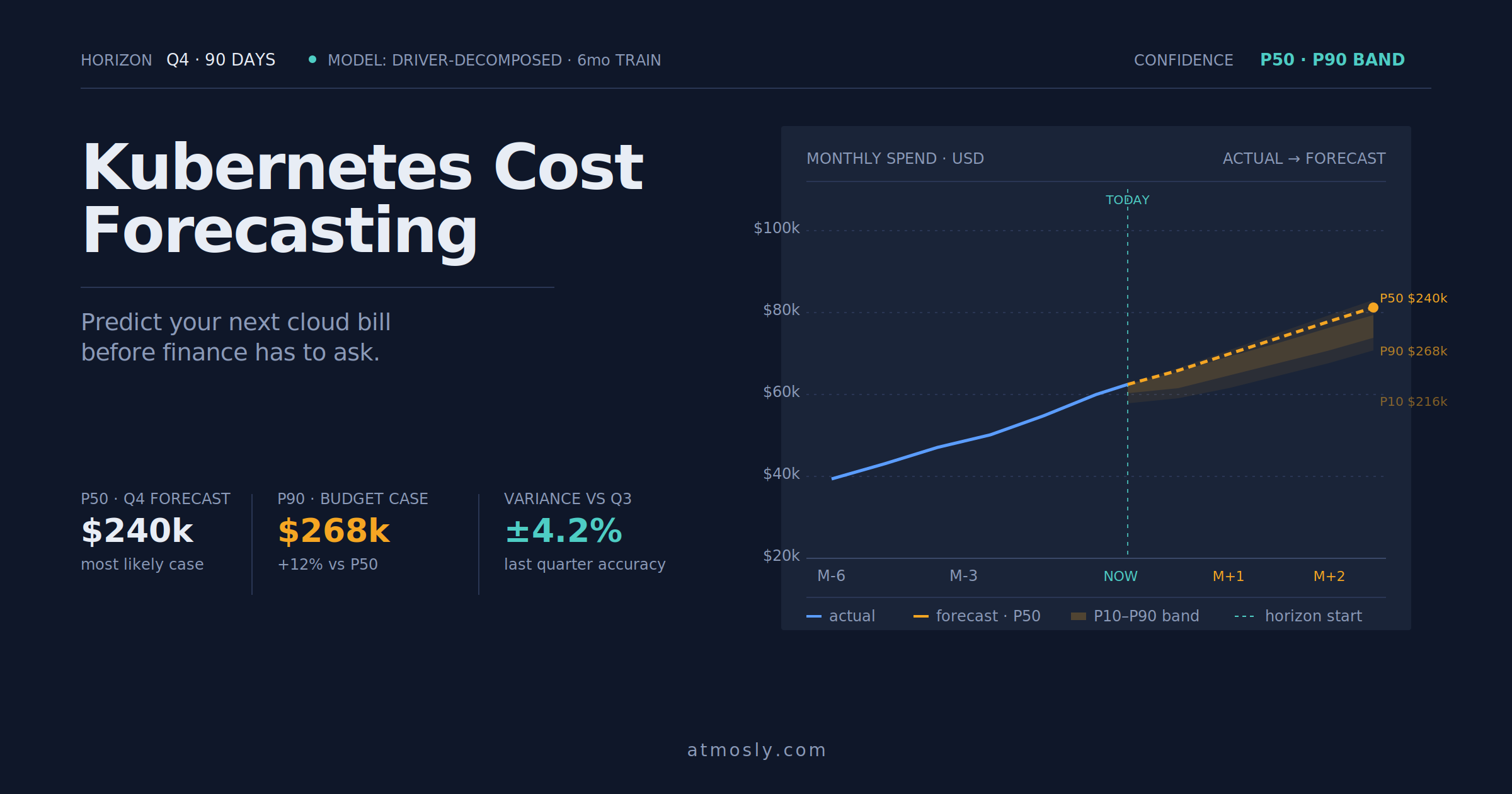
Budgets need forecasts to work. A budget of $50k/month is meaningless if the team is trending toward $80k by week two — the useful signal is not the current spend but the projection of month-end spend given the current run rate. The pattern of joining actuals to a forecast to detect early overrun, and turning that into ownership-attributed action, is essentially the same discipline as showback and chargeback for shared clusters.
Ownership rules answer the question "who is accountable when a workload violates a policy or exceeds a budget." Every namespace has an owning team (via the required labels), every team has an escalation path (usually a Slack channel and a tech lead), and every alert or violation routes to that path rather than a generic "platform" channel. Ownership without routing is fictional — the routing is what turns a violation into someone's problem.
The right level of ownership granularity depends on organization size. Small teams can share a single "engineering" namespace and route everything to one channel. Larger teams need namespace-per-team ownership at minimum, and often service-owner-level ownership on top so that individual workloads route to the on-call for that service. The routing is worth investing in — a governance program where alerts go to a channel nobody reads is worse than no governance program, because it creates the illusion of coverage.
How to Monitor and Enforce Kubernetes Cost Policies
Policies without enforcement are documentation. The mechanics of turning them into working controls involve three layers: the policy engine, the reporting layer, and the review cadence.
The policy engine is the technical infrastructure that evaluates deploys against rules. Kyverno and OPA/Gatekeeper are the standard choices, and both are mature enough that the decision is mostly about your team's preferences — Kyverno uses YAML that reads like Kubernetes manifests, OPA uses Rego which is more expressive but has a steeper learning curve. Whichever you pick, install it in every cluster, apply the same policy set uniformly, and treat policy changes as code that goes through PR review. Cluster-specific policies (dev vs. prod) are fine but should be the exception, not the rule.
Admission policies fire at deploy time and either warn or reject. Rejection is stronger but riskier — a policy that rejects legitimate deploys during an incident is worse than no policy at all. The safe pattern is to run new policies in warn-only mode for a period (typically two to four weeks) to observe what they catch, tune the thresholds based on real data, and only then flip to enforcement. This also builds trust with application teams — they see the policy running, understand what it flags, and are not surprised when it starts blocking.
The reporting layer shows which workloads currently violate policy and which are approaching thresholds. This surfaces the drift that admission policies cannot catch — workloads that were compliant when deployed but grew past their limits, HPAs that were sized correctly at launch but need maxReplicas raised, teams that ship dozens of small over-requests each of which is under the threshold but which aggregate to something worth reviewing. A weekly report to platform team and to each workload owner is enough for most environments; daily is overkill and gets ignored.
The review cadence is where policies stop being purely automated and start involving human judgment. A weekly triage of policy violations that names owners, sets timelines for remediation, and escalates repeat offenders is what keeps governance credible. This is the meeting that gets skipped when things get busy and that quietly kills governance programs when it does — the discipline of holding it, even briefly, is worth more than any specific policy in the catalog.
Exceptions and exemptions are part of the system, not a workaround for it. A workload that legitimately needs to violate a policy gets an exemption annotation, a documented reason, and an expiry date. Exemptions without expiry become permanent, and the exemption list becomes a shadow policy that nobody maintains. Every exemption expires and either gets renewed with a fresh review or is removed.
The Kubernetes documentation on validating admission policies covers the native admission mechanism that many governance policies build on. Policy engines like Kyverno and OPA sit on top of this primitive and add the ergonomics that make writing and maintaining large policy catalogs practical.
Ship guardrails without the DIY.
Connect a cluster read-only and get a policy audit against the recommended cost governance rules — what would pass, what would fail, and which workloads are the highest-impact fixes. Setup takes a few minutes; nothing changes in your cluster. Try it free →
Related Articles