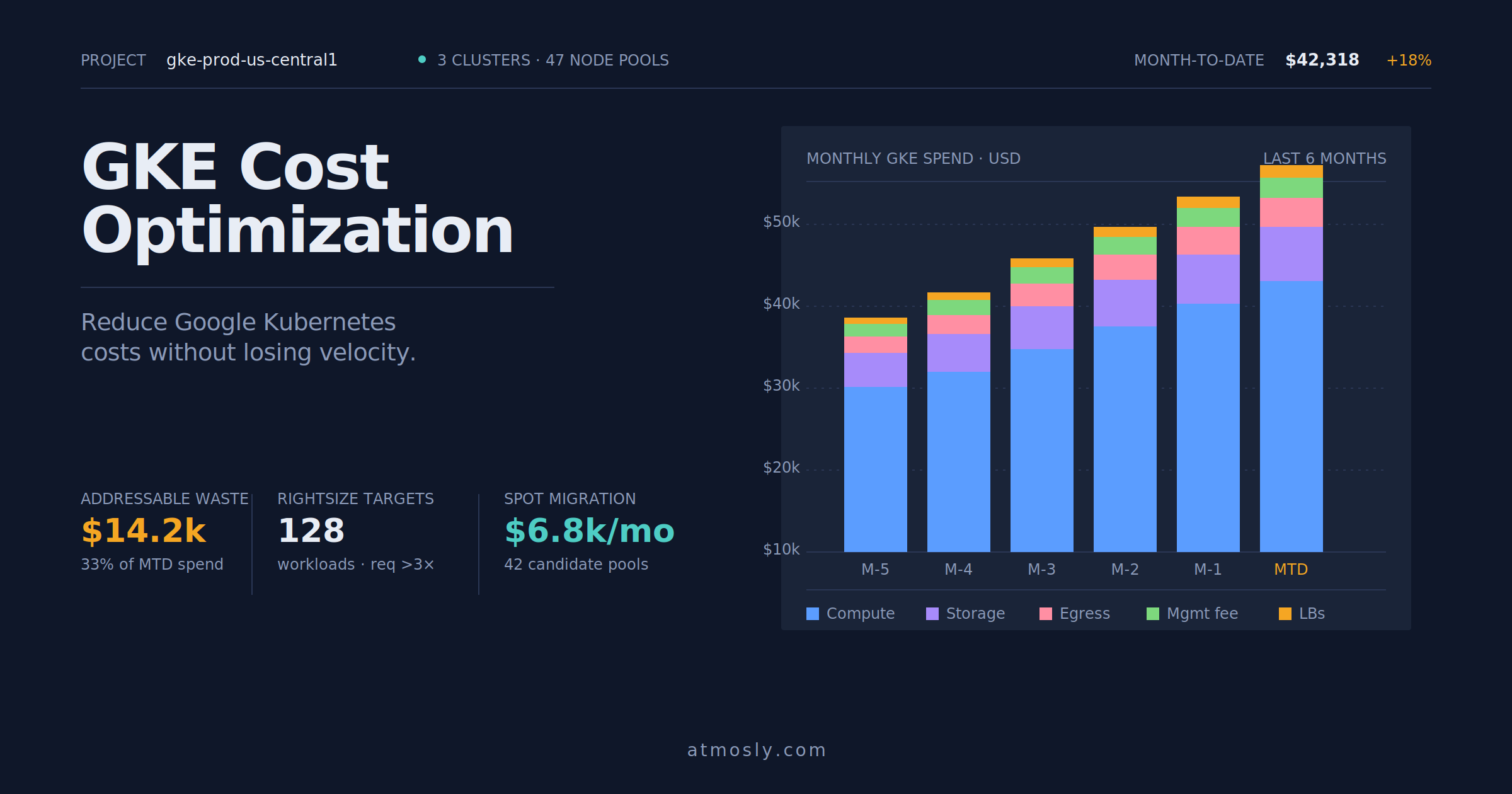
Google Kubernetes Engine bills grow faster than the workloads running on them. A cluster that cost $8k a month at launch is at $22k eighteen months later, and only some of that increase corresponds to real product growth. The rest is idle capacity, over-requested pods, storage that was provisioned once and never revisited, and network egress from architectural choices that made sense on a whiteboard but cost real money at scale. GKE cost optimization separates growth tied to product traction from growth that isn't, and reverses the second category without breaking the first.
This guide covers the parts of GKE cost management that are specific to Google Cloud — Autopilot versus Standard, Spot VMs, Committed Use Discounts, cross-zone traffic pricing, and the management fee that quietly compounds as you add clusters. Most of the mechanics are portable across cloud providers, but the pricing model is not, and the choices that produce the largest savings on GKE are different from the ones that produce the largest savings on EKS or AKS.
The single largest lever in any Kubernetes environment is the gap between what pods request and what they use, and GKE is no exception. GKE has enough of its own idiosyncrasies — Autopilot's per-pod pricing model, Google's aggressive Spot VM discounts, the way egress is billed across zones inside the same region — that treating it as "just Kubernetes" leaves 20-40% of the addressable savings on the table. Teams that would rather have these audits automated instead of running them by hand can layer a Kubernetes Cost Optimization platform on top of the cluster to surface the same signals continuously; either way, the mechanics below are what actually produce the bill reduction.
Why GKE Costs Increase as Clusters Scale
The default trajectory for a GKE cluster is that its cost curve outruns its workload growth by a meaningful margin, and understanding why is the first optimization. Five forces drive most of that gap.
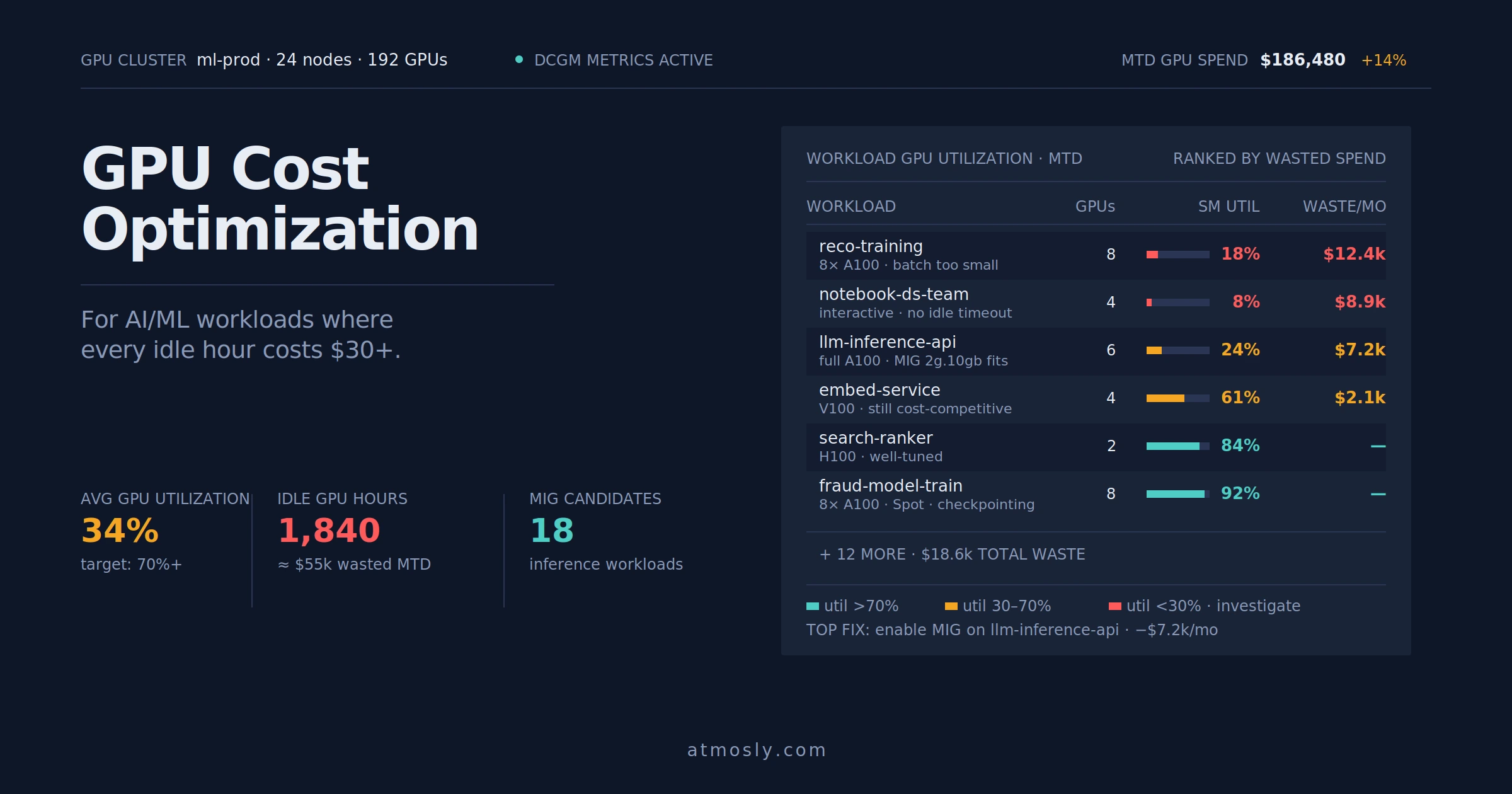
The first is overprovisioned pod requests. When a team ships a new service, resource requests are almost always set based on a rough guess or a copy-pasted template — 2Gi memory, 1 CPU — regardless of what the workload actually uses. GKE's scheduler reserves that capacity on a node whether the pod uses it or not, and the Cluster Autoscaler adds nodes to keep enough headroom for those requests. Over time, most production clusters end up with average CPU utilization in the 15-25% range and memory utilization only marginally better. The nodes are paid for at 100%; the workloads use a fraction of them.
The second is suboptimal node choice. GKE Standard defaults to general-purpose N-series machines, which are fine for mixed workloads and expensive for specialized ones. A memory-heavy service running on N2 nodes pays for CPU it never uses; a burst-compute service running on E2 nodes pays for sustained baseline it does not need. Compute-optimized (C-family), memory-optimized (M-family), and Tau (T2) instances are meaningfully cheaper per unit of the resource that actually matters, but only if someone matches the workload to the machine.
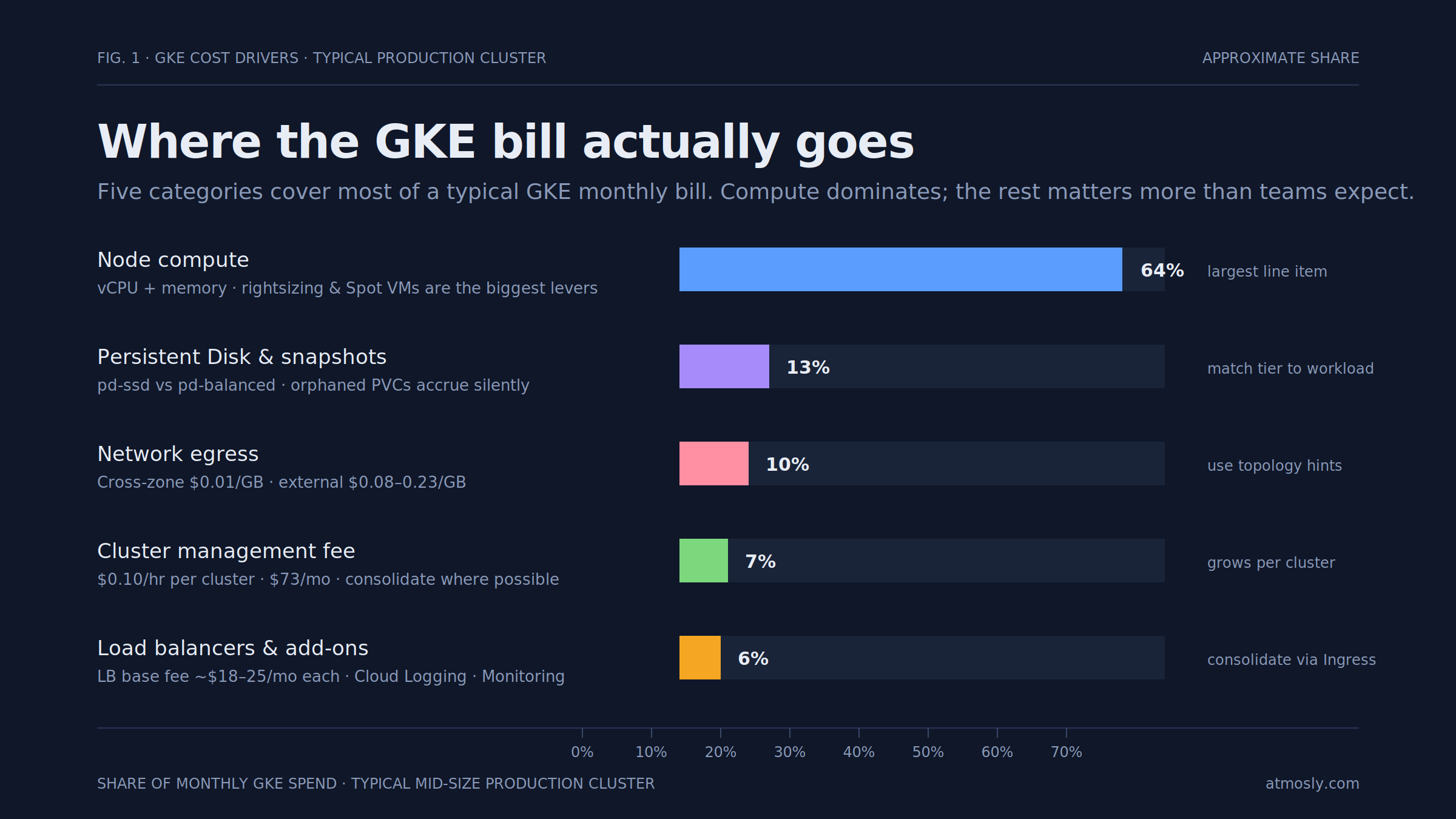
The third is the management fee and cluster proliferation. GKE charges $0.10 per cluster per hour (approximately $73/month per cluster) above the Autopilot or Standard node costs, waived only for the first Autopilot cluster per billing account under the free tier. Teams that spin up separate clusters per environment, per team, or per region accumulate these fees quickly. A company with 20 clusters is paying roughly $1,500/month in management fees alone before any workload runs.
The fourth is storage that is provisioned and forgotten. Persistent Disks attached to StatefulSets or PVCs live independently of the pods that mount them, and Google does not garbage-collect them when the workload is deleted. Snapshots taken by backup jobs accumulate unless a lifecycle policy retires them. Object storage buckets used for build artifacts, ML training data, or log archives grow indefinitely without a class-transition policy moving cold data to Nearline or Coldline.
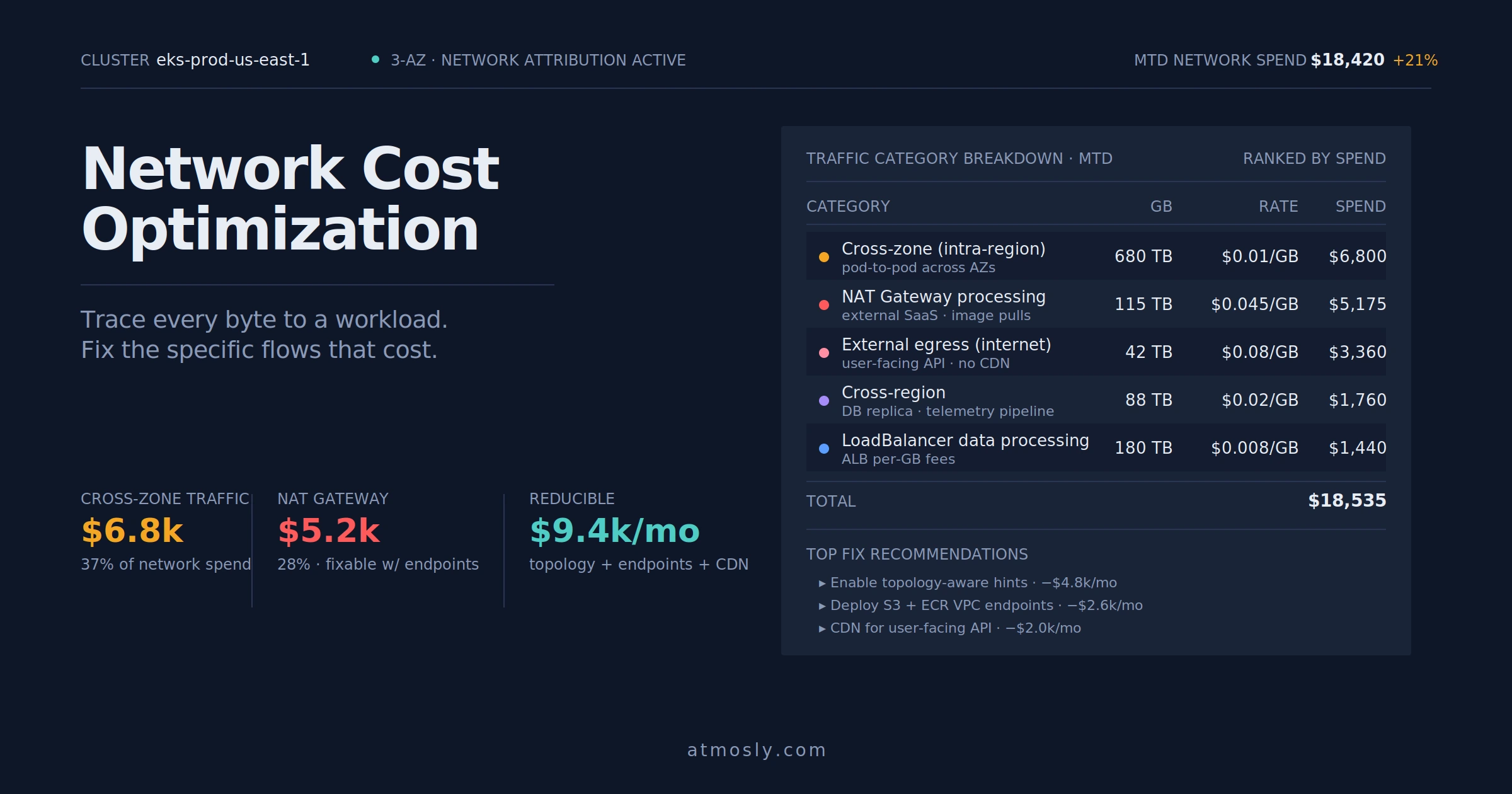
The fifth is cross-zone and cross-region network egress. Google charges $0.01 per GB for traffic between zones within the same region and $0.02-$0.12 per GB for cross-region traffic. Cluster designs that spread pods across zones for availability — which is the default and usually the right call — produce cross-zone traffic every time a pod calls a service that happens to be scheduled in a different zone. At single-digit request volumes this is invisible; at hundreds of thousands per second it becomes one of the top line items on the bill.
How to Identify GKE Cost Drivers
Before optimizing anything, you need to know where the money is actually going. GKE's own billing console gives you the top-level split — compute, storage, network, management — but the useful granularity is one level down, at the namespace and workload level.
The starting point is Google Cloud's billing export to BigQuery, which delivers detailed billing data with a 24-hour lag. That gets you cost per resource ID, but to translate that into cost per namespace or per workload, you need to join it against GKE resource labels. The join is straightforward if every workload consistently uses cost allocation labels (team, service, environment), and painful if the labeling was retrofitted after the fact. Teams that have not yet standardized their labels usually spend a sprint just getting attribution right before any real optimization begins.
Within the cluster, kubectl top and Prometheus give you the usage side. The gap between what workloads request and what they actually consume is where most of the addressable waste sits. A P95 request-to-usage ratio above 3× on either CPU or memory means the workload is significantly overprovisioned. Above 5× is severely overprovisioned and usually the fastest single fix for the bill.
For workloads that own their own infrastructure — StatefulSets with PVCs, services with LoadBalancers, jobs that create ephemeral resources — the audit needs to catch orphaned objects too. Unattached PersistentVolumeClaims still charge for the underlying Persistent Disk. LoadBalancer Services with no pod endpoints still incur the LB base fee. The full audit playbook for orphaned resources and idle capacity covers the specific kubectl and jq commands to surface these; the pattern applies identically to GKE.
The output of this discovery phase is a ranked list of workloads and namespaces by spend, with each line annotated by category — over-requested compute, storage, egress, or orphaned object. That ranking is what focuses the optimization work on the changes that actually move the bill, rather than the changes that feel productive but touch small workloads.
GKE Compute and Resource Optimization Strategies
Compute is roughly 60-70% of a typical GKE bill, so this is where the largest optimizations live. The mechanics differ meaningfully between GKE Standard and GKE Autopilot, and the choice between them is itself one of the optimization decisions.
Rightsizing pod requests is the largest single lever regardless of which mode you run. The goal is to set requests to the P95 of observed usage over a 14-30 day window, leaving limits at 2-3× requests to handle legitimate spikes. Under-requesting produces throttling and OOMKills; over-requesting produces the waste that got you here. The safe cadence is to land the change through the normal PR pipeline (not kubectl edit), roll it out to one replica first, and watch throttling and OOMKill counters for 24-48 hours before rolling to the rest. The P95-based rightsizing methodology covers the Prometheus queries and the rollout mechanics in detail.
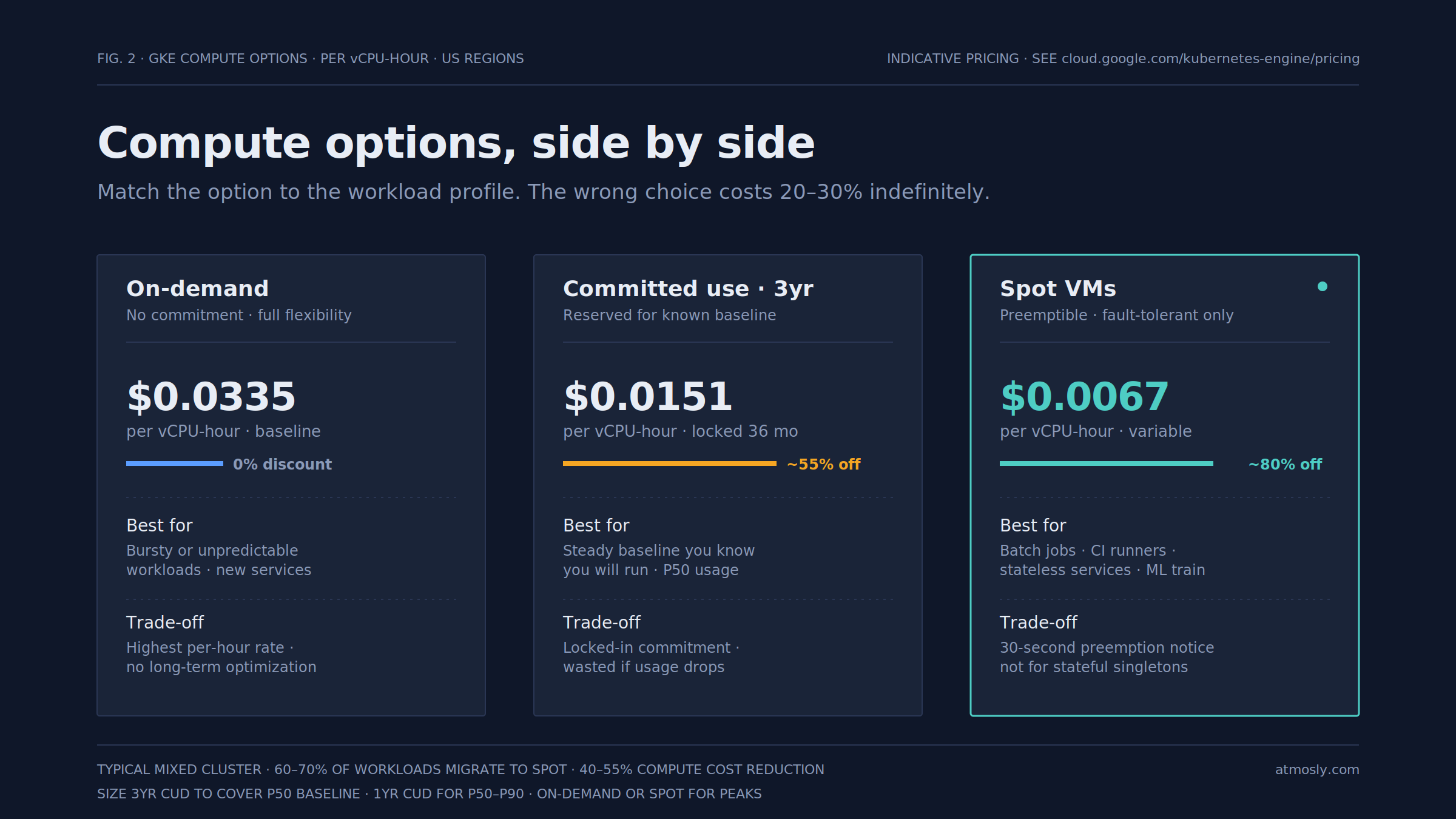
Spot VMs are the single fastest cost reduction available on GKE Standard. They deliver 60-91% off on-demand pricing in exchange for 30-second preemption notice and no availability guarantee. Fault-tolerant workloads — batch processing, CI runners, stateless web services with more than one replica, ML training with checkpointing — should run on Spot node pools by default. Stateful services, databases, and singletons stay on regular nodes. The typical mixed workload cluster runs 60-70% of pods on Spot after this migration and cuts total compute cost by 40-55%.
Committed Use Discounts (CUDs) apply to the baseline capacity you know you will always run. A 1-year commitment gives you roughly 25% off, a 3-year commitment roughly 55% off. The math works out when you can accurately size the commitment — over-committing wastes the discount, under-committing leaves savings on the table. Most teams cover their P50 (median) usage with 3-year CUDs, add 1-year CUDs for the layer between P50 and P90, and leave the top 10% of demand on on-demand or Spot capacity.
Autopilot versus Standard is a design decision with real cost implications. Autopilot bills per pod's requested resources rather than per node — you pay for the requests you set, and Google manages the underlying nodes. This is cheaper for small clusters with well-sized pods and expensive for clusters with overprovisioned requests, because with Standard you can rely on bin-packing across pods to absorb some of the waste. As a rough rule: if your pod requests are rightsized to actual usage, Autopilot is competitive and eliminates node operations work; if your requests are still 3-5× oversized, Standard with careful node management is cheaper. GKE's documentation on Autopilot pricing versus Standard walks through the specific rates.
Horizontal Pod Autoscaler with the right metric matters more than the choice of autoscaler. HPA on CPU is the default and works fine for CPU-bound workloads. For queue-driven or latency-sensitive services, custom metrics (queue depth, request rate, P95 latency) produce far better scaling behavior. A misconfigured HPA that scales aggressively on the wrong metric is one of the fastest ways to produce a runaway cost spike — the same pattern that makes real-time cost anomaly detection valuable in the first place.
How to Optimize GKE Storage and Networking Costs
Compute gets the attention because it is the largest line item, but storage and network together are usually 20-30% of the bill and are where teams find "surprise" money — waste that was invisible until someone specifically looked.
Persistent Disk selection is a per-workload choice. GKE defaults to Balanced Persistent Disks (pd-balanced), which are a fine general-purpose choice. Standard PDs (pd-standard) are cheaper for workloads that do not need high IOPS, such as backup targets or log archives. SSD PDs (pd-ssd) are appropriate for databases and I/O-heavy services and are the most expensive tier. A workload running on pd-ssd when pd-balanced would suffice is silently overpaying by 40-60% on storage.
Snapshot lifecycle policies matter more than most teams notice. Backup jobs typically create snapshots on a schedule and rely on manual or forgotten cleanup. Google charges for snapshot storage at roughly $0.026 per GB per month, which does not sound like much until you notice a cluster with 200 PVCs and daily snapshots retained for 90 days. Setting explicit retention policies and moving older snapshots to Archive storage class (if they are kept at all for compliance) is a small change with a real effect.
Cross-zone network traffic is the network optimization most teams underestimate. Any pod calling another pod in a different zone pays $0.01/GB in one direction, and the traffic goes both ways in most protocols. Service mesh or CNI configurations that keep traffic within a zone when possible — for example, using topology-aware hints in Kubernetes 1.21+ to prefer same-zone endpoints — cut this cost dramatically for high-volume internal traffic. The tradeoff is availability: same-zone preference means a zone outage cuts off more traffic than a zone-spread setup. For most internal service-to-service traffic this is an acceptable trade; for critical user-facing paths it is not.
External egress is billed separately and more expensively. Traffic leaving Google Cloud to the internet costs $0.08-$0.23 per GB depending on destination continent and volume tier. For content-heavy workloads, Cloud CDN in front of egress-heavy services shifts the cost curve substantially. For internal traffic to other Google Cloud projects, Private Service Connect keeps traffic on Google's backbone and avoids egress charges entirely.
Load balancer consolidation is a small but real optimization. Each LoadBalancer-type Service provisions a dedicated Google Cloud load balancer with a base cost of roughly $18-$25/month plus data processing fees. Consolidating multiple services behind a single Ingress with path- or host-based routing collapses that per-service base cost onto one shared load balancer.
GKE Cost Optimization Best Practices
The teams that hold their GKE savings over time do a few things consistently that teams that regress do not.
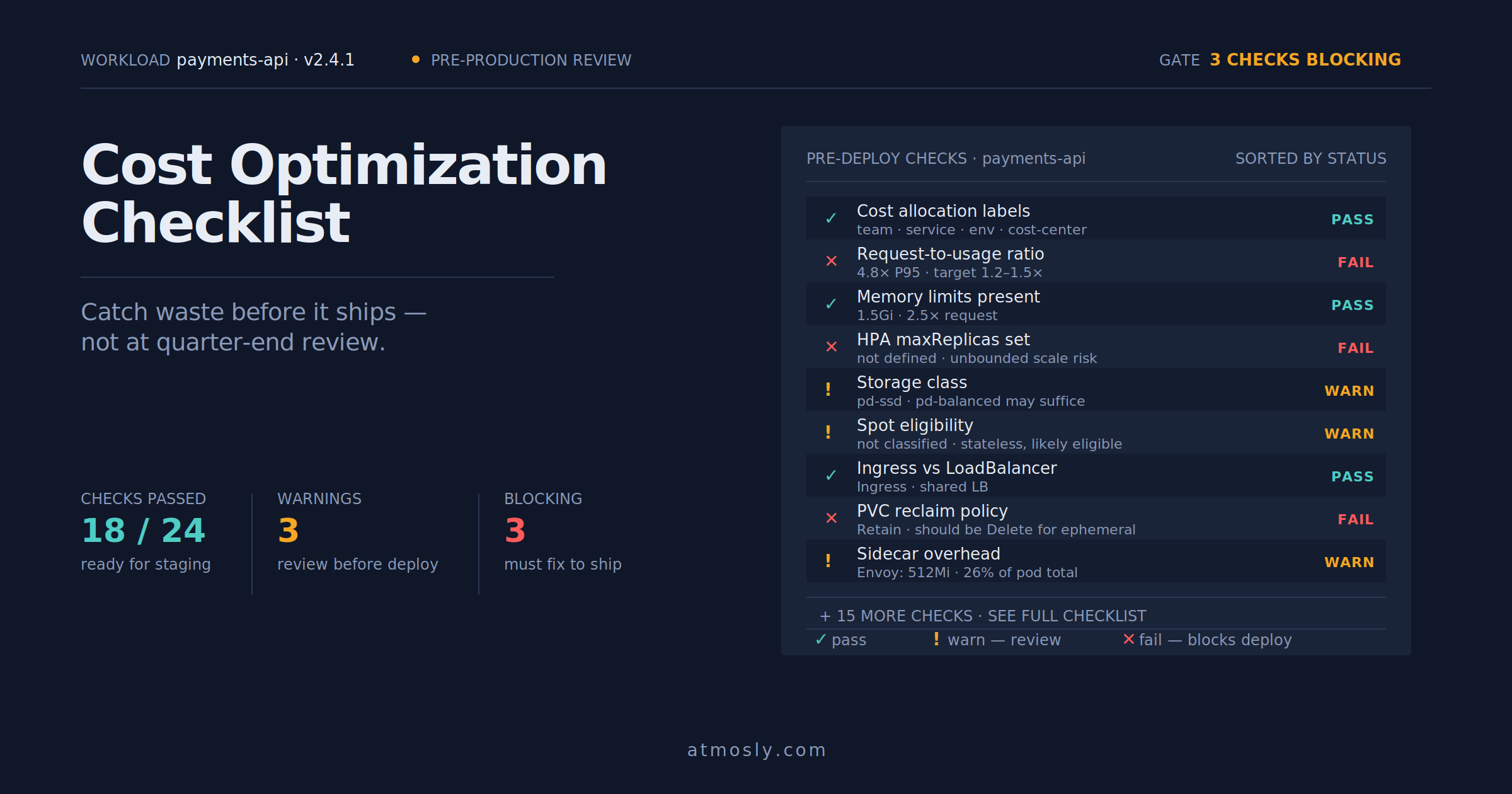
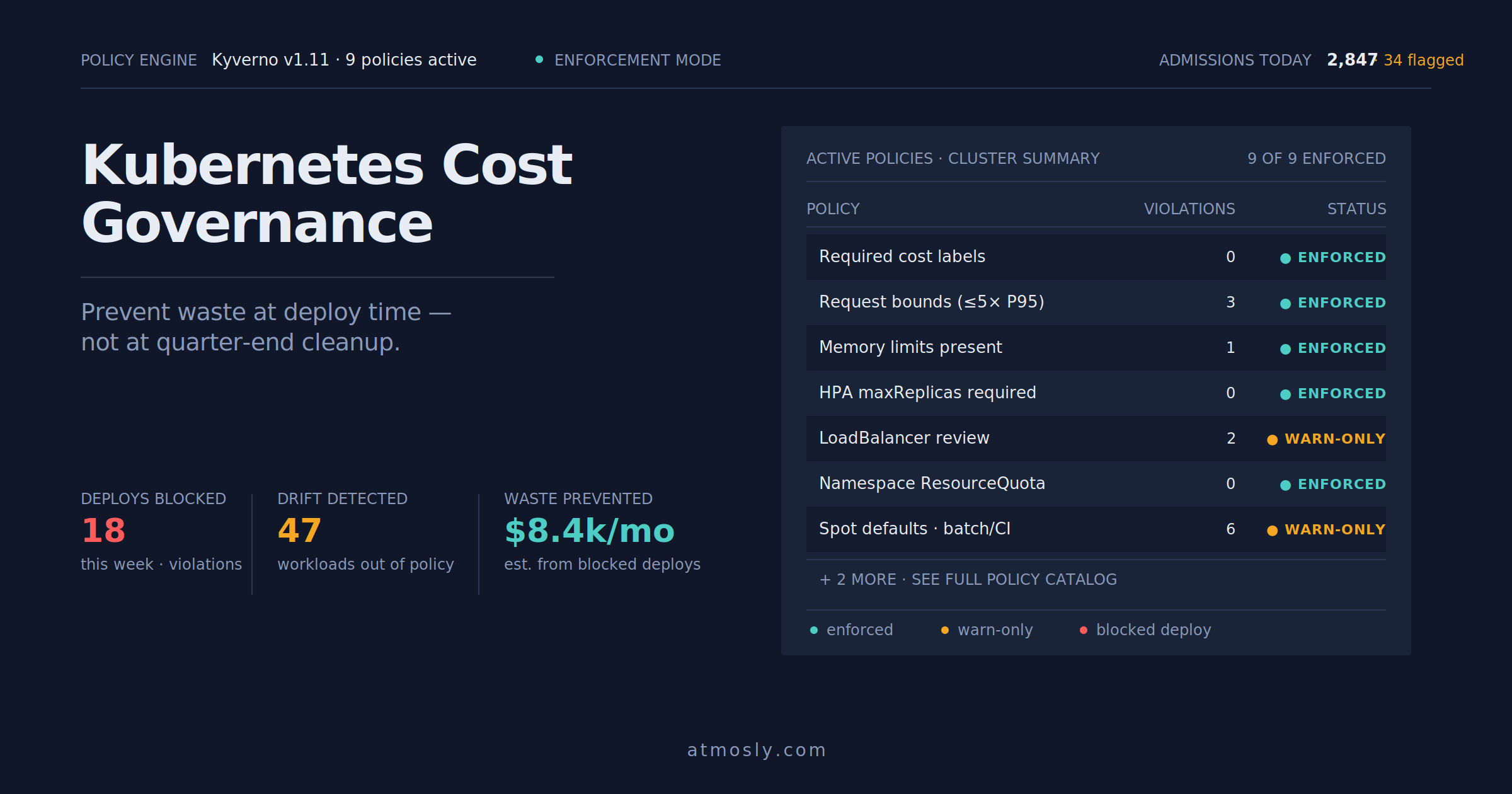
They enforce sane defaults at deploy time rather than fixing waste after the fact. Kyverno or OPA/Gatekeeper policies that reject Deployments requesting more than N× the namespace's historical usage stop new waste from landing. Policies that require cost allocation labels on every workload keep the attribution pipeline working. Guardrails that cap max replicas and max node count prevent runaway autoscalers from producing catastrophic cost anomalies. This is not glamorous work, but it is the difference between cleanup being a one-time project and being an every-quarter firefight.
They treat rightsizing as a recurring workflow, not a one-time cleanup. P95 usage numbers drift as workloads grow, so rightsizing recommendations need to be regenerated monthly and shipped through the normal PR pipeline. The teams that get this wrong run one big rightsizing pass, celebrate the savings, and then watch the numbers drift back within two quarters as new services deploy with copy-pasted resource blocks.
They make cost visible per team, not per cluster. A cluster-level cost dashboard tells you what the platform team spent; a namespace-level breakdown attributed to service owners tells the people who can actually change something. The mechanics of turning shared cluster spend into per-team accountability are covered in the showback and chargeback playbook, and the routing pattern applies directly to GKE.
They watch for cost anomalies in real time, not at month-end. A misconfigured HPA, a runaway log pipeline, or a debug flag left on in production can burn thousands of dollars per day before month-end billing surfaces it. Rolling-baseline anomaly detection catches these within hours instead of weeks.
They consolidate clusters where possible. The GKE management fee at $73/month per cluster is small individually and meaningful in aggregate. Teams running per-environment or per-team clusters often find that consolidating dev/staging into shared clusters with strong namespace-level isolation cuts management fees by 60-70% while making the platform easier to operate.
They choose the right mode for the workload profile. Autopilot is genuinely cheaper for teams that already rightsize aggressively and would rather not manage nodes. Standard is genuinely cheaper for teams running large clusters with sophisticated bin-packing, Spot orchestration, and mixed workload types. The wrong choice for a given profile costs 20-30% on the compute line indefinitely.
See what your GKE cluster is actually paying for.
Connect a GKE cluster read-only and get a per-namespace cost breakdown, P95-based rightsizing recommendations, and Spot VM migration candidates within minutes. Nothing changes in your cluster. Try it free →
Related Articles