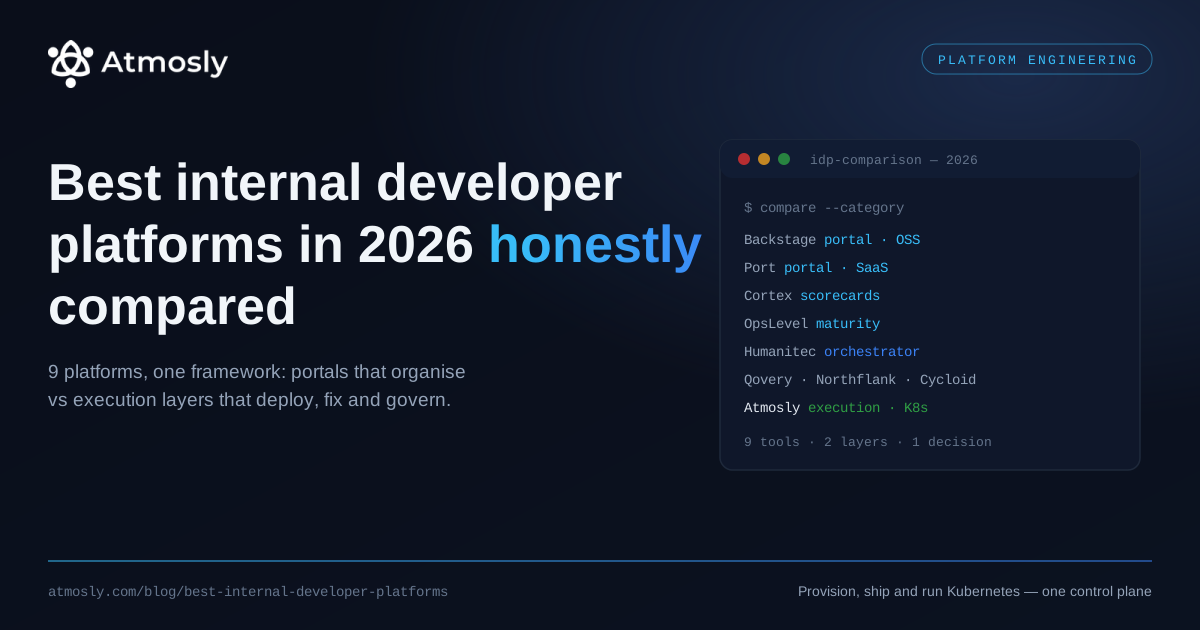
The short answer: there is no single best internal developer platform in 2026, because "IDP" describes two different products. If you need a service catalog, ownership maps and scorecards, the strongest options are Port, Cortex, OpsLevel, or Backstage if you can staff it. If you need a platform that actually provisions infrastructure, deploys, fixes incidents and governs cost, look at Atmosly for Kubernetes-first teams, Humanitec for enterprise config orchestration, or Qovery, Northflank and Cycloid depending on your estate. Most organisations past ~30 engineers eventually run one of each.
This comparison covers all nine — including where our own product is the wrong choice. Every vendor claim below is either publicly verifiable or clearly marked as an estimate, and we say plainly which tools are better than ours at which jobs. Disclosure up front: Atmosly is our product; its entry is written to the same standard as the other eight.
Here is the whole landscape in one table:
| Platform | Category | Hosting | Pricing model | Strongest fit |
|---|---|---|---|---|
| Backstage | Portal (framework) | Self-hosted, open source | Free software; real cost is the team running it | Enterprises with a staffed platform team that need deep customisation |
| Atmosly | Execution (Kubernetes-native) | Managed; self-hosted control plane on Platform tier | Free read-only audit; paid tiers | Kubernetes-first teams that want CI/CD, AI SRE, security and cost on one control plane |
| Port | Portal | SaaS only | Free up to ~15 users, then per-seat; check current terms | Mid-size teams that want a rich catalog without running infrastructure |
| Cortex | Portal (scorecard-first) | SaaS | Sales-led; no public pricing | Engineering orgs driving standards and production-readiness programmes |
| OpsLevel | Portal (maturity-first) | SaaS | Per-seat; check current terms | Teams that want catalog plus service maturity tracking, quickly |
| Humanitec | Execution (orchestrator) | SaaS / self-managed | Enterprise, sales-led | Large orgs standardising deployment config across many teams |
| Qovery | Execution (DevOps automation) | SaaS, deploys into your cloud | Free tier, then per-user/usage | Startups that want environments-on-demand on their own AWS/GCP/Azure |
| Northflank | Execution (deployment platform) | SaaS or bring-your-own-cloud | Usage-based, free tier | Product teams that want a PaaS-like experience without PaaS lock-in |
| Cycloid | Execution (hybrid/multi-cloud) | SaaS / self-hosted | Sales-led | European and hybrid-infrastructure orgs with governance requirements |
The one distinction that matters: portal vs execution
Most "best IDP" lists fail because they rank catalogs against deployment engines, as if a bookshelf and a delivery van were competitors. We wrote a full breakdown of this split in Portal IDP vs Execution IDP; the short version:
- Portals read. They aggregate what already exists — services, owners, docs, scores — into one searchable place. Backstage, Port, Cortex and OpsLevel live here. Their output is knowledge.
- Execution layers write. They provision infrastructure, run deployments, spin environments up and down, remediate incidents and enforce cost and security policy. Atmosly, Humanitec, Qovery, Northflank and Cycloid live here. Their output is change.
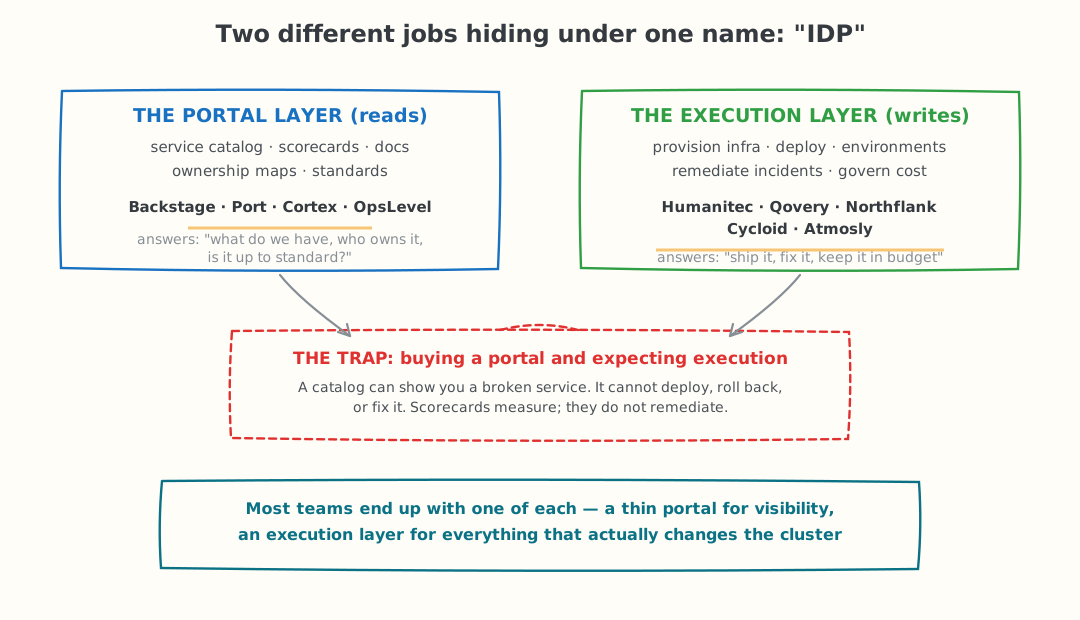
Two different jobs hiding under one acronym. The most expensive mistake in this market is buying one layer while expecting the other.
The trap runs both ways. Teams adopt a portal and are surprised it cannot deploy anything; teams adopt an execution platform and are surprised it has no service catalog. Neither is a product flaw — it is a category confusion, and it is why the internaldeveloperplatform.org community keeps insisting on the distinction.
How we evaluated (and why you should be suspicious of us)
We build Atmosly, so we have a horse in this race. The way we keep this useful anyway: we only compare on publicly verifiable facts, we concede competitor strengths explicitly, and we tell you where Atmosly is the wrong pick — it is Kubernetes-only by design, and it is not a portal. If your need is a service catalog for 400 microservices across VMs, serverless and mainframes, several tools below serve you better than ours.
The criteria that actually separate these products in 2026:
- Layer. Portal or execution — the table above. Decide this before comparing features.
- Time-to-value. SaaS portals demo in a day. Backstage takes weeks to months. Execution platforms land somewhere between, depending on how opinionated your infrastructure already is.
- Total cost, fully counted. Licence price is the visible half. The invisible half is the engineers who run and extend the thing.
- Blast radius and governance. Anything that writes to production needs approvals, audit trails and rollback as first-class features, not add-ons.
- Exit cost. What happens when you outgrow it or it changes pricing? Open standards (Score, OpenTelemetry, GitOps manifests in your repos) keep the door open; proprietary config formats close it.
See what an execution IDP finds in your cluster.
Free, read-only. Takes 10 minutes. Nothing changes in your cluster.
With the framework set, here is each platform on its own terms, portals and execution layers interleaved and each judged by the same standard.
The 9 best internal developer platforms in 2026
1. Backstage — the open-source default, with a real bill attached
Category: portal (framework) · Best for: enterprises with a staffed platform team.
Backstage, created by Spotify and donated to the CNCF, is the most adopted developer portal framework in existence, and for good reason: unlimited customisation, a large plugin ecosystem, no per-seat fees, and no vendor to outgrow. If you have unusual requirements, an air-gapped environment, or a compliance regime that rules out SaaS, it is often the only real option — and at 200+ engineers its economics genuinely work.
The counterweight is operational cost. Backstage is a framework, not a product — someone has to build and run your instance: the catalog model, the auth integration, the plugin upgrades, the TechDocs pipeline. Community TCO estimates commonly land around $150K per year for a 20-developer organisation once platform-engineer time is counted, which is why the strongest Backstage deployments are at companies that treat the portal itself as a product with a dedicated team. Below that scale, hosted portals get you 80% of the value for a fraction of the effort. We compared it to hosted portals in more depth in our Backstage vs hosted portals guide.
2. Atmosly — the Kubernetes-native execution IDP (ours)
Category: execution · Best for: Kubernetes-first teams that want deploy, fix, secure and govern-cost as one layer. Disclosure: Atmosly is our product.
Atmosly is an execution-layer IDP that is deliberately Kubernetes-only. Where the portals above organise knowledge about your services, Atmosly operates the services themselves — on one control plane it covers four jobs that are usually four separate tools:
- CI/CD and provisioning. Visual pipelines, GitOps-native deployment with approvals, environments and one-click rollback, governed cloud provisioning with guardrails, and ephemeral environments — a full isolated environment per pull request, torn down on merge. Teams can keep their existing CI (GitHub Actions, GitLab) and let Atmosly own the Kubernetes deployment and day-2 side.
- AI SRE (Astra). On a real failure — a pod OOMKilled, a service crash-looping — Astra infers the actual root cause from cluster evidence, proposes ranked fixes, and opens the remediation as a reviewable GitOps pull request with verification and auto-rollback. A human merges every change.
- Security. Always-on posture scanning of the live cluster — drift, not just images at build time — against CIS, PCI DSS, SOC 2 and NSA hardening benchmarks, with audit-ready evidence on demand.
- Cost Intelligence. Per-namespace and per-workload cost from real billing data (no tagging project required), idle cost surfaced as its own bucket, and right-sizing applied as GitOps PRs — the only kind of fix that survives the next ArgoCD sync. Most customers save 20–40% on Kubernetes costs within the first three months.
The trust posture matters as much as the features: read-only by default, agent-based or API-based, every action reversible with a full audit trail, ISO 27001 certified with SOC 2 Type II in progress, and capabilities switch on one at a time so adoption is incremental — nothing gets ripped out. The low-friction way in is the free 5-minute read-only cluster audit.
Where it is the wrong choice, plainly: it has no service catalog or scorecards — that is portal work, and teams that need both pair Atmosly with Port or Backstage. And if your workloads are not on Kubernetes, nothing above applies; look at Qovery, Northflank or Cycloid instead.
3. Port — the strongest no-code portal
Category: portal · Best for: mid-size teams that want a rich catalog without running infrastructure.
Port took the opposite bet from Backstage: a SaaS-only portal with a genuinely flexible data model, no-code catalog building, and self-service actions that call your existing automation. Its catalog depth and modelling flexibility are, in our view, the best in the hosted-portal category — you can model services, environments, clusters, packages and anything else as first-class entities and wire scorecards over them. The free tier (up to roughly 15 users) makes evaluation easy. Pricing beyond that is per-seat — third-party trackers put standard plans at around $40 per user per month billed annually, and entity volume can matter at scale, so check current terms directly.
The trade-off is inherent to the category: Port's self-service actions trigger your pipelines and scripts. The execution machinery still has to exist and be maintained underneath it — which is exactly why portal-plus-execution pairings are becoming the default architecture.
4. Cortex — scorecards as the product
Category: portal · Best for: engineering orgs driving standards programmes at scale.
Cortex leads with engineering standards: production-readiness scorecards, migration tracking, and service maturity as a first-class programme. If your primary problem is "we have 300 services and no idea which ones meet our standards", Cortex attacks that problem more directly than anyone — scorecards are not a feature bolted onto a catalog, they are the organising idea. It is sales-led with no public pricing, which typically signals an enterprise motion — budget accordingly, and go in with a clear standards programme you want to run, because that is where the tool earns its keep.
5. OpsLevel — catalog plus maturity, quickly
Category: portal · Best for: teams that want the catalog-and-standards job done fast.
OpsLevel sits close to Cortex in intent — service catalog, ownership, maturity tracking — with a reputation for fast setup and a lower-friction adoption path. Where Cortex assumes a formal standards programme, OpsLevel works well for teams that want ownership clarity and basic maturity checks running within days rather than quarters. As with Port, the actions layer connects to automation you already own, so it complements rather than replaces your delivery tooling. For many mid-size teams the real Port-vs-OpsLevel decision comes down to data-model flexibility (Port) versus speed to a working catalog (OpsLevel).
6. Humanitec — the enterprise platform orchestrator
Category: execution · Best for: large orgs standardising deployment config across many teams.
Humanitec effectively defined the "platform orchestrator" pattern: developers declare what their workload needs via the open Score spec, and the orchestrator generates environment-specific configuration and drives deployment. For large organisations trying to standardise how hundreds of teams deploy across environments, that dynamic-configuration model is its genuine strength — it removes the per-team YAML sprawl that portals can only catalogue. Its enterprise governance features reflect that focus. It is a bigger adoption lift than the SaaS tools here, and it expects you to invest in the platform-team operating model around it; teams that treat it as a drop-in tool rather than an operating-model change tend to stall.
7. Qovery — environments on demand for startups
Category: execution · Best for: startups that want self-service on their own cloud accounts.
Qovery's sweet spot is small teams that want production-like environments on their own AWS, GCP or Azure accounts without building a platform: connect a repo, get deployments, preview environments and lifecycle automation. It deploys into your cloud rather than hosting your workloads, which keeps data ownership and billing clean — an underrated property when procurement and security reviews arrive later. For very small teams the free tier plus per-user pricing is one of the cheapest routes to real self-service anywhere in this list. As you scale, evaluate whether its abstractions still fit; the exit path is reasonable precisely because the infrastructure was always in your account.
8. Northflank — the PaaS experience without the PaaS ceiling
Category: execution · Best for: product teams that want Heroku-grade DX on their own terms.
Northflank offers the most PaaS-like developer experience in this comparison — build, deploy, jobs, databases, previews — with the important twist that it can run in its cloud or yours (bring-your-own-cloud on your Kubernetes). Teams that loved Heroku's ergonomics but outgrew its constraints tend to shortlist it, and its usage-based model with a free tier makes a real trial cheap. The BYOC option is the differentiator to test seriously: it converts the classic PaaS lock-in objection into a configuration choice rather than a migration project.
9. Cycloid — hybrid, multi-cloud and governance-first
Category: execution · Best for: European and hybrid-infrastructure orgs with governance requirements.
Cycloid, from Europe, aims at organisations whose reality is hybrid: multiple clouds, legacy plus Kubernetes, and compliance requirements that rule out one-size-fits-all SaaS. Its stacks-and-forms model lets platform teams package golden paths over Terraform and existing tooling rather than replacing it, and it is notable for building FinOps and GreenOps views into the platform itself — cost and carbon as platform concerns, not afterthoughts. If your estate is genuinely heterogeneous — VMs next to clusters, on-prem next to cloud — it deserves a look ahead of the Kubernetes-only options, including ours.
How to choose: a five-step shortlist
A concrete path through the table above:
- Name the layer you are missing. If developers cannot find things, you have a portal problem. If developers cannot ship or operate things without tickets, you have an execution problem. Fix the one that is actually costing you time.
- Inventory your estate honestly. All-Kubernetes points to Atmosly. Heterogeneous or hybrid points to Cycloid or Humanitec. Small and cloud-native points to Qovery or Northflank.
- Price the operating model, not the licence. Ask every vendor — including us — who runs the thing, and cost that person or team in.
- Demand governance proof for anything that writes. Approvals, audit trail, rollback, read-only defaults. Ask to see the audit log in the demo, not the feature slide.
- Pilot on one real team for 30 days. A portal pilot should produce a catalog people actually open; an execution pilot should produce measurable time saved on deploys, environments or incidents. If it does not, the tool failed the pilot — not your team.
Verdict by team size
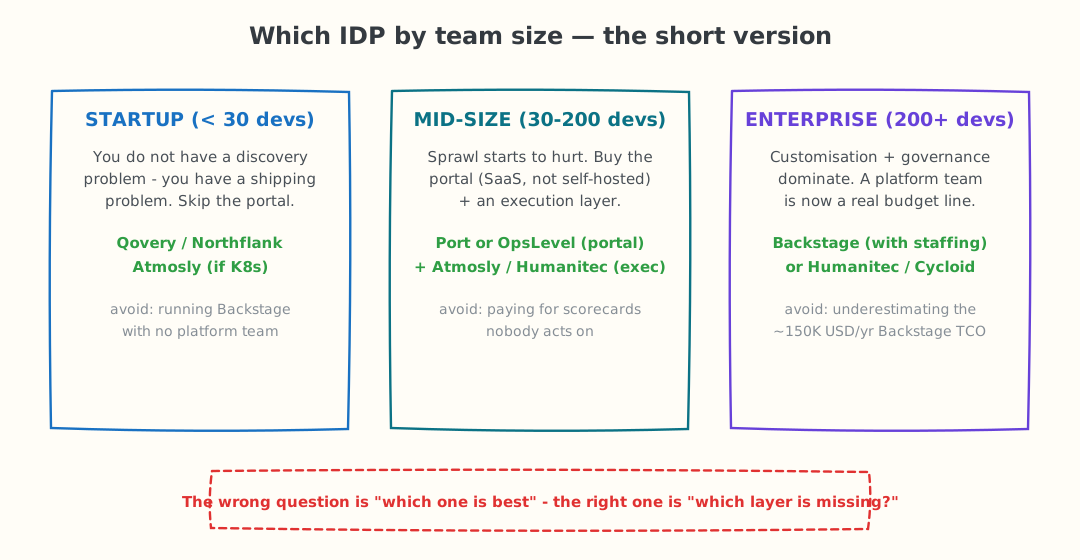
The decision chart. The right question is not "which tool wins" but "which layer are you missing".
- Under ~30 engineers: skip the portal entirely — you can hold the catalog in your head. Your bottleneck is shipping and operating. Atmosly if you are Kubernetes-first; Qovery or Northflank for general cloud workloads. Do not self-host Backstage without a platform team; the software is free, the operation is not.
- 30–200 engineers: this is where sprawl starts to cost real money. A SaaS portal (Port or OpsLevel) for visibility, plus an execution layer (Atmosly for Kubernetes estates, Humanitec if you are standardising deployment config across many stacks). Buying scorecards nobody acts on is the classic waste at this size.
- 200+ engineers: customisation and governance dominate. Backstage becomes rational because you can staff it as a product; Humanitec and Cycloid earn their enterprise positioning; Cortex's standards programme pays off at exactly this scale. Budget for the platform team, not just the licences — the platform engineering community is unambiguous that the operating model matters more than the tool.
Build vs buy: the third option this list hides
Every platform above competes with a fourth choice: building your own IDP from open-source parts — ArgoCD, Crossplane, Backstage, Terraform, glued together by your platform team. That path maximises fit and minimises licence spend, and for some teams it is right. But count it honestly: the glue is the product, the glue is undocumented, and the engineer who wrote the glue will eventually leave. We walked the whole decision end to end in building an IDP on Kubernetes — read that before committing a quarter of platform-team time, and treat "buy the execution layer, build the thin portal on top" as the pragmatic middle path many teams land on.
What this guide deliberately does not cover
To keep one intent per page, we have kept this a platform comparison and put the neighbouring questions elsewhere:
- Developer portal tools in depth — head-to-head portal feature comparison lives in our developer portal tools guide.
- The broader platform engineering toolchain — IaC, CI/CD and the full stack around IDPs is covered in platform engineering tools ranked by engineers.
- Kubernetes-specific portal features — Kubernetes developer portal tools.
- Building your own IDP on Kubernetes — the build-vs-buy path is walked end to end in building an IDP on Kubernetes.
Key takeaways
- "Best IDP" is two questions. Portals (Backstage, Port, Cortex, OpsLevel) organise knowledge; execution platforms (Atmosly, Humanitec, Qovery, Northflank, Cycloid) change infrastructure. Decide which layer you are missing first.
- Free software is not free platform. Backstage's real cost is the team that runs it — commonly estimated around $150K/year at 20 developers.
- Match the tool to your estate. Kubernetes-first → Atmosly. Heterogeneous or hybrid → Cycloid or Humanitec. Small and cloud-native → Qovery or Northflank.
- Portals need execution underneath. Self-service buttons are only as good as the automation they trigger.
- Most mature setups run one of each layer — a thin portal for visibility, an execution layer for everything that writes.
- Pilot before you commit. Thirty days, one real team, one measurable outcome — and price the operating model, not the licence.
If your estate runs on Kubernetes and you want to see what an execution IDP actually does before believing any vendor's table — including ours — connect a cluster read-only and look at your own data: start the free cluster audit.