Kubernetes GPU Cost Optimization for AI/ML Workloads
Reduce Kubernetes GPU costs for AI/ML workloads — rightsizing, utilization, scheduling, and MIG partitioning.

Atmosly automates Kubernetes deployments, cloud infrastructure provisioning, CI/CD and environment management in one platform — so developers self-serve on golden paths and the platform team sets the guardrails once.
Running an enterprise rollout? Book a demo →
Clusters, deploys, integrations, security posture and cost in a single view — the platform reads your existing Kubernetes estate read-only, so this is populated on day one without changing anything.
Here's what's happening across your 4 clusters.
Atmosly dashboard. Cluster names, cloud account identifiers and regions anonymised for this page.
An internal developer platform (IDP) is the self-service layer between developers and infrastructure.
It brings together the tools, automation, workflows and guardrails developers need to build, deploy and operate software without managing the underlying infrastructure themselves.
A good IDP provides self-service environments, application delivery, infrastructure provisioning, observability and operational workflows, while platform teams define the standards, security policies and guardrails behind them.
The goal isn't to hide infrastructure from developers. It's to remove the repetitive complexity around it, so developers can follow proven paths without becoming experts in every underlying tool.
Read the full internal developer platform guide →Give developers the ability to provision environments, deploy applications, and access platform services without waiting on the platform team.
Provide opinionated, reusable workflows for common tasks so teams don't have to design infrastructure and deployment processes from scratch.
Automate the work behind the developer experience — infrastructure provisioning, deployments, configuration, environment creation, upgrades and lifecycle management. An IDP isn't just a collection of buttons: the automation behind those buttons is what makes it a platform.
Enforce RBAC, security policies, approved configurations, secrets management, compliance and cost controls without making developers manage these manually.
Give developers a consistent interface and workflow across infrastructure, deployments and environments, hiding unnecessary underlying complexity while keeping the important controls accessible.
Without a platform layer, infrastructure work concentrates in one team and every developer request becomes a queue. These are the symptoms teams describe before they adopt an IDP.
A new namespace, a managed database, a test environment — each one is a ticket, a Terraform review and a context switch for someone else. Lead time to production is dominated by waiting, not building.
Senior DevOps and SRE engineers spend their week on provisioning requests, access changes and deployment babysitting instead of the automation that would remove the requests.
Kubernetes manifests, Helm values, pipeline YAML and rollout strategy live in a handful of heads. Nobody else can ship confidently, and nobody can ship on a Friday.
Staging drifts from production, preview environments are too expensive to keep, and reproducing a bug means recreating a stack from memory and a stale README.
Each team wires RBAC, secrets, network policy and tagging its own way. Security posture is discovered during an audit rather than enforced at provisioning time.
Over-provisioned requests and limits, idle node groups and forgotten environments accumulate because no single system sees allocation, utilization and ownership together.
Three layers on one control plane: infrastructure provisioning, application delivery and Kubernetes operations. Each one is a working capability — not an integration point you have to implement, staff and maintain.
Import any Kubernetes cluster — EKS, GKE, AKS, DigitalOcean, Linode or self-hosted, including private clusters whose endpoints are not exposed to external traffic — then let developers request clusters, node groups, managed databases, caches and add-ons from curated infrastructure blueprints. Every provisioning action is scoped by RBAC, checked against policy-as-code, audited and reversible, so self-service infrastructure never becomes an unbounded cloud bill.
Turn any running Kubernetes workload into a reusable deployment blueprint, ship it through visual or GitOps pipelines with one-click rollback, and clone an entire environment — workloads, config, dependencies — for previews and per-tenant stacks on demand. Developers get a paved road from commit to production instead of a blank pipeline file.
Astra, our AI SRE agent, detects incidents, performs root cause analysis and proposes automated remediation. Continuous scanning keeps CIS Benchmark, PCI DSS and SOC 2 posture current and catches configuration drift live. Cost intelligence attributes Kubernetes spend by team, namespace and service and recommends right-sizing. This is the layer a developer portal cannot provide — the platform acts on what it observes.
The two terms get used interchangeably, and it costs teams entire quarters. A portal is a catalog and a user interface. A platform is the execution layer that provisions infrastructure and deploys applications. You need the second one to remove work.
| Capability | Developer portalA catalog and UI over your tools | Developer platformThe execution layer, working out of the box |
|---|---|---|
| Service catalog & ownership | Aggregates service metadata, owners, docs and scorecards. | Inventory of every workload, cluster and environment it operates. |
| Infrastructure provisioning | Self-service actions call Terraform modules and pipelines you write and maintain. | Provisions EKS and GKE clusters, node groups, managed databases and add-ons — and imports any conformant cluster you already run: AKS, DigitalOcean, Linode, on-prem or self-hosted. |
| Application delivery | Triggers the CI system you built; the pipeline logic stays yours. | CI/CD and GitOps pipelines with environment promotion and one-click rollback. |
| Environment management | Not in scope — links out to whatever creates environments. | Clones full environments on demand for previews and per-tenant stacks. |
| Day-2 operations | Reports what is deployed and what broke. It does not remediate. | AI root cause analysis, automated remediation, security posture and cost optimization. |
| Onboarding an existing service | Register it in the catalog, then build the plugin that acts on it. | Reads a running workload and turns it into a reusable deployment blueprint. |
| Cost to stand up | 4–6 platform engineers and roughly a year of plugin work, then permanent upkeep. | Import a cluster read-only; first golden path running the same week. |
| Typically | Backstage · Port · Cortex | Atmosly |
Already invested in a portal? Atmosly coexists with Backstage or Port — the portal stays the front door and software catalog while Atmosly executes provisioning, deployment and operations behind it.
Four common implementations of developer self-service — all on standard Kubernetes, Helm and GitOps, on the clusters you already run.
Clone a full production-shaped environment per branch — workloads, dependencies and configuration — so reviewers test against a real stack instead of a shared staging tier. Environments expire automatically, so preview infrastructure never becomes permanent cloud spend.
Capture the deployment pattern your best-run service already uses as a workload blueprint, then make it the golden path other teams deploy on. New services inherit pipeline, probes, resource policy and rollback behaviour by default — nobody starts from an empty YAML file.
Provision an isolated environment, database and namespace per customer from one blueprint, with cost attributed per tenant and policy applied identically to each. Onboarding a new tenant stops being a bespoke script someone has to remember to run.
Give business units self-service inside scoped RBAC and approval gates, with SSO, continuous CIS, PCI DSS and SOC 2 posture, drift detection and audit evidence collected as a by-product of normal operation — not assembled the week before a review.
Building a usable IDP in-house means staffing a platform engineering team and waiting roughly a year for golden paths, then maintaining the portal, plugins and Terraform modules forever. Atmosly delivers the same developer self-service and infrastructure governance on the Kubernetes clusters you already run.
Developers provision infrastructure and deploy applications themselves on golden paths, so time from commit to production stops being dominated by waiting on another team.
Environment requests, access changes and routine deployments move to self-service inside guardrails — the platform team returns to automation instead of queue duty.
One place where RBAC, policy-as-code, security posture and cost attribution apply to every team, cluster and cloud — instead of six teams doing it six ways.
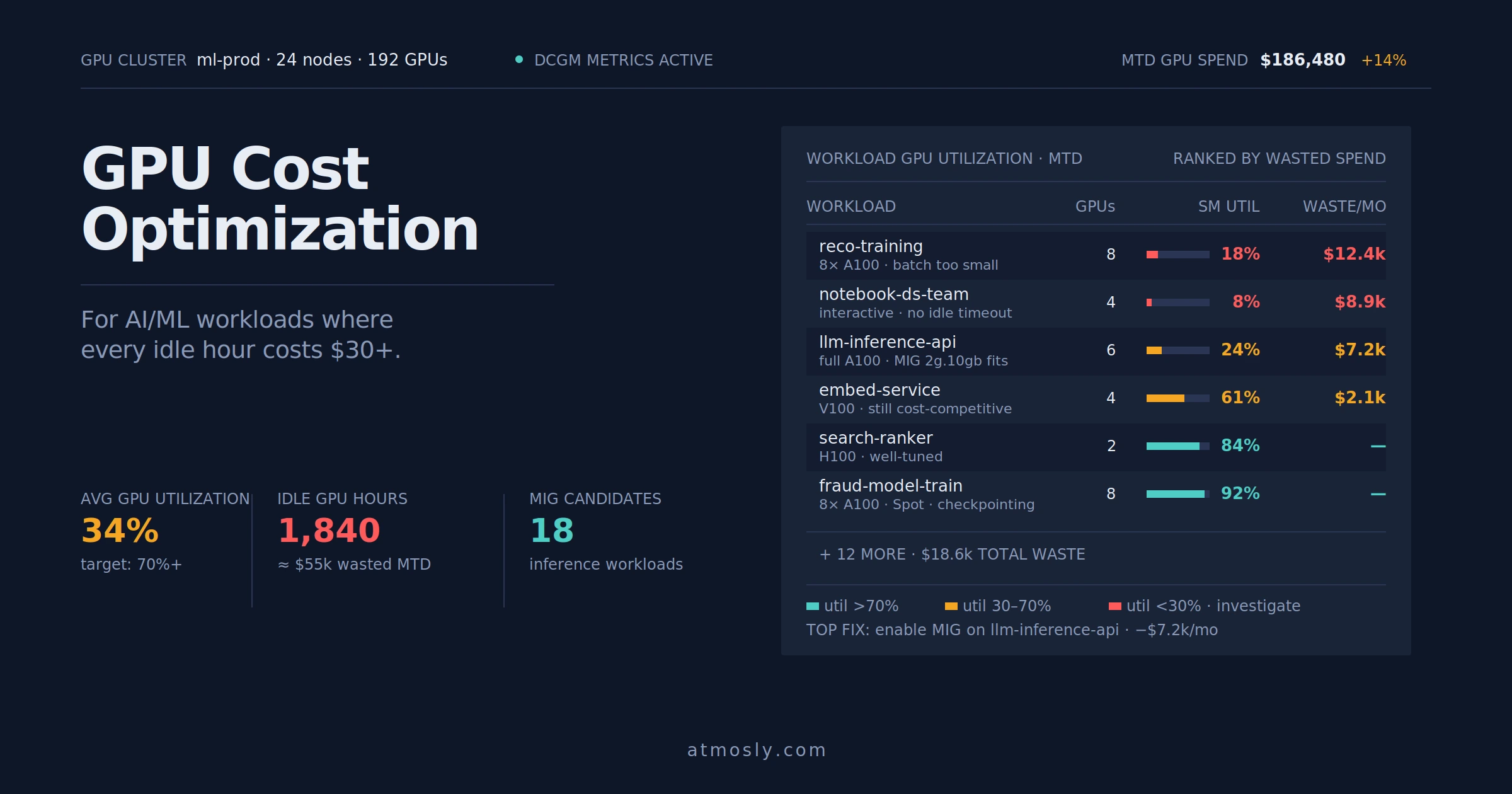 Kubernetes
Reduce Kubernetes GPU costs for AI/ML workloads — rightsizing, utilization, scheduling, and MIG partitioning.
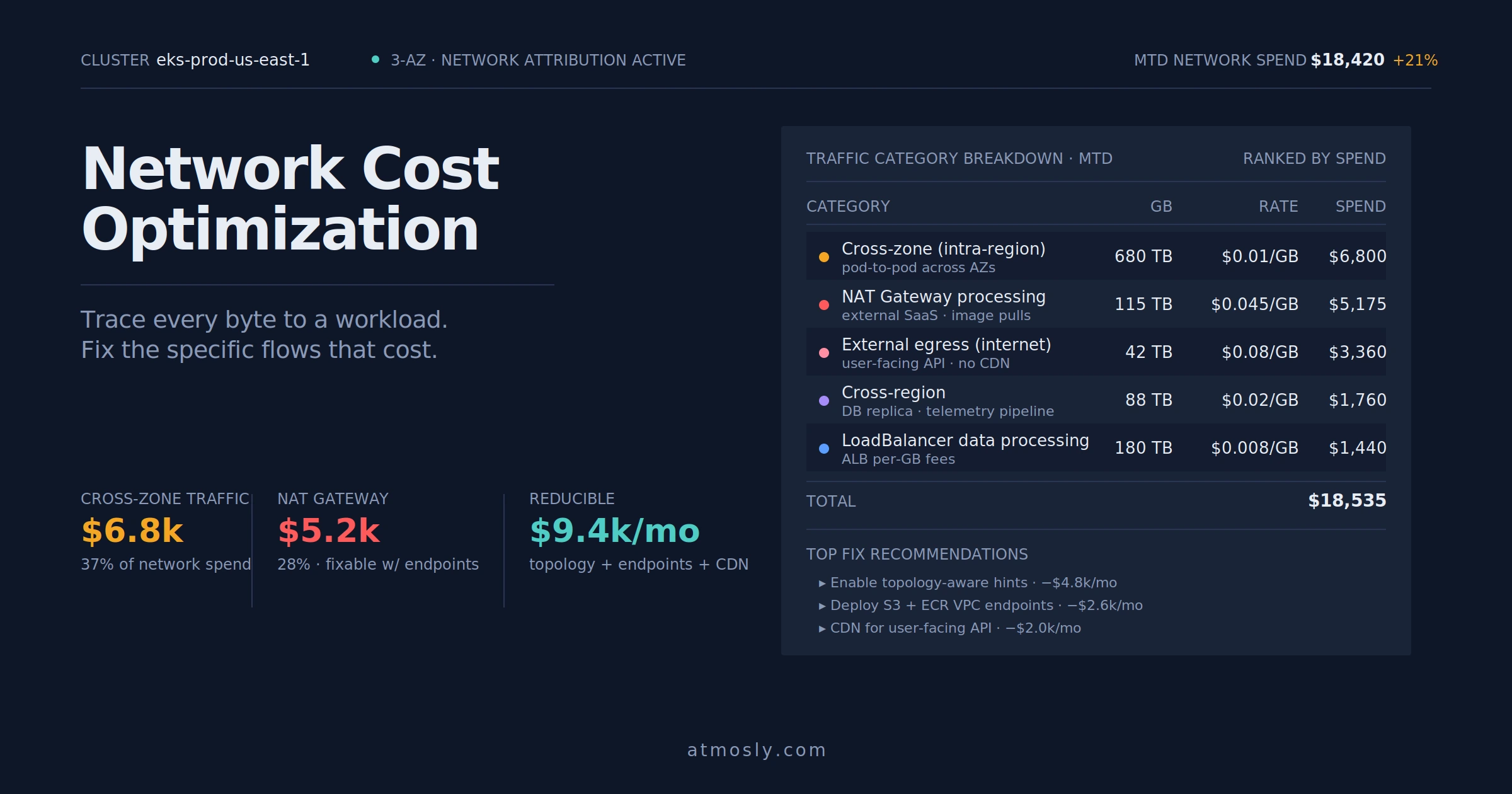 Kubernetes
Cut Kubernetes network costs — cross-zone egress, NAT Gateway charges, and inter-region traffic patterns engineers can fix.
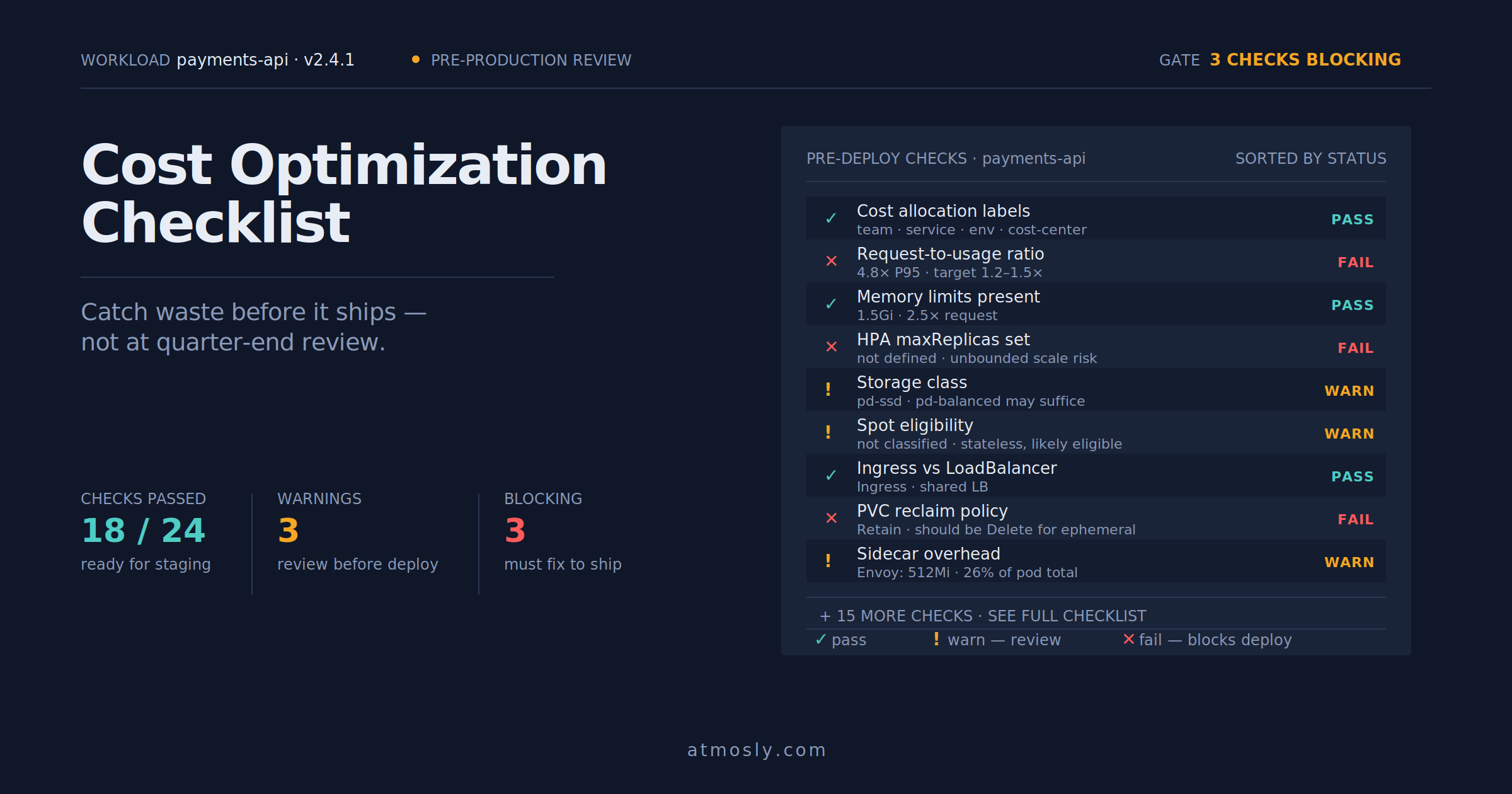 Kubernetes
A pre-production Kubernetes cost checklist that catches waste before it ships instead of after finance asks.
Connect a Kubernetes cluster read-only and see the internal developer platform work on your own workloads — provisioning, deployment and operations, in minutes. Free, no sales call.