Introduction: The Paradox of Choice in 2026
The Cloud Native Computing Foundation (CNCF) landscape now includes over 1,200 tools. For a developer trying to ship a simple feature, this ecosystem is not a candy store; it is a minefield.
Should they use Helm, Kustomize, or Jsonnet? Jenkins, GitHub Actions, or Tekton? Prometheus, Thanos, or VictoriaMetrics?
When every team makes their own choices, you end up with "Snowflake Infrastructure" where every microservice is deployed slightly differently. This kills velocity, makes on call a nightmare, and bloats costs.
Platform Engineering exists to solve this paradox of choice. The solution is the Golden Path (also known as Paved Road). A Golden Path is an opinionated, supported, and automated workflow for building and deploying software. It is the core product of any successful platform team.
This deep-dive guide explores how to design, build, and enforce Golden Paths for Kubernetes. We will look at the anatomy of a Golden Path, the code required to implement it, and how modern platforms can accelerate the creation and maintenance of these standardized workflows.
1. What is a Golden Path?
A Golden Path is not a mandate ("You MUST use this tool"). It is a product ("If you use this tool, your life will be easier").
The Four Pillars of a Golden Path:
- Opinionated: The platform team has made the hard decisions (e.g., "We use Java 17 on Distroless images").
- Supported: The Platform Team treats it as a product with an SLA. If the Golden Path pipeline breaks, the Platform Team fixes it.
- Automated: Scaffolding, pipelines, and infrastructure are provisioned automatically via API/CLI.
- Opt-in: Developers can go off-road, but they lose the support and automation. (See Section 4: The Off-Road Problem).
2. Golden Path vs Paved Road vs Guardrails
These three terms get used interchangeably in platform engineering discussions, and the blurring causes real design mistakes. They describe different things.
- Golden Path — the supported, opinionated workflow for a specific use case. It is a product the platform team owns and maintains. "Spring Boot service on EKS with Postgres" is a Golden Path.
- Paved Road — Netflix's original term for the same idea. If you see both in one document they almost certainly mean the same thing; use whichever your organization already says.
- Guardrails — the non-negotiable constraints that apply whether or not you are on the Golden Path. Pod Security Standards, network policies, image-registry allowlists and admission controllers are guardrails.
The distinction matters because they fail differently. A Golden Path is opt-in: if developers do not use it, that is a product problem and the fix is better developer experience. A guardrail is mandatory: if developers bypass it, that is a security problem and the fix is enforcement through a policy engine such as OPA Gatekeeper or Kyverno.
Teams that conflate the two end up either enforcing their Golden Path so rigidly that legitimate exceptions get blocked, or leaving genuine security controls opt-in. Keep them separate — make the Golden Path attractive, and make the guardrails unavoidable.
3. Anatomy of a Kubernetes Golden Path
Let's design a theoretical Golden Path for a standard "Spring Boot Microservice". This is what actually happens under the hood when a developer clicks "Create Project".
Layer 1: The Scaffolding (Day 0)
When a developer starts a new service, they shouldn't start with an empty folder. They need a starter kit.
The Path: They run a CLI command like `platform create service --template java-spring`.
The Result: A Git repository is created with:
- Standard `pom.xml` with approved internal dependencies (Nexus proxy configured).
- `Dockerfile` optimized for caching (multi-stage build) and security (non-root user).
- `k8s/` folder with Helm charts pre-wired for logging (Fluentbit sidecar) and metrics (Prometheus annotations).
- `Jenkinsfile` or `.github/workflows/deploy.yaml` pre-configured with secrets.
Platform Implementation: This scaffolding is typically implemented using template engines (Cookiecutter, Copier) or custom tooling. Modern internal developer platforms can provide service templates that handle parameter substitution (e.g., `{{SERVICE_NAME}}`, `{{TEAM}}`) and automatically generate the required repository structure and CI/CD configurations.
Stop reinventing the wheel for every project.
Atmosly simplifies Golden Path creation with built-in support for service templates and automated scaffolding. Define your organizational standards once, and let developers self-serve. Start for free and build your first Golden Path in minutes.
Layer 2: The Inner Loop (Day 1)
Developers need to test on Kubernetes without waiting for a 20-minute CI build.
The Path: Developers can spin up an Ephemeral Environment for their feature branch.
Platform Approach: Modern platforms support environment cloning and ephemeral deployments. When a developer creates a PR, the platform can automatically provision a preview environment with its own namespace and ingress route (e.g., `pr-123.dev.company.com`). This allows for rapid iteration without affecting shared development environments.
Layer 3: The Path to Production (Day 2)
Promoting code should be boring. The Golden Path defines the gates.
The Pipeline:
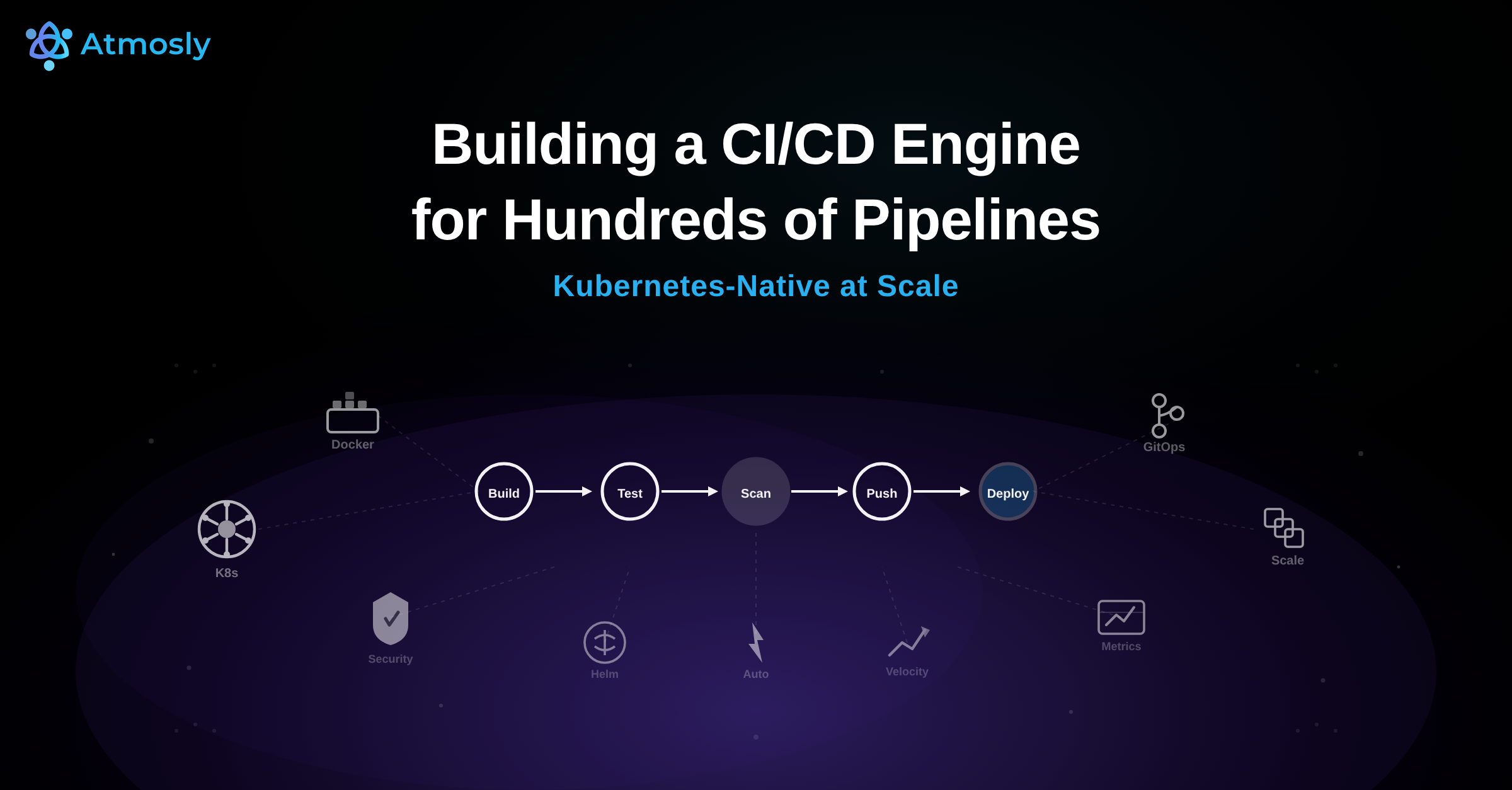
- Build: Docker build + Trivy Scan (Block Criticals).
- Test: Unit Tests + Contract Tests (Pact).
- Deploy Dev: Helm Upgrade to `dev` namespace.
- Gate: Integration Tests pass?
- Deploy Staging: Helm Upgrade to `staging`.
- Gate: Manual Approval from Tech Lead.
- Deploy Prod: Canary Rollout (5% -> 50% -> 100%).
Platform Features: Platforms can provide visual workflow builders or declarative pipeline definitions to implement these multi-stage deployments. Atmosly supports approval workflows and multi-environment deployments, allowing platform teams to define promotion gates and automated rollout strategies.
4. The "Off-Road" Problem
What happens when a team needs to use Rust instead of Java, or Cassandra instead of Postgres?
The Wrong Approach: "No, you can't." (Stifles innovation).
The Right Approach: "You can, but you are off the Golden Path."
The Contract:
If you stay on the Golden Path:
- I page the Platform Team if the pipeline breaks.
- Security patching is automated.
- Upgrades (Java 17 -> 21) are handled by the platform.
If you go Off-Road:
- YOU carry the pager for your custom pipeline.
- YOU are responsible for patching your custom OS.
- YOU must prove compliance to auditors manually.
Eventually, if enough teams go "off-road" for Rust, the Platform Team paves a new Golden Path for Rust. This is Platform-as-Product thinking.
5. Designing the Template: A Technical Example
A Golden Path is code. Let's look at a snippet of what a service blueprint definition might look like (conceptual format).
Example Blueprint Definition
apiVersion: platform.company.io/v1
kind: ServiceBlueprint
metadata:
  name: spring-boot-microservice
spec:
  parameters:
    - name: javaVersion
      default: "17"
      options: ["11", "17", "21"]
    - name: databaseType
      default: "postgres"
      options: ["postgres", "mysql", "none"]
  scaffolding:
    gitTemplateUrl: "git@github.com:platform/templates/spring-boot.git"
  infrastructure:
    terraform:
      module: "aws-rds"
      enabled: "{{ .databaseType != 'none' }}"
  pipeline:
    workflow: "standard-java-ci-cd"
When a developer instantiates this blueprint, the platform engine typically:
1. Clones the template repo.
2. Substitutes the variables based on user input.
3. Creates a new repository with the generated code.
4. Provisions infrastructure (e.g., RDS database) via Terraform or Crossplane.
5. Sets up webhooks for CI/CD integration.
6. Case Study: Reducing Onboarding Time
Company: E-commerce Retailer (500 Engineers).
Before Golden Paths:
- New microservices took 3 weeks to "productionize".
- Developers had to file tickets for DNS, Load Balancers, Secrets, and CI/CD setup.
- Every team used a different logging format, breaking the central Splunk dashboard.
After Implementing Platform Blueprints:
- Platform team created standardized service templates for common patterns.
- Includes: Pre-configured ALB Ingress, WAF rules, and observability agents.
- Result: "Hello World" to Production in 45 minutes.
- Standardization: 100% of new services emitted JSON-structured logs, fixing observability instantly.
7. Measuring Success
How do you know if your Golden Paths are working? Measure these KPIs:
- Adoption Rate: % of services using the Golden Path vs Custom. (Target > 80%).
- Time-to-Hello-World: Time from "New Repo" to "Running in K8s". (Target < 1 hour).
- Support Tickets: Should decrease as the Path automates common requests.
- Version Consistency: % of services on the latest supported library version.
Platform Visibility: Platforms with central dashboards can provide visibility into project compliance and template adoption. You can track which services are using which templates and identify outliers that may need migration or support.
8. Why Golden Paths Fail
Most Golden Path initiatives do not fail on technology. They fail on adoption, and the failure modes are predictable enough to design around.
Built without talking to developers
A platform team designs the path it thinks developers should want, ships it, and then discovers nobody uses it because it does not cover the dominant service pattern. The fix is unglamorous: interview ten developers before writing any template, and build for the pattern that appears most often rather than the one that is most interesting to build.
The path rots
A template is generated once and then drifts. Six months later the base image carries known CVEs, the Helm chart uses a deprecated API version, and the first developer to hit a problem finds the platform team has moved on. A Golden Path with no maintenance owner is worse than none at all, because it carries an implied support promise it cannot keep.
No escape hatch
If the only options are "use the template exactly" or "you are on your own", teams with slightly unusual requirements go off-road immediately and never come back. Progressive disclosure — simple defaults, optional advanced settings, and full manifest editing for the last five percent — keeps far more services on the supported path.
Measured by output instead of outcome
"We shipped four templates" is not a success metric. "Eighty percent of services launched this quarter used a Golden Path" is. Teams that report templates built rather than templates adopted tend to keep building templates nobody asked for.
Treated as a project rather than a product
Golden Paths are not a migration you finish. Language versions move, base images get patched, cloud services get deprecated. Budget ongoing capacity for maintenance from day one, or the path degrades into the thing developers route around.
9. Implementation Strategy
Phase 1: Define Your First Golden Path (Week 1-2)
- Interview developers: What are their pain points?
- Identify the most common service pattern (e.g., "REST API with Postgres").
- Create the template repository with all necessary boilerplate.
- Document the "happy path" deployment flow.
Phase 2: Automate Scaffolding (Week 3-4)
- Build or configure tooling to generate services from templates.
- Integrate with your Git provider (GitHub/GitLab) for automatic repo creation.
- Set up CI/CD pipeline automation.
- Test with 2-3 pilot teams.
Phase 3: Promote and Iterate (Month 2+)
- Present at engineering all-hands to promote the Golden Path.
- Collect feedback and iterate on the template.
- Build additional Golden Paths for other common patterns.
- Measure adoption and impact on developer velocity.
10. Build, Buy, or Assemble Your Golden Paths?
There are three realistic implementation routes, with honest trade-offs between them.
Assemble from open source. Cookiecutter or Copier for scaffolding, Backstage for the catalog and software templates, Argo CD for delivery, and Terraform or Crossplane for infrastructure. Maximum control and no licence cost, but you are integrating and then maintaining four or five separate systems. A realistic timeline to a working first path is three to six months with dedicated platform engineers.
Buy a commercial platform. Faster to a working path — weeks rather than months — with vendor support behind it. The trade-offs are per-developer pricing and working within the platform's model rather than one of your own design.
Build fully custom. Justifiable only when your requirements genuinely have no off-the-shelf analogue, which is rarer than most platform teams initially believe. Budget a year and a standing team.
The honest test is whether Golden Paths are your product or your plumbing. If your platform team's differentiator is the paths themselves — the standards, the templates, the developer experience — then assembling or buying the machinery and spending engineering time on path design is usually the better allocation.
Conclusion
Golden Paths are the secret weapon of high-velocity engineering organizations. They allow you to standardize without standardizing everything. By making the right way the easy way, you align developer incentives with organizational goals.
Building these paths yourself involves stitching together Cookiecutter, Backstage, Jenkins, and Terraform typically a 6-12 month effort. Modern Kubernetes platforms can accelerate this journey by providing built-in support for service templates, workflow automation, and governance. This allows platform teams to focus on defining organizational standards rather than building infrastructure for infrastructure.