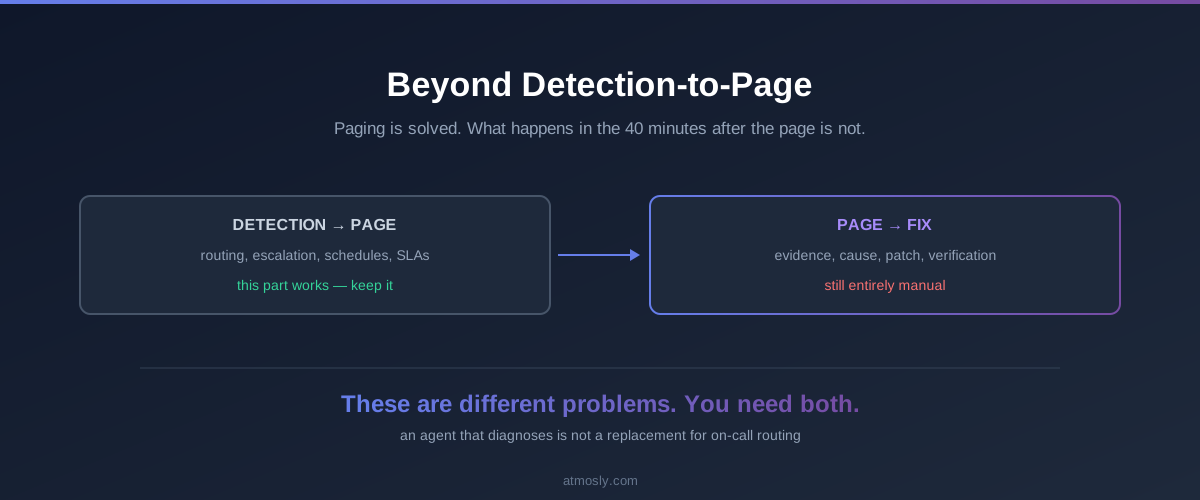
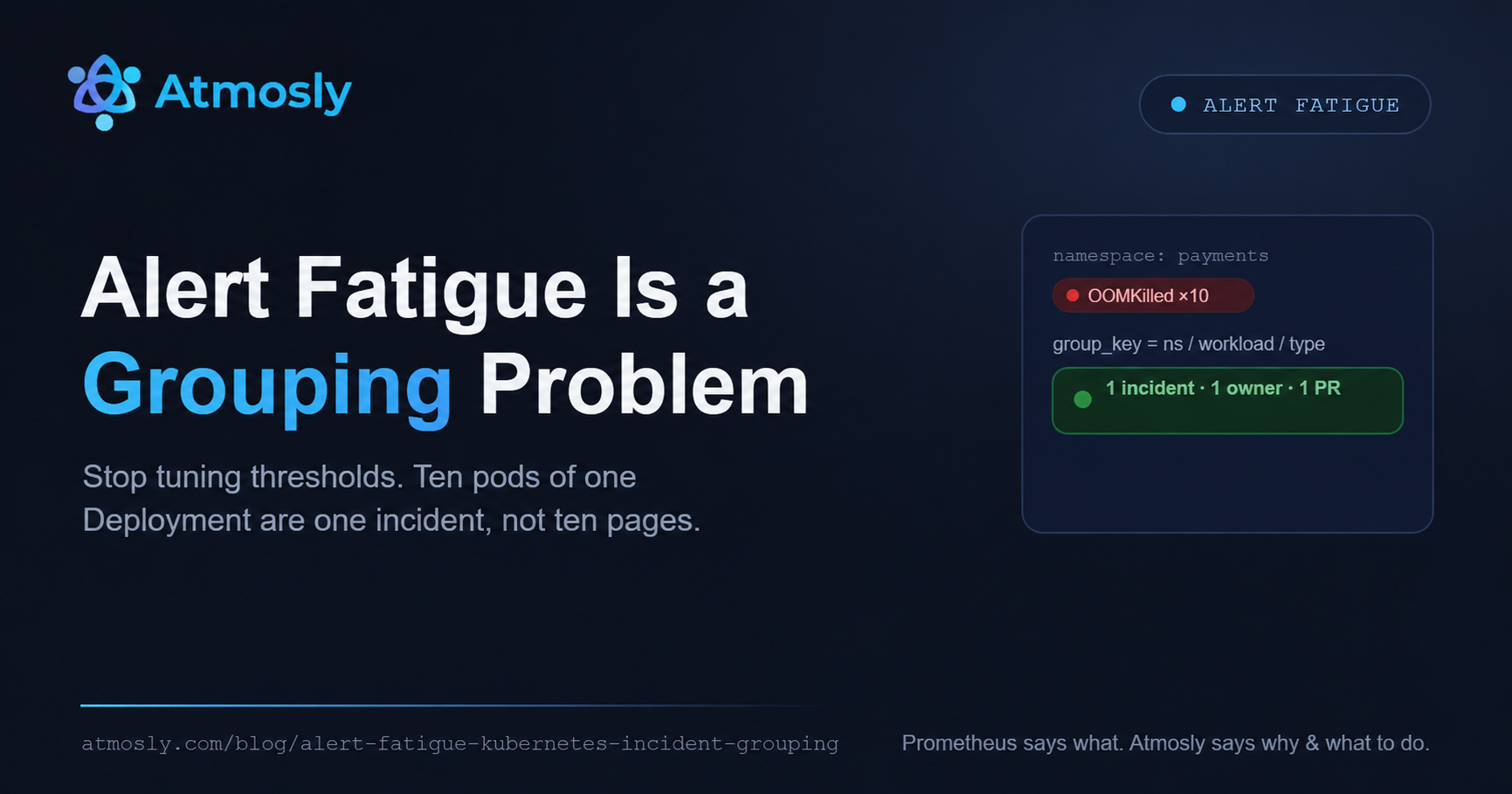
At 02:14 a Deployment in the payments namespace starts OOMKilling pods. Within ninety seconds your pager fires ten times — one page per pod, each one a near-identical PodOOMKilled alert. You are not debugging yet. You are deduplicating in your head: which of these ten are the same fault, which dashboard shows the cause, and what shipped three hours ago. That triage tax, paid on every multi-replica failure, is alert fatigue.
The usual response is to tune thresholds — raise the for: duration, bump a limit, silence a noisy rule. That treats the symptom. Alert fatigue is not a threshold problem; it is a grouping problem. Ten crash-looping pods of one Deployment are one incident with one root cause and one fix. The job is to make your tooling say that, instead of paging ten times. This post covers why label-based grouping in Alertmanager is necessary but not sufficient, what "grouping by workload identity" means mechanically, and how an AI SRE agent turns a grouped incident into a single reviewable fix.
What alert fatigue actually is
Alert fatigue is the measurable degradation in response quality when engineers receive more alerts than they can act on. It has two mechanical sources, and only one of them is about thresholds:
- Signal-to-noise: alerts that fire without a required human action — flapping, non-actionable warnings, alerts on causes that self-heal. This is a rule-design problem.
- Fan-out: a single fault emitting many alerts because it affects many objects — N pods of a Deployment, every pod behind a failing Service, every node in a bad AZ. This is a grouping problem, and it is the one that dominates on multi-replica Kubernetes workloads.
Fan-out is what makes 3am ugly. A Deployment running 10 replicas that hits a bad memory limit does not produce one OOMKilled signal; it produces up to 10, plus the downstream CrashLoopBackOff events as the kubelet backs off restarts (covered in depth in our CrashLoopBackOff guide). The fault is singular. The alert stream is not.
Why tuning thresholds does not fix it
Threshold tuning attacks alert frequency, not alert cardinality. Consider the standard OOM rule most teams run:
- alert: PodOOMKilled
  expr: |
    kube_pod_container_status_last_terminated_reason{reason="OOMKilled"} == 1
    and on(pod) increase(kube_pod_container_status_restarts_total[5m]) > 0
  for: 2m
  labels:
    severity: critical
  annotations:
    summary: "OOMKilled in {{ $labels.namespace }}/{{ $labels.pod }}"
The expression is correct. But kube_pod_container_status_last_terminated_reason is per-pod, so the vector has one series per affected pod, and Alertmanager receives one alert per series. Raising for: 2m to for: 5m delays every page by three minutes; it does not collapse ten pages into one. You cannot tune your way out of cardinality. The fan-out is a property of the label set, not the threshold.
Alertmanager grouping: necessary, not sufficient
Alertmanager already has a grouping primitive. Its routing tree groups alerts by a chosen label set before notifying, per the Alertmanager documentation:
route:
  group_by: ['alertname', 'namespace']
  group_wait: 30s
  group_interval: 5m
  repeat_interval: 4h
inhibit_rules:
  - source_matchers: [ severity="critical" ]
    target_matchers: [ severity="warning" ]
    equal: ['namespace', 'pod']
This helps. Grouping by ['alertname','namespace'] means one OOM burst in one namespace becomes one notification group, and inhibit_rules suppress the dependent warnings. Every team should configure this. But it has three structural limits:
- Label sensitivity. Group only on labels that are identical across the fan-out. Include
podorinstanceand grouping collapses to one-per-pod again. Miss a label and unrelated faults merge into one page. - No workload awareness. Alertmanager groups on flat labels. It does not know that
checkout-api-7f9c-abcandcheckout-api-7f9c-xyzare replicas of the same Deployment — unless a metric relabeling step already stamped aworkloadlabel onto the series, which most stacks do not do consistently. - It groups notifications, not incidents. A notification group is a batching of alerts for delivery. It carries no root cause, no remediation, and no lifecycle. When the group clears, the knowledge evaporates.
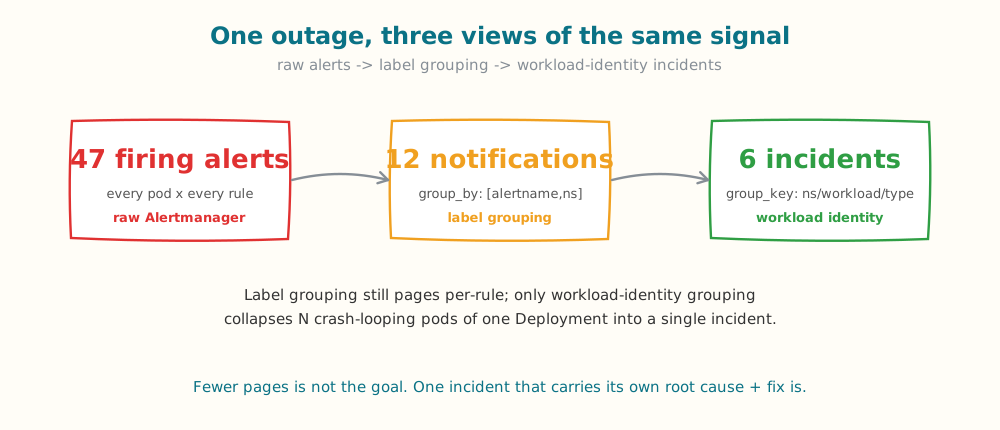
Label grouping cuts volume but still pages per rule and per label permutation. Only workload-identity grouping collapses N pods of one Deployment into a single incident.
The missing primitive: grouping by workload identity
The durable fix is to group on the identity of the thing that is broken, not on the raw labels of the signal. The grouping key that works in practice is:
group_key = (cluster, namespace, workload, failure_type)The non-trivial term is workload. A pod name is ephemeral; the owning controller is stable. Resolving it means walking ownerReferences from Pod to ReplicaSet to Deployment (or StatefulSet, DaemonSet, Job) rather than trusting a name prefix:
# pod -> replicaset -> deployment, via ownerReferences (not string parsing)
kubectl get pod checkout-api-7f9c-abc -n payments \
  -o jsonpath='{.metadata.ownerReferences[0].name}'   # -> checkout-api-7f9c (ReplicaSet)
kubectl get rs checkout-api-7f9c -n payments \
  -o jsonpath='{.metadata.ownerReferences[0].name}'   # -> checkout-api (Deployment)
Once every failing pod resolves to payments/checkout-api and the failure classifies as oom, all ten alerts share one group_key. Ten pages become one incident: "checkout-api is crash-looping (×10), cause: memory limit." This is the same identity model you rely on elsewhere — it is why HPA and the VPA operate on workloads, not pods. Alerting is the one place teams forget to apply it.
From a grouped incident to a merged fix
Grouping is worth doing on its own, but its real payoff is that a single incident is something you can act on once. An AI SRE Platform treats grouping as stage two of a five-stage loop: detect, group, diagnose, ship, verify. Atmosly's agent collapses the fan-out into one incident, resolves the owning workload, reads the live Pod spec and terminated state for evidence, and attaches a proposed fix — for an OOM, a memory-limit patch derived from observed usage.
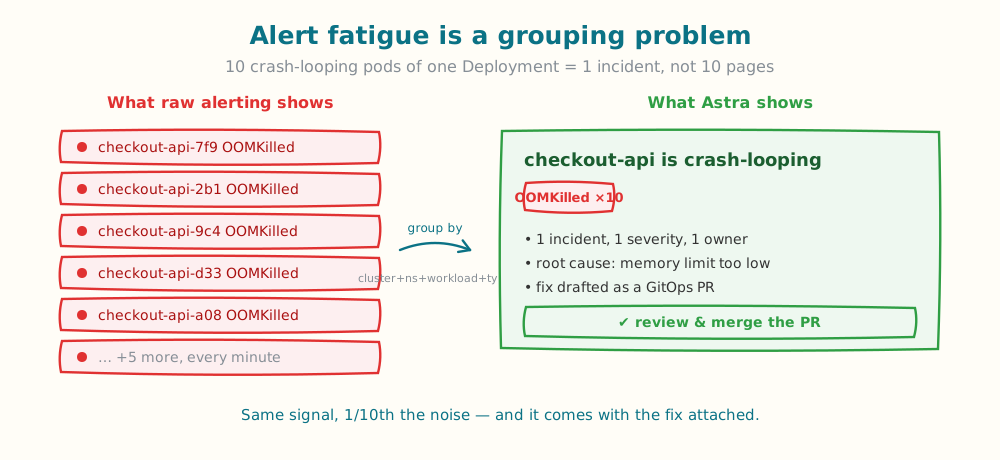
One incident, one owner, one root cause — and the remediation attached as a reviewable pull request.
Two honest constraints matter here. The remediation is delivered as a GitOps pull request that a human merges; the agent does not mutate production on its own. And GitOps discovery is Argo CD-based today — it introspects the Argo CD Application that owns the workload and patches the manifest in the backing repo, so a direct edit is not silently reverted at the next reconcile. If you run Flux or raw Helm, treat that as a caveat to verify, not a promise. For where this sits among other tools, see our comparison of the best AI SRE tools in 2026.
How to measure alert fatigue before and after
Grouping changes are easy to hand-wave and hard to argue for without numbers. Track four metrics per on-call rotation so the before/after is concrete:
- Alerts-per-incident ratio. Total alerts fired divided by distinct root-cause incidents. A healthy target is close to 1. If you are at 6–10, fan-out is your problem, and grouping — not tuning — is the lever.
- Pages per on-call shift. The raw human load. Count pages that interrupted sleep separately; those cause the most attrition.
- Actionable rate. The share of pages that required a human action versus self-resolved or informational. Below ~50% and your rule design, not just grouping, needs work.
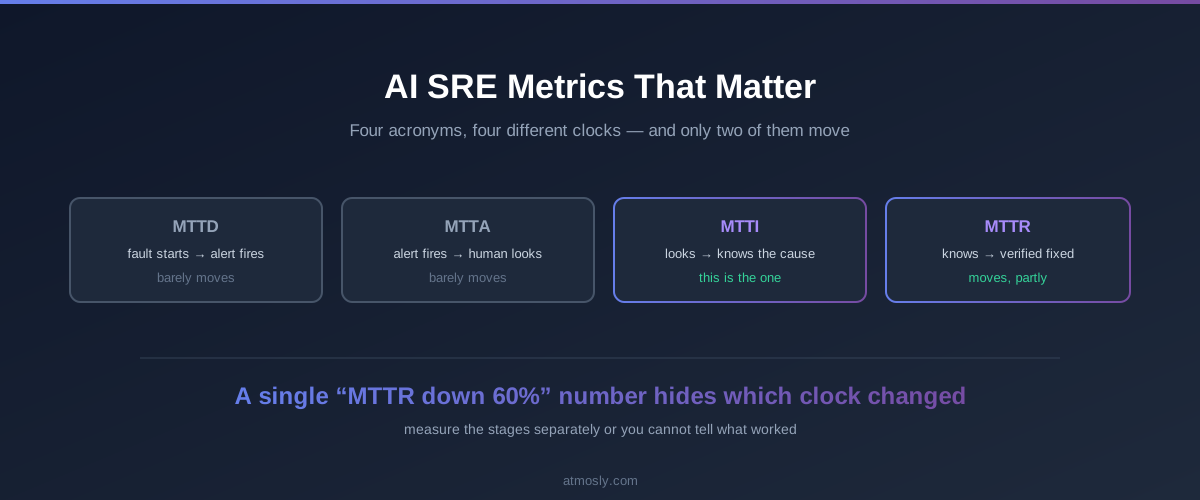
- Time-to-acknowledge trend. Rising acknowledgment latency over a quarter is the earliest measurable sign of on-call burnout — engineers are tuning the pager out.
Instrument these before you change anything. Grouping by workload identity typically moves the alerts-per-incident ratio toward 1 without touching a single threshold, which is the clearest evidence that fan-out — not sensitivity — was the real cost.
A practical alerting model that reduces noise
Grouping is one layer. Combined with disciplined rule design — the philosophy laid out in Google's SRE book — it gives you an alerting model that stays quiet until a human is genuinely needed:
- Page on symptoms, not causes. Alert on user-visible SLO burn (error rate, latency), not on every underlying cause. A single symptom alert replaces dozens of cause alerts.
- Group by workload identity. Resolve every alerting series to its owning controller and set that as the grouping key, so replica count never drives page count.
- Configure Alertmanager grouping and inhibition as the baseline:
group_byon stable labels,inhibit_rulesto suppress dependents, sanegroup_intervalandrepeat_interval. - Route by ownership. One incident, one owning team, one channel. Fan-out to humans is as damaging as fan-out to pagers.
- Attach the fix to the incident. The highest-leverage noise reduction is not sending fewer alerts — it is making the one alert you send actionable by carrying its root cause and remediation, so it closes fast instead of lingering and re-firing.
Key takeaways
- Alert fatigue on Kubernetes is mostly fan-out, not frequency. One fault across N replicas produces N alerts; threshold tuning cannot collapse that.
- Alertmanager grouping is the baseline, not the finish line. It batches notifications on flat labels; it is not workload-aware and carries no incident lifecycle.
- Group by
(cluster, namespace, workload, failure_type), resolving the workload throughownerReferences, so replica count stops driving page count. - Page on symptoms, group by identity, route by ownership — and attach the fix to the incident so it closes instead of re-firing.
- An AI SRE agent makes grouping actionable by turning the single incident into a reviewable GitOps PR — Argo CD-based, human-merged.
Want to see your next OOM or crash-loop arrive as one grouped incident with the fix attached, instead of ten pages? Connect a cluster read-only and run a free audit in about five minutes. Start with Atmosly.