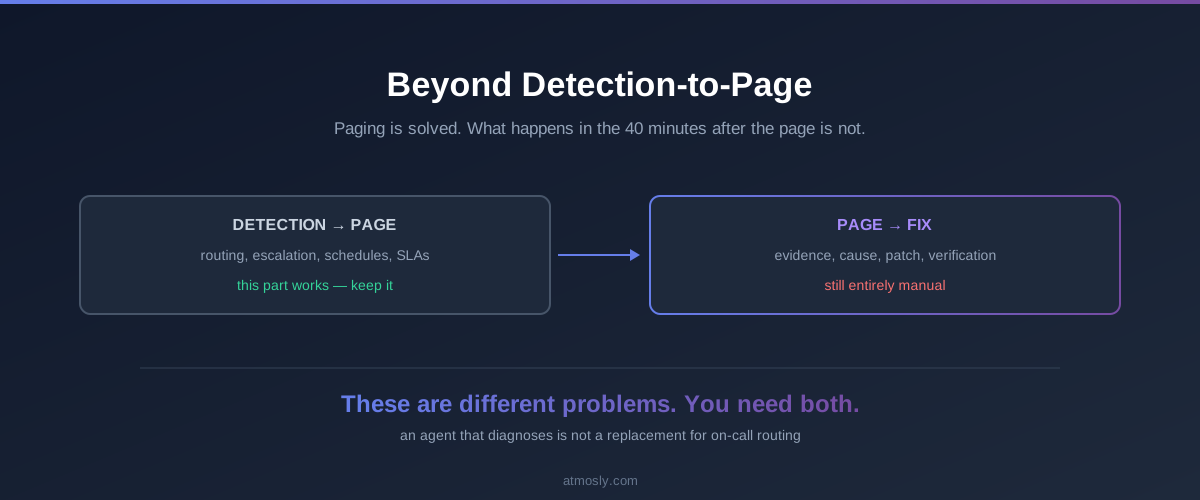
It is 02:14. A payment service starts OOMKilling pods. The old playbook is familiar: a pager fires, a human wakes up, greps logs, guesses a memory number, runs kubectl patch against prod, and hopes the change survives the next GitOps reconcile. An AI SRE agent compresses that entire arc — detection, root-cause analysis, and remediation — into a reviewable pull request that lands before most on-call engineers have found their laptop. This post is a frame-by-frame anatomy of that single fix: from the first health signal to a merged, root-cause PR.
If you are evaluating AI SRE tooling, the question that matters is not "can it summarize an incident?" — plenty of bots do that. It is "can it produce a correct, reversible change through the same review gate my team already trusts?" That is the bar we will hold the workflow to here. For the interactive, ask-questions-about-a-broken-cluster side of the story, see our companion guide on Kubernetes troubleshooting with AI using Atmosly Copilot; this article stays narrowly focused on the autonomous alert-to-PR loop.
What an AI SRE Agent Actually Is (in 2026)
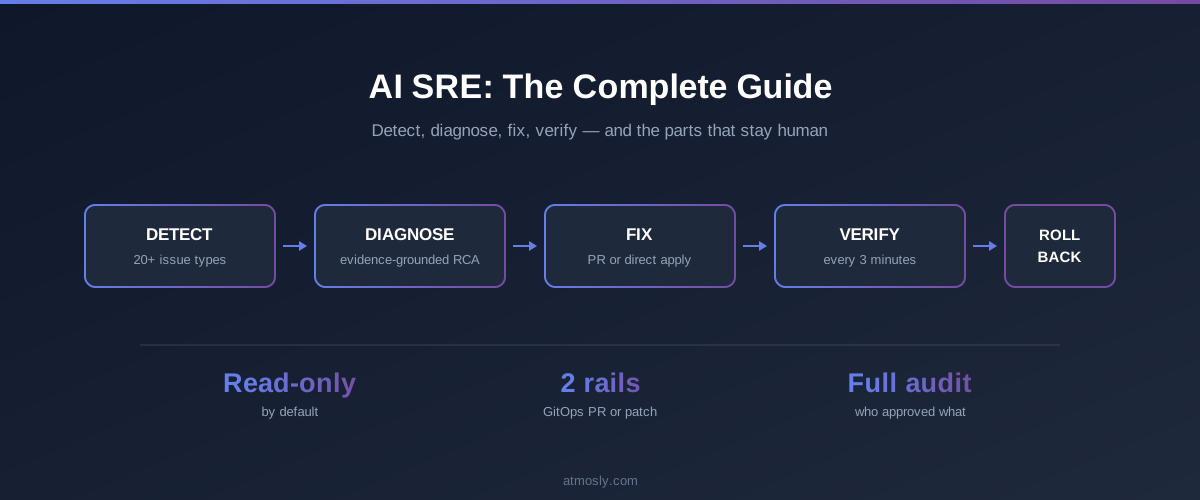
In 2026, "AI SRE agent" has a specific meaning that goes well beyond a chat window bolted onto Grafana. A real agent is a closed control loop with four stages:
- Ingestion — continuous detection of health issues from the cluster (not just scraping a dashboard a human is already staring at).
- Root-cause analysis (RCA) — correlating the signal with live object state, events, and resource evidence to explain why, not just what.
- Remediation — generating a concrete, typed fix and delivering it through a safe rail: a GitOps PR for review, or a guarded direct apply.
- Verification — re-checking that the fix actually worked, and rolling back automatically if it made things worse.
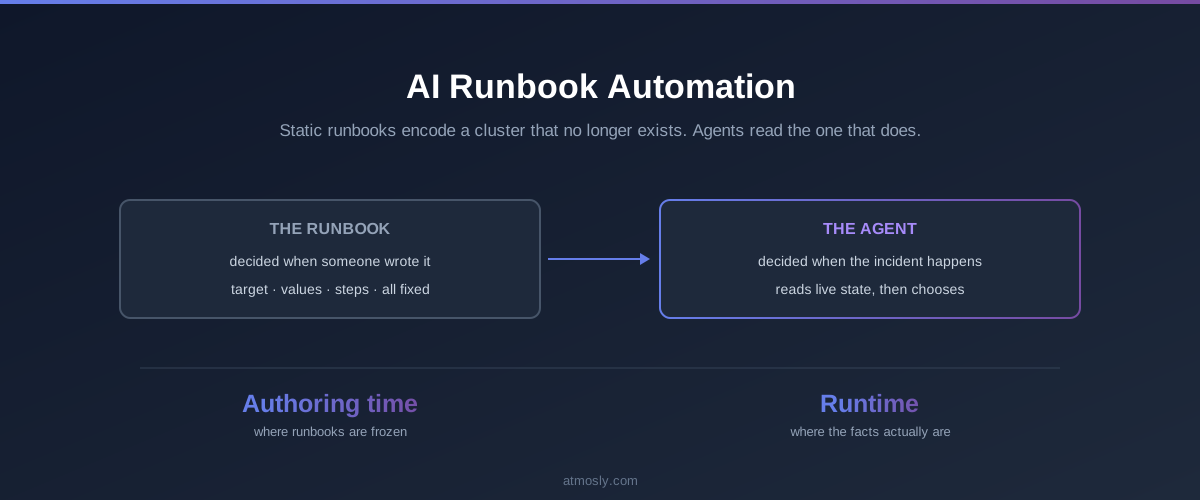
Crucially, this all runs on the GitOps-by-default model that has become the standard deployment posture on Kubernetes 1.33+. The agent does not fight your Argo CD reconciler — it works through it. A patch that ignores GitOps is a patch your controller silently reverts on the next sync; an agent that opens a PR against the source of truth produces a durable fix. That distinction is the entire ballgame.
Stage 0: The Alert — Detection, Not Just a Dashboard
Our worked example is a real-world shape we see constantly: a Java-based checkout-api Deployment in the payments namespace, sized with an optimistic memory limit, getting OOMKilled under a traffic spike. Here is the kind of Prometheus Alertmanager rule a mature team already has firing:
groups:
- name: workload-health
  rules:
  - alert: PodOOMKilled
    expr: |
      increase(kube_pod_container_status_restarts_total{namespace="payments"}[5m]) > 0
      and on(pod) kube_pod_container_status_last_terminated_reason{reason="OOMKilled"} == 1
    for: 2m
    labels:
      severity: critical
    annotations:
      summary: "Container OOMKilled in payments/checkout-api"
      description: "checkout-api restarted after OOMKill (exit 137). Working set exceeded memory limit."
That alert tells a human something is wrong. It does not tell them the current limit, the affected container, the owning controller, or a defensible new value. An AI SRE agent does not start from the alert text — it starts from the live object. Atmosly's in-cluster debug agent independently detects 20+ infrastructure issue types (pod crashes, OOMKills, image-pull failures, node pressure, config faults) on a continuous monitoring cycle, and at detection time it reads the actual Pod spec and status rather than scraping prose. For an OOM, it captures the affected container name, the current request and limit, and the OOMKilled terminated-state — the exit 137 on status.containerStatuses[].lastState.terminated. That structured evidence is what makes the downstream fix honest instead of guessed.
See it on your own cluster. The fastest way to understand the alert-to-PR loop is to watch it run against a real workload. Connect a cluster to Atmosly free and let the SRE agent ingest, diagnose, and propose a root-cause PR for your next real health issue — no production change is applied without your review.
Stage 1: Root-Cause Analysis — From Symptom to Cause
RCA is where most "AI ops" tools wave their hands. The hard part is not narrating the symptom ("the pod restarted") — it is grounding a cause in observed state and turning it into a typed remediation proposal with a target, a value, and a rollback. Atmosly's RCA is AI-enhanced (LLM-backed) but anchored to the resource evidence the agent captured at detection, so the proposed value is derived from what the workload actually did, not a hardcoded default.
For the checkout-api OOM, the resulting RCA trace looks like this:
issue_id:        65f3a1c4e9b2  (group_key: payments/checkout-api/oom)
type:            pod_oom_killed
severity:        critical
evidence:
  owner_kind:      Deployment
  owner_name:      checkout-api
  container:       checkout-api          # resolved via ownerReferences, not index 0
  current_request: 256Mi
  current_limit:   512Mi
  restart_count:   7
  oom_killed:      true                  # exit 137
root_cause: >
  checkout-api is OOMKilled under load: the working set exceeds the 512Mi
  limit during peak checkout traffic. The limit is undersized for observed demand.
proposal:
  primitive:     patch_resource_spec
  target:        Deployment/checkout-api .spec.template.spec.containers[checkout-api]
  change:        resources.limits.memory: 512Mi -> 640Mi
  basis:         3x_current_limit clamped to evidence; rounded to 64Mi boundary
  reversible:    true
  rollback_spec: { memory: 512Mi }
  confidence:    est. 0.78
Three details separate this from a toy. First, the target is resolved from the Pod's ownerReferences (collapsing the ReplicaSet to its Deployment) and patches the named affected container — not a hardcoded index 0, which silently mis-patches multi-container pods. Second, the new memory value is evidence-driven and rounded to a sane Kubernetes memory boundary, with a captured rollback_spec so the change is reversible. Third, confidence is labeled est. — an honest estimate from the fix type and reasoning, not a measured success rate dressed up as one. An agent that presents a guess as a certainty is worse than no agent at all.
Stage 2: Choosing the Rail — GitOps PR vs Direct Apply
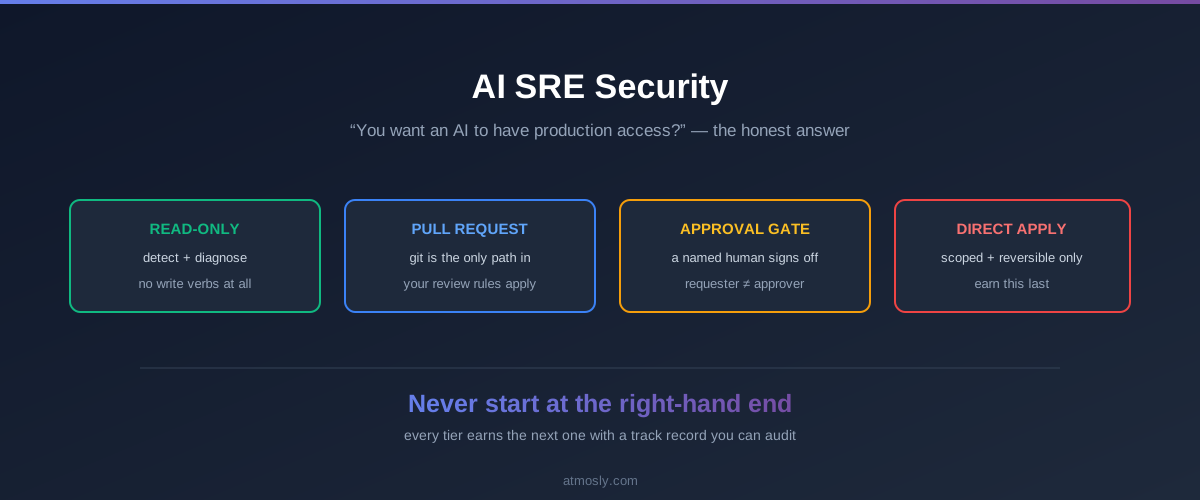
A typed proposal is useless until it reaches the cluster safely. Atmosly's SRE agent offers two remediation rails, and choosing correctly is itself part of the intelligence:
- GitOps PR (recommended when the workload is GitOps-managed): the agent introspects Argo CD to find the
Applicationthat owns the workload, locates the manifest in the backing Git repo, patches the YAML, and opens a pull request to GitHub, GitLab, or Bitbucket. The fix flows through your existing review and merge gate. - Direct apply (guarded): a
kubectl patchvia the ops-agent, used when speed matters and a human approves — captured in an audit row with a rollback spec and a short revert TTL.
The agent detects whether an Argo CD Application manages the target. If one does, the PR rail is the right answer — and it is honest about the failure mode when one does not: a direct patch on a GitOps-managed workload will be reverted by the controller on the next reconcile. This is the practical reality of Argo CD auto-sync: the repo is the source of truth, so the fix has to land in the repo. Picking the wrong rail is how "automated remediation" turns into a flapping fight between a bot and a reconciler.
Stage 3: The Root-Cause PR
Here is the artifact the whole loop exists to produce — a reviewable, root-cause pull request. The agent pauses Argo CD sync for that application while the PR is open (so the controller does not thrash), patches the manifest, and writes a description a human can approve in seconds:
PR #482  fix(payments): raise checkout-api memory limit 512Mi -> 640Mi

Opened by: atmosly-sre-agent

--- a/apps/payments/checkout-api/deployment.yaml
+++ b/apps/payments/checkout-api/deployment.yaml
@@ spec.template.spec.containers[checkout-api].resources
         resources:
           requests:
             memory: 256Mi
           limits:
-            memory: 512Mi
+            memory: 640Mi

Root cause: checkout-api OOMKilled (exit 137) under peak checkout load;
working set exceeded the 512Mi limit (7 restarts in the incident window).

Basis: limit raised to 640Mi from observed OOM evidence (current limit 512Mi),
rounded to a 64Mi boundary. Request unchanged.
Rollback: revert this commit, or restore limits.memory: 512Mi.
Linked issue: payments/checkout-api/oom (group_key)
Argo CD sync: paused for app=checkout-api until merge (auto-resumes).
This is the difference between an AI SRE agent and an alert bot. The output is not a Slack paragraph — it is a diff against your source of truth, scoped to one container, with the root cause, the basis for the value, and an explicit rollback, sitting in the review tool your team already gates production with. A reviewer approves it the way they would any change. Nothing touched prod outside the pipeline.
Stage 4: Verify and Auto-Rollback — Closing the Loop
Most "remediation" stories end at apply and assume success. That open loop is exactly where trust dies: a patch that worsens things with no safety net is a liability, not an upgrade. Atmosly closes the loop. After a fix is applied, a backend verification sweep re-checks the issue and returns a verdict — healthy, still_firing, or regressed (a different new problem on the same workload). If the change regressed the workload, the agent replays the captured rollback_spec automatically and writes a linked revert audit row.
# post-merge verification sweep
issue: payments/checkout-api/oom
applied: limits.memory 512Mi -> 640Mi
verdict: healthy        # no OOMKills in the verification window; restarts stable
state:   resolved_by_fix
# had the verdict been "regressed", the agent would replay rollback_spec
# (640Mi -> 512Mi), log an auto-revert row, and escalate to on-call.
The auto-rollback is deliberately conservative: it triggers on a genuine regression, never on a fix that is merely still settling, and non-reversible primitives skip auto-revert and escalate instead. When the PR merges, a GitOps PR-merge webhook flips the agent's internal ledger from open to merged, resumes Argo CD sync for that application, and auto-resolves the incident. The loop is now genuinely closed: alert in, merged root-cause PR out, verified healthy, incident closed — with an audit trail at every hop.
Why This Beats the Manual Runbook
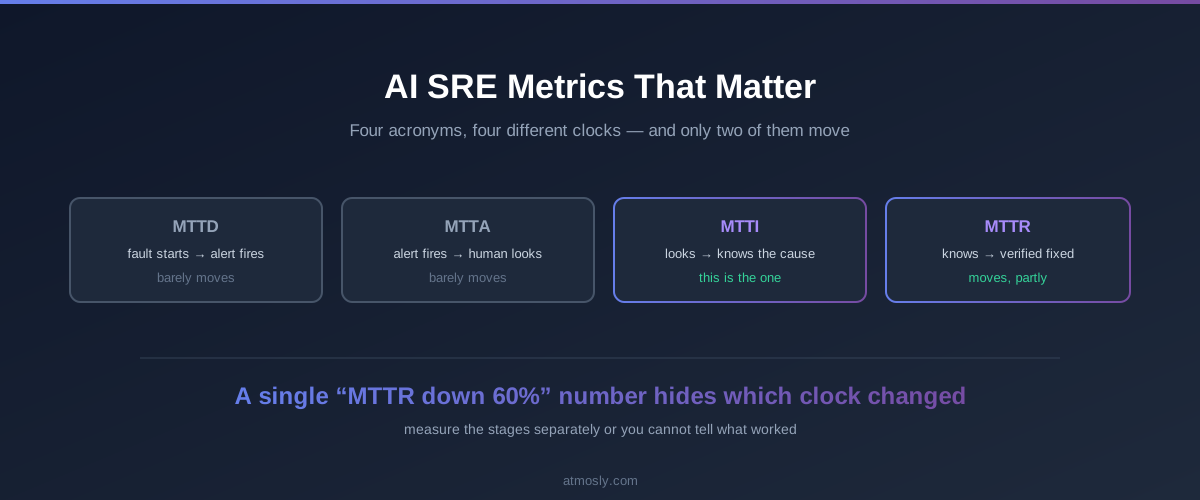
Compare the 02:14 incident under both models. The economics are not subtle — Gartner pegs the cost of downtime at roughly $5,600 per minute, and engineers spend an estimated 40% of their time on incident response and toil.
| Step | Manual on-call | AI SRE agent (alert to PR) |
|---|---|---|
| Detect | Pager fires; human wakes, opens dashboards | Continuous detection; structured evidence captured at the OOM |
| Diagnose | Grep logs, correlate events, guess the cause | Evidence-grounded RCA with owner + container + current limit |
| Decide a value | Pick a memory number from intuition | Evidence-driven value, rounded, with a rollback spec |
| Apply safely | kubectl patch prod (drifts from Git) | PR against the GitOps source of truth; Argo sync paused |
| Verify | Stare at graphs; hope | Automated verdict; auto-rollback on regression |
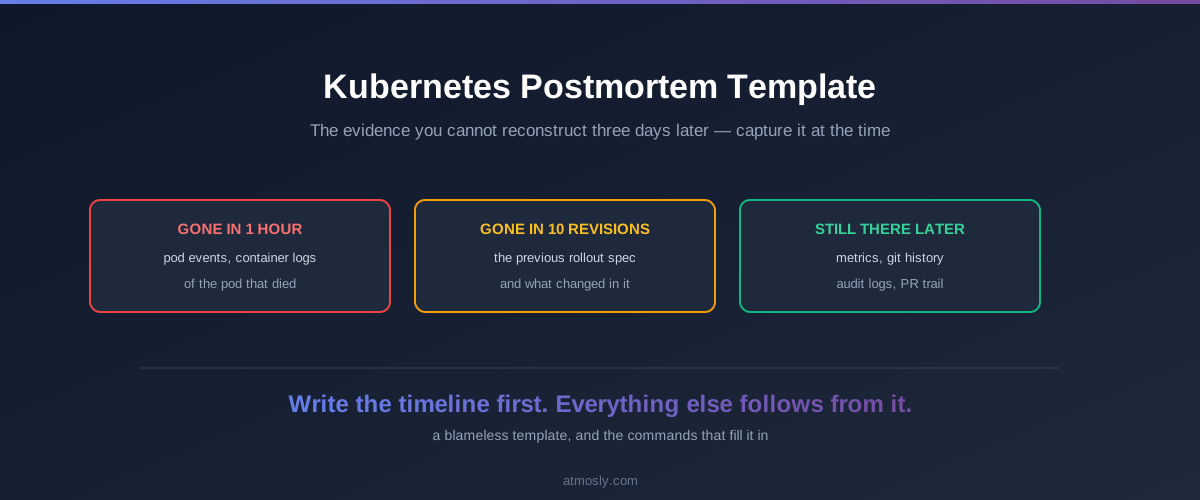
| Close out | Manual incident write-up | PR-merge webhook auto-resolves + audit trail |
The agent does not remove the human — it removes the 2 a.m. toil and the guesswork, and hands the engineer a reviewable diff instead of a blank terminal. The human stays in the loop exactly where judgment matters: approving the PR.
The Honest Limits (Because Trust Requires Them)
A credible AI SRE agent is upfront about its edges. GitOps detection today is Argo CD-aware; a Flux- or Helm-operator-managed workload may revert a direct patch on reconcile, so the agent surfaces that caveat rather than promising a clean apply. Autonomy is bounded — high-risk changes route through human approval, and confidence is presented as an estimate until a per-cluster track record exists. And the agent's scope is Kubernetes infrastructure remediation (resource, rollout, reschedule-class fixes), not arbitrary application logic. These are not weaknesses to hide; they are the guardrails that make the autonomous parts trustworthy. For broader platform context, see how the agent fits alongside cost intelligence and the rest of the Atmosly AI SRE agent capabilities.
Where Atmosly Fits
Karpenter provisions nodes; Argo CD reconciles desired state; Prometheus tells you something broke. None of them diagnose the cause and write the fix. That is the intelligence layer Atmosly's AI SRE agent occupies: it ingests health issues from your clusters, performs evidence-grounded RCA, and delivers remediation as a GitOps PR or a guarded direct apply — then verifies the result and rolls back if it regressed. It is built for the CNCF-native, GitOps-default stack most teams already run, and it slots into your existing Git, Argo CD, and Slack workflows rather than replacing them. The result is a measurably shorter path from alert to durable fix, and an audit trail your compliance reviewers will actually like.
Conclusion
The anatomy of an AI SRE fix is a four-stage loop: ingest the alert as structured evidence, ground the root-cause analysis in live object state, deliver the remediation as a reviewable root-cause PR through your GitOps pipeline, and verify-or-rollback to close the loop. Done well, an AI SRE agent turns a 2 a.m. fire drill into a one-click PR approval — without ever bypassing the review gate your team trusts. The technology to do this safely exists in production today. Start free with Atmosly, connect a cluster, and watch your next health issue arrive as a root-cause PR instead of a page.