Shared staging is where velocity goes to die. One engineer pushes a schema-changing branch, another is mid-way through a load test, a third just merged a feature flag — and now the single staging cluster is an unreliable composite of three half-finished worlds. Nobody trusts what they see. QA files bugs that can't be reproduced. The release manager becomes a human mutex, pinging Slack to ask "is anyone using staging right now?"
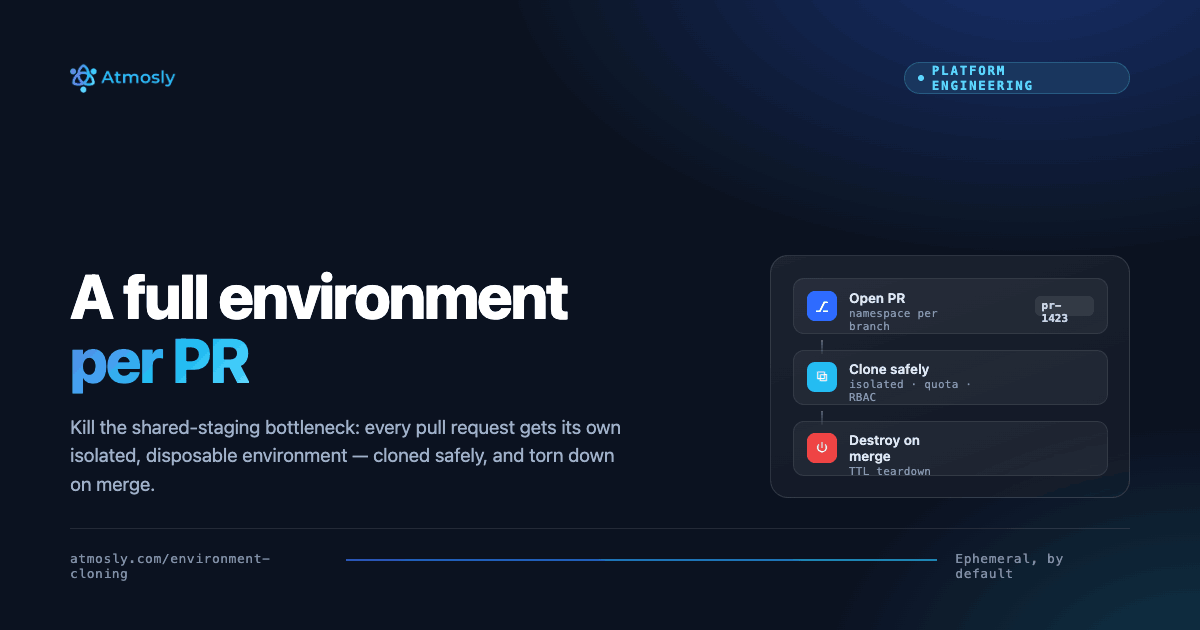
The fix that high-performing teams have converged on is preview environments: every pull request gets its own full, isolated, disposable environment. Instead of queueing for one shared box, each PR is reviewed in a living copy of the real system — app, dependencies, config, and data — that is created on demand and torn down when the branch merges. The pattern is often called namespace per PR (or per-branch ephemeral environments), and when it is done right it removes the staging bottleneck entirely.
But "done right" is the hard part. A preview environment that quietly shares a database with staging, leaks secrets, has no resource ceiling, or never gets cleaned up is worse than no preview environment at all — it is a reliability and cost incident waiting to happen. This guide covers how to give every PR a full environment, how to clone it safely (isolation, quotas, RBAC, secret handling), and how to make sure ephemeral environments stay ephemeral instead of becoming a permanent line item on your cloud bill.
TL;DR — Key Takeaways
- Shared staging is a serialization point. Preview environments parallelize it: one full environment per PR, created on push and destroyed on merge.
- "Namespace per PR" is the unit of isolation on Kubernetes — a dedicated namespace gives you a clean boundary for
NetworkPolicy,ResourceQuota, and RBAC. - "Full environment" means more than the app. It is the service plus its dependencies (datastores, config, env vars, secrets) wired together so the PR behaves like production.
- Safe cloning = isolation + regenerated identities + scoped secrets. Names, namespaces, and credentials must be regenerated so a clone can never clobber its source.
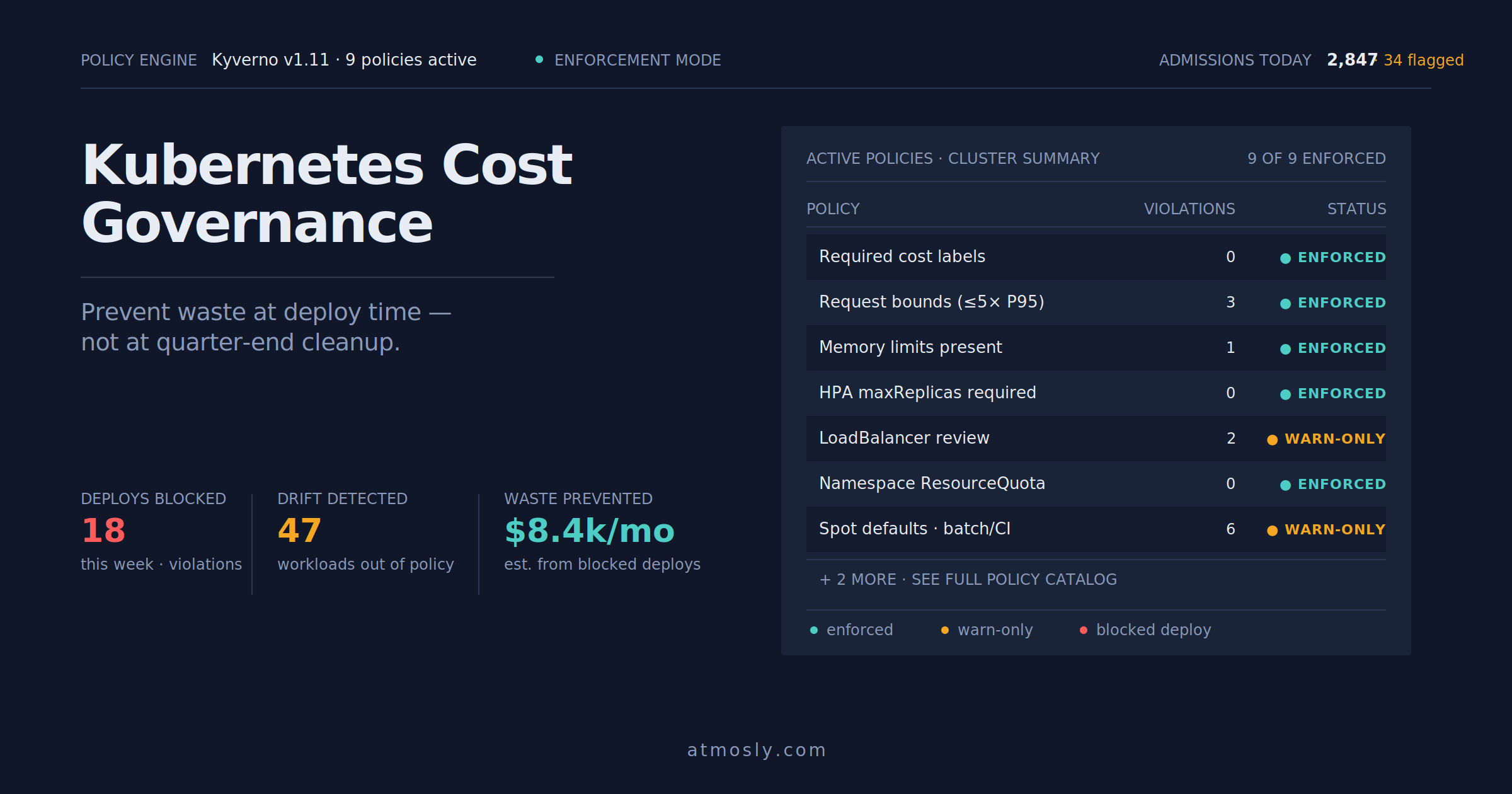
- Ephemeral must actually expire. Without an automatic teardown (TTL / scheduled destroy), preview environments become a silent cost leak. Tie cleanup to merge events and to scheduled guardrails.
- Atmosly provides the real primitives — full-environment cloning, namespaced isolation with per-environment RBAC, GitOps-style pipeline deploys, and scheduled scale-down/destroy guardrails — to build this pattern without hand-rolling it.
Why Shared Staging Became the Bottleneck
A single shared staging environment made sense when teams deployed monthly and one feature was in flight at a time. In 2026, with trunk-based development, dozens of concurrent PRs, and GitOps as the default delivery model, that model collapses under its own concurrency.
The failure modes are predictable:
- State collision. Two branches mutate the same database rows, the same feature-flag config, or the same message queue. Test results become non-deterministic.
- The "is staging free?" tax. Engineers serialize their work around a shared resource. Effective throughput drops to one-at-a-time even though you have ten people.
- Configuration drift. Staging slowly diverges from production as people hand-patch it to unblock themselves. The thing you test against stops resembling the thing you ship.
- Blast radius. A bad migration on a branch takes out staging for the whole org, not just the author.
- Slow, low-confidence review. Reviewers read a diff instead of clicking through a running copy of the feature. Bugs that only appear at runtime slip through.
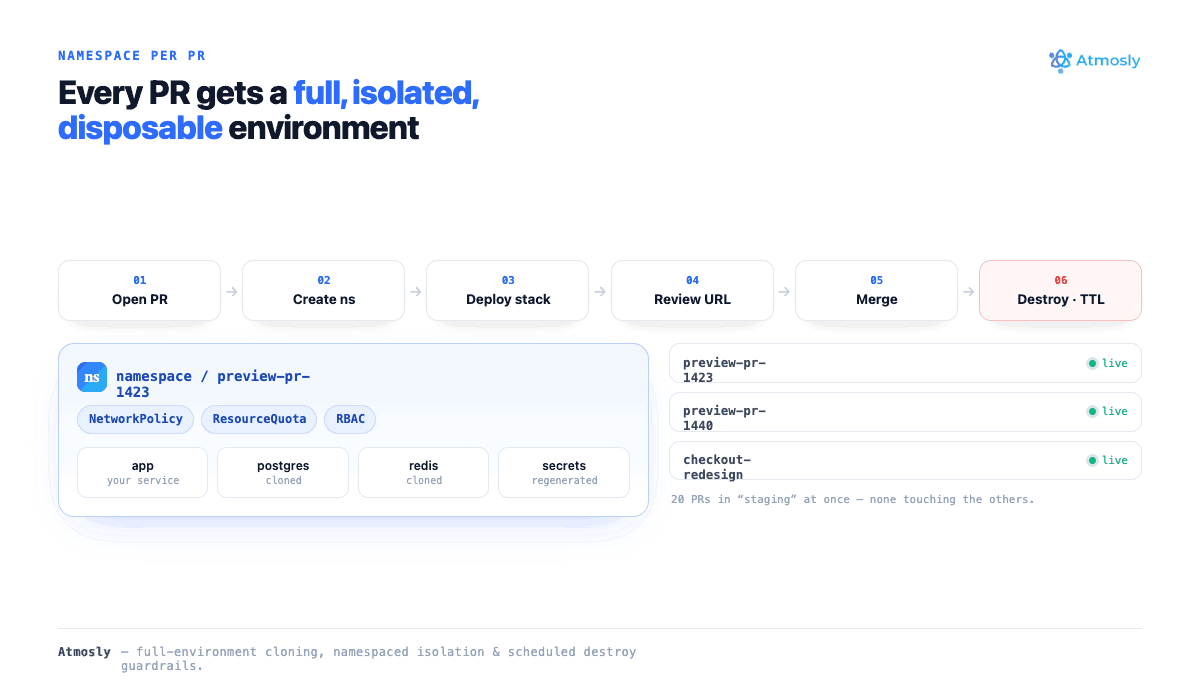
Preview environments break this by giving every change its own world. The PR author gets a real URL to a real, isolated deployment. Reviewers and QA interact with the actual behavior. And because each environment is independent, twenty PRs can be "in staging" simultaneously without ever touching each other.
Evaluating the build-vs-buy decision for preview environments? The hard parts are not "run
kubectl applyin a new namespace" — they are safe secret handling, dependency cloning, isolation boundaries, and reliable teardown. Create a free Atmosly account to see full-environment cloning, namespaced isolation, and scheduled destroy guardrails working against your own cluster before you commit to hand-building the plumbing.
What "Namespace Per PR" Actually Means
On Kubernetes, the natural unit of isolation for a preview environment is the namespace. The "namespace per PR" pattern maps each open pull request (or each branch) to a dedicated namespace — preview-pr-1423, preview-checkout-redesign, and so on — and deploys the full application stack into it.
The namespace is the right boundary because it is exactly where Kubernetes lets you draw security, capacity, and access lines. As the Kubernetes namespaces documentation notes, namespaces provide a scope for names and a hook for policy. A workload sitting in the default namespace has none of that — per-namespace NetworkPolicy, ResourceQuota, and RBAC all become harder to apply, which is why dedicated namespaces per environment are a baseline best practice.
A minimal per-PR namespace, created by your CI pipeline on PR open, looks like this:
apiVersion: v1
kind: Namespace
metadata:
  name: preview-pr-1423
  labels:
    app.kubernetes.io/managed-by: preview-controller
    preview.example.com/pr: "1423"
    preview.example.com/branch: checkout-redesign
    preview.example.com/owner: a.rivera
  annotations:
    # consumed by your teardown job / TTL controller
    preview.example.com/expires-at: "2026-06-17T18:00:00Z"
That expires-at annotation is doing quiet but critical work — we will return to it in the teardown section, because it is the difference between an ephemeral environment and an accidental permanent one.
Why namespaces, not separate clusters, for most teams
You can give every PR its own cluster, and for hard multi-tenant isolation (untrusted code, strict compliance separation) you sometimes should. But a cluster per PR is slow to provision, expensive, and operationally heavy. For the common case — your own engineers, your own code — namespace per PR on a shared preview cluster is the sweet spot: fast to create (seconds, not minutes), cheap, and isolated enough when you actually apply quotas, network policy, and RBAC. Reserve cluster-level isolation for the genuinely hostile or regulated workloads.
What a "Full" Per-Preview Environment Has To Include
The word that trips teams up is full. A preview environment that is just your one service talking to mocked dependencies will pass tests that fail in production. To be useful, a per-PR environment has to reproduce the system, not just the artifact.
A genuinely full preview environment includes:
- The application workload(s) — the deployment(s) under review, built from the PR's commit or redeployed from an existing artifact.
- Its dependencies — the datastores (Postgres, Redis, a message broker), and any sibling services the app calls, deployed into the same isolated namespace so calls stay internal.
- Configuration — the ConfigMaps, environment variables, and feature-flag defaults the app expects.
- Secrets — database credentials, API keys, and tokens, supplied safely (more on this below — they should be fetched from a secret manager, not copied around).
- Ingress / routing — a unique hostname (e.g.
pr-1423.preview.example.com) so reviewers have a clickable URL that does not collide with any other preview. - Lineage — a record of which source environment this preview was cloned from, so you can reason about drift and reproduce issues.
The cleanest way to get all of that consistently is environment cloning: instead of reassembling the stack from scratch in CI, you snapshot the definition of a known-good environment (staging, or a golden template) and stamp out a fresh, isolated copy of the whole thing. This is the core of the per-PR pattern: a clone is a deployable copy of the entire environment — cluster placement, namespace, every service with its build and deploy config, and every datastore with its replicas, resource limits, and backup settings — not just a bag of manifests.
This is precisely the model Atmosly's environment cloning implements. When you clone an environment, it duplicates the full environment definition — the namespace, labels, each application service (its source type, env vars, CD values, container registry, and workflow), and each datastore with its configuration — and records the source as the clone's parent for lineage. Crucially, it gives you two modes:
- Clone CD-only — redeploy the existing built artifacts straight into the new environment when you just need a running copy fast. Ideal for review/QA previews where the image is already built by CI.
- Clone with full CI + CD — rebuild from source when the preview must reflect new code on the branch.
That CD-only mode maps perfectly onto the per-PR workflow: your CI builds the image once, and the preview environment is a fast redeploy of that artifact into a fresh isolated namespace.
Cloning Safely: Isolation, Identity, and Secrets
This is where naive preview-environment scripts get dangerous. Copying a YAML directory and changing the namespace is not "cloning safely." Three things must hold for a clone to be safe.
1. Regenerate everything that must be unique
If a clone reuses any identifier from its source, it can collide with — or worse, overwrite — the original. A safe clone regenerates:
- Environment name and namespace — so two environments never share a scope.
- Database passwords and other unique credentials — so the clone never shares a secret with its source.
- Record prefixes / DNS-facing identifiers — so ingress and hostnames don't clash.
- Container-registry bindings — so image pushes from one environment can't stomp another's tags.
Atmosly's clone flow treats these as clone_unique_fields and regenerates them for the copy. You review and name the new environment before it is created, and the platform regenerates the namespace, database passwords, record prefixes, and registry bindings so the clone is collision-free by construction. The clone also stores its parent_env_unique_id, giving you lineage back to the source.
2. Handle secrets without copying them around
The most common preview-environment security mistake is copying production-grade secret values into dozens of ephemeral namespaces. Every copy is a new place a credential can leak from, and you lose any ability to rotate centrally.
The safe pattern is to keep secrets in a secret manager and resolve them at deploy time. The External Secrets Operator is the CNCF-aligned way to sync secrets from AWS Secrets Manager, GCP Secret Manager, or HashiCorp Vault into a namespace as native Kubernetes Secrets, so the values live in the manager and not in your manifests:
apiVersion: external-secrets.io/v1beta1
kind: ExternalSecret
metadata:
  name: checkout-db-credentials
  namespace: preview-pr-1423
spec:
  refreshInterval: 1h
  secretStoreRef:
    name: aws-secrets-manager
    kind: ClusterSecretStore
  target:
    name: checkout-db-credentials
    creationPolicy: Owner
  data:
    - secretKey: DATABASE_URL
      remoteRef:
        key: preview/checkout/pr-1423/database-url
Atmosly follows the same principle: when an environment is cloned, secret-backed environment variables are re-fetched from your AWS or GCP Secret Manager at clone time rather than copied between environments. And it respects access control — if the user triggering the clone lacks the "view secret" permission, the secret values are masked rather than exposed. Combined with regenerated database passwords, the result is that a clone never inherits its parent's live credentials.
3. Draw isolation boundaries inside the namespace
A namespace is a name scope, not a security wall, until you add policy. For preview environments that share a cluster, apply three boundaries:
Resource quotas so one runaway preview can't starve the others or the node pool:
apiVersion: v1
kind: ResourceQuota
metadata:
  name: preview-quota
  namespace: preview-pr-1423
spec:
  hard:
    requests.cpu: "2"
    requests.memory: 4Gi
    limits.cpu: "4"
    limits.memory: 8Gi
    pods: "20"
---
apiVersion: v1
kind: LimitRange
metadata:
  name: preview-defaults
  namespace: preview-pr-1423
spec:
  limits:
    - default:
        cpu: 250m
        memory: 256Mi
      defaultRequest:
        cpu: 100m
        memory: 128Mi
      type: Container
The ResourceQuota documentation explains how these caps work per namespace; the LimitRange ensures every pod gets a sane default request even if the manifest omits one — important when you are stamping out many similar environments.
Network policy so a preview can talk to its own dependencies but not reach into staging, production, or another team's preview. A default-deny posture, opened only for intra-namespace traffic, per the NetworkPolicy docs:
apiVersion: networking.k8s.io/v1
kind: NetworkPolicy
metadata:
  name: default-deny-cross-namespace
  namespace: preview-pr-1423
spec:
  podSelector: {}
  policyTypes: [Ingress]
  ingress:
    - from:
        - podSelector: {}        # allow traffic from within this namespace only
RBAC scoping so the PR author can debug their environment without holding cluster-wide power. A per-namespace Role and RoleBinding, following the Kubernetes RBAC guidance, gives least-privilege access. Atmosly assigns object-level permissions per environment automatically when an environment is created, so access follows the environment rather than being granted broadly — the same multi-tier RBAC model it uses across the platform extends to each cloned preview.
Deploying Previews the GitOps Way
In 2026, bare kubectl apply from a CI runner is not how production-adjacent environments should be deployed. Preview environments are most maintainable when they ride the same GitOps / pipeline path as everything else: a commit triggers a pipeline, the pipeline builds (or reuses) the artifact, renders the manifests for the new namespace, and reconciles the desired state. Tools like Argo CD make per-PR apps a first-class concept via ApplicationSets, and the result is that previews are reproducible, auditable, and self-healing rather than the output of a one-off script.
Atmosly's pipeline builder executes both CI and CD stages, and the clone flow plugs directly into it. For a fast review preview you clone CD-only — the pipeline redeploys the existing artifact into the freshly cloned namespace. For a from-source preview you clone with the full CI + CD pipeline so the running code matches the branch. Either way, the deploy goes through the same governed pipeline path as your real environments, which is what keeps previews trustworthy.
A typical end-to-end flow looks like:
- PR opened → webhook triggers the preview pipeline.
- Clone the golden source environment → fresh namespace, regenerated identities, secrets re-fetched from the secret manager.
- Deploy via the pipeline (CD-only redeploy, or full rebuild).
- Expose a unique ingress hostname and post it back to the PR.
- PR merged or closed → teardown is triggered; the environment is destroyed.
Step 5 is the one teams forget. It is also the one that determines whether previews save money or cost it.
Ephemeral Means Ephemeral: Teardown, TTL, and Cost
The dirty secret of preview environments is that they are only "ephemeral" if something actually deletes them. Left unmanaged, abandoned previews from closed PRs, spike branches, and forgotten experiments accumulate into a steady, invisible drain — pods holding node capacity, volumes billing storage, load balancers charging by the hour. Industry FinOps surveys consistently find that roughly a third of cloud spend is wasted, and orphaned non-production environments are a textbook contributor.
Safe preview environments need two layers of cleanup:
Event-driven teardown
The primary trigger should be the PR lifecycle: when a PR is merged or closed, delete its namespace and everything in it. Because each preview is a self-contained namespace with regenerated identities and no shared state, deleting it is safe — there is nothing for it to clobber on the way out. This is the happy path and it handles the majority of environments.
Time-based teardown (TTL) as the safety net
Event-driven cleanup fails when webhooks are missed, branches are abandoned without closing the PR, or someone spins up a preview manually for a demo and forgets it. You need a backstop: a TTL. That expires-at annotation from earlier is consumed by a scheduled job that destroys any environment past its expiry, regardless of PR state.
Atmosly implements this safety net directly through guardrails. A guardrail can run on a schedule (with repeat frequency) and take environment-level actions — Env Scale Down, Env Scale Up, or Environment Destroy. Two patterns map cleanly onto preview cost control:
- Nightly scale-down. Schedule a guardrail to scale preview environments down outside working hours and scale them back up in the morning. Reviewers rarely click a preview at 3 a.m.; paying for idle previews overnight is pure waste.
- Scheduled destroy / TTL. Schedule a guardrail to destroy stale preview environments, so a missed webhook or an abandoned branch can't leave an environment running indefinitely.
Because a clone is just a normal environment, it inherits all of this automatically — you can pair any cloned preview with a guardrail to scale it down on a schedule or destroy it after its useful life, without writing custom cleanup cron jobs.
Make the cost of previews visible
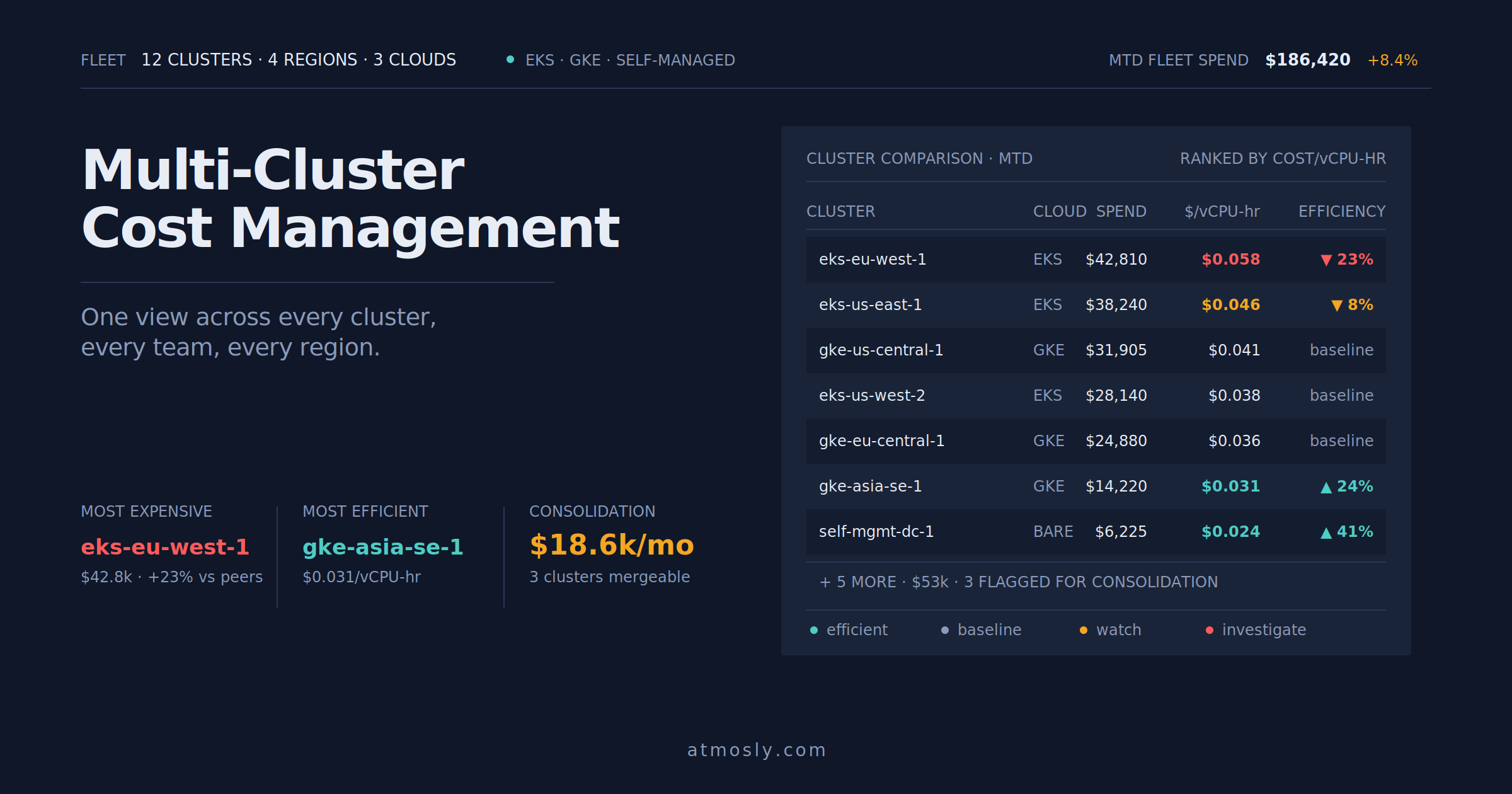
Cleanup policy is most effective when you can see what previews cost. Granular cost attribution — spend broken down by cluster, namespace, and workload — turns "we have some preview environments somewhere" into "preview namespaces cost \$2,140 last month and three of them have been idle for a week." Atmosly's cost intelligence attributes spend at the cluster, namespace, and workload level and surfaces rightsizing recommendations, which is exactly the granularity you need to govern ephemeral environments: you can spot the preview namespaces that are over-provisioned or abandoned and act on them before they show up on the invoice.
The combination — namespaced previews, scheduled scale-down/destroy guardrails, and namespace-level cost visibility — is what keeps the per-PR pattern from turning into a per-PR cost problem.
A Practical Checklist for Safe Preview Environments
Use this as the gate before you roll preview environments out org-wide:
| Concern | Requirement | How to satisfy it |
|---|---|---|
| Isolation unit | One namespace per PR/branch | Namespace named/labeled from PR metadata |
| Full environment | App + dependencies + config + secrets, not just the artifact | Clone the full environment definition (services + datastores) |
| Identity safety | No reused names, namespaces, passwords, registry bindings | Regenerate all unique fields on clone |
| Secret safety | Secrets never copied between environments | Re-fetch from secret manager at deploy time; mask without permission |
| Capacity isolation | One preview can't starve others | ResourceQuota + LimitRange per namespace |
| Network isolation | Previews can't reach staging/prod or each other | Default-deny NetworkPolicy, intra-namespace allow |
| Access isolation | Least-privilege, scoped to the environment | Per-environment RBAC / object-level permissions |
| Reproducible deploy | Governed, auditable, self-healing | GitOps / pipeline path, not ad-hoc kubectl apply |
| Event teardown | Deleted on merge/close | PR-lifecycle webhook → destroy namespace |
| TTL safety net | Nothing lives forever by accident | Scheduled destroy guardrail / TTL controller |
| Cost visibility | Know what previews cost | Namespace-level cost attribution + rightsizing |
If you can check every row, you have preview environments that accelerate delivery instead of generating incidents and surprise bills.
A Note on Data: Seeding and Branching (Going Deeper)
There is one dimension this guide intentionally keeps at altitude: data. A "full" preview environment needs some data to be useful, and how you provide it is a deep topic in its own right — anonymized production snapshots, synthetic seed data, copy-on-write database branching, and the privacy/compliance tradeoffs of each. The safe baseline is what we covered above: deploy the datastore into the isolated namespace with regenerated credentials, and seed it with non-sensitive fixture or synthetic data rather than copying live customer records into ephemeral environments. Database branching and production-like seeding — the strategies, the tooling, and the governance — deserve their own treatment, and we will cover them in a dedicated follow-up. For now, treat data as: isolated by default, seeded deliberately, never a copy of raw production secrets.
Conclusion
Preview environments are no longer a luxury — with concurrent development and GitOps as the norm, a full environment per PR is the only way to keep review fast and trustworthy at scale. The pattern is simple to state ("namespace per PR") and easy to get dangerously wrong. The teams that succeed treat it as an engineering discipline: clone the full environment, regenerate every unique identity, fetch secrets from a manager instead of copying them, wrap each namespace in quotas, network policy, and scoped RBAC, deploy through a governed pipeline, and — most importantly — make sure every ephemeral environment actually expires.
You can assemble all of this from raw Kubernetes primitives. But the plumbing — safe cloning, secret regeneration, per-environment RBAC, GitOps deploys, scheduled teardown, and namespace-level cost visibility — is exactly what a platform layer should provide. Atmosly gives you full-environment cloning with regenerated identities and re-fetched secrets, namespaced isolation with automatic per-environment permissions, pipeline-driven deploys, and scheduled scale-down/destroy guardrails so previews never become a cost leak. Start free with Atmosly and stand up your first safe, self-cleaning preview environment against your own cluster.