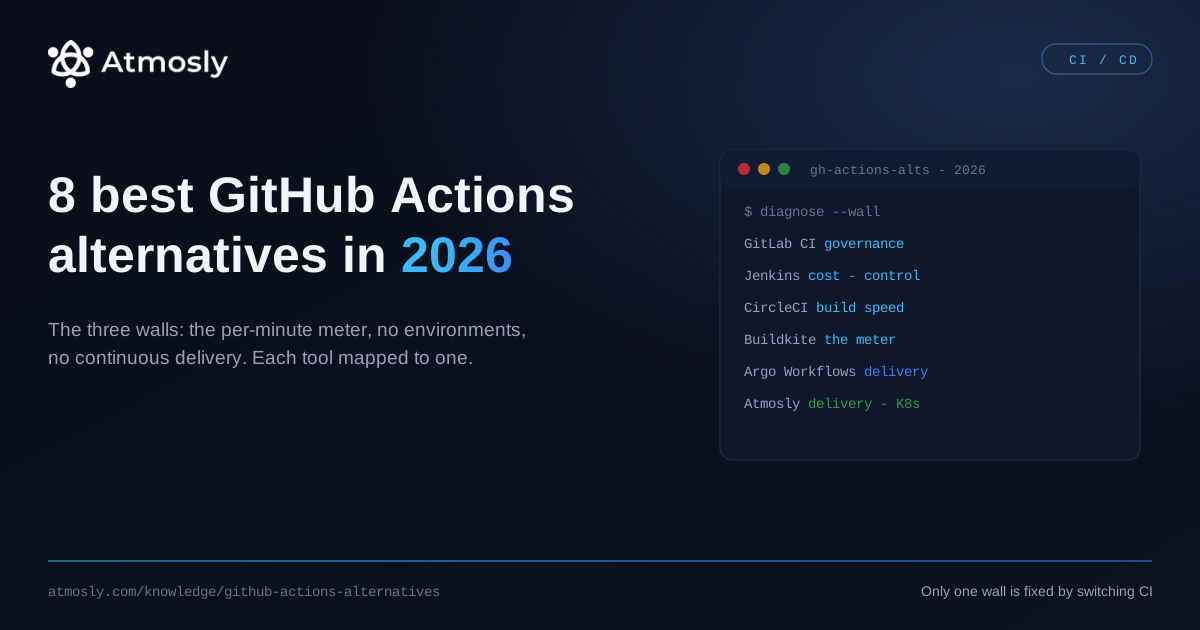
Short answer: teams leave GitHub Actions for one of three reasons, and the right alternative depends on which one applies. If the CI bill or build speed is the problem, look at Buildkite, CircleCI or self-hosted runners. If governance and audit are the problem, look at GitLab CI, Azure Pipelines or Harness. If deployment, environments and rollback are the problem, no CI tool will help — you need a delivery layer such as Argo Workflows paired with Argo CD, or Atmosly on Kubernetes.
Below are the eight worth shortlisting in 2026, each mapped to the problem it actually solves, with an honest section on when staying on GitHub Actions is correct. Disclosure: Atmosly is our product — it appears at number two and is held to the same standard as the rest.
| Tool | Solves which wall | Hosting | Pricing model | Best for |
|---|---|---|---|---|
| GitLab CI | Governance | SaaS or self-managed | Free tier, then per-user | Teams wanting one platform for code, CI, registry and scanning |
| Atmosly | Environments + delivery | Managed; self-hosted control plane available | Free read-only audit; paid tiers | Kubernetes teams whose pain is after the build |
| Jenkins | Cost + control | Your infrastructure | Free (Apache 2.0); cost is operations | Full control, air-gapped builds, unusual requirements |
| CircleCI | Build speed | Cloud or self-hosted runners | Credit-based; free tier | Heavy caching, test splitting, macOS and mobile builds |
| Buildkite | The meter | SaaS control plane, your agents | Per-user, plus your own compute | Large build fleets where compute economics dominate |
| Azure Pipelines | Governance | SaaS or self-hosted agents | Free tier, then per parallel job | Microsoft-centric enterprises and hybrid estates |
| Argo Workflows | Environments + delivery | In your cluster | Free (CNCF graduated) | DAG pipelines, data and ML steps, paired with Argo CD |
| Harness | Governance | SaaS or self-managed | Enterprise, sales-led | Approvals, policy-as-code and progressive delivery |
The three walls teams hit with GitHub Actions
GitHub Actions is genuinely good, which is why most teams do not leave it until something specific breaks. In practice it is almost always one of three things.
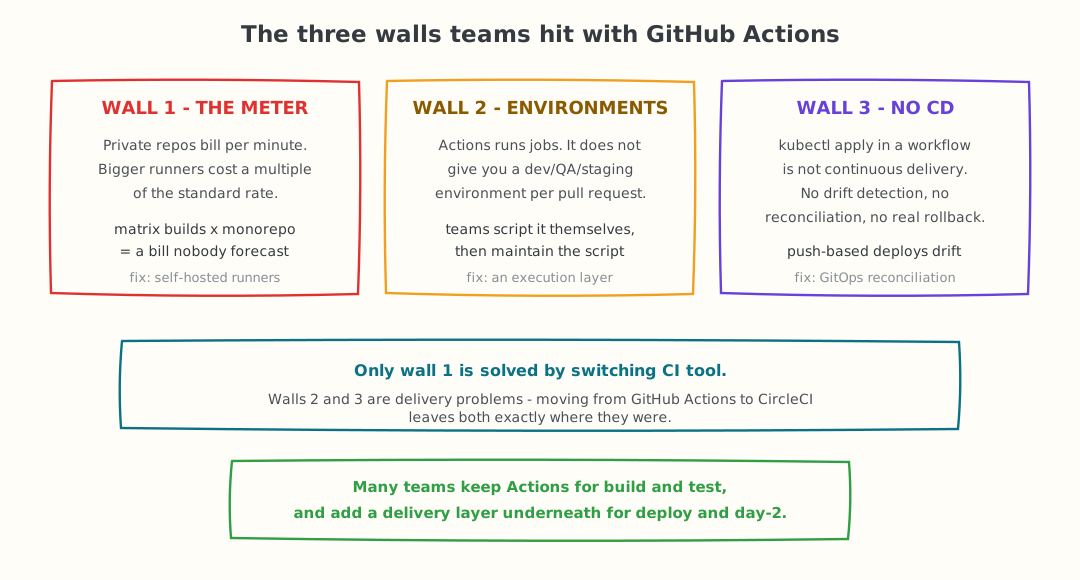
Only the first wall is solved by switching CI tool. The other two are delivery problems.
- Wall 1 — the meter. Private repositories bill per minute, and larger runners cost a multiple of the standard rate. A monorepo with a matrix build produces a monthly figure nobody forecast. This is a real CI problem with real CI answers: self-hosted runners, or a tool with different economics.
- Wall 2 — environments. Actions runs jobs; it does not hand you a dev, QA or staging environment, and certainly not one per pull request. Teams script it themselves with Terraform and Helm called from a workflow, and then own that script forever.
- Wall 3 — no continuous delivery. A
kubectl applystep in a workflow is a deployment, not continuous delivery. There is no drift detection, no reconciliation loop, and rollback means re-running an old workflow and hoping the cluster was where you left it.
This distinction matters commercially. Moving from GitHub Actions to CircleCI can halve your build times and leave walls two and three exactly where they were.
Find out which wall you are actually hitting.
Free, read-only. Takes 10 minutes. Nothing changes in your cluster.
With the diagnosis clear, here are the eight tools worth shortlisting.
The 8 best GitHub Actions alternatives in 2026
1. GitLab CI — the complete-platform answer
Solves: governance · Pricing: free tier, then per-user.
GitLab CI is the most direct like-for-like alternative, and the strongest argument for it is not the pipeline syntax but everything around it. Source control, merge requests, container registry, security scanning, package registry and the CI runner ship as one product with one permission model — which is exactly what an auditor wants and what a fragmented toolchain cannot produce.
Pipeline features are mature: parent-child pipelines, include for shared templates, protected environments with approval rules, and a Kubernetes agent for GitOps-style deploys. It can be self-managed if data residency matters. The trade-off is the mirror image of the benefit — you are consolidating on a single vendor, and if your code stays on GitHub you are running two platforms. See the GitLab CI comparison.
2. Atmosly — for walls two and three
Solves: environments and delivery · Kubernetes only · Disclosure: Atmosly is our product.
Atmosly does not compete with GitHub Actions on build minutes, and a comparison that pretended otherwise would not be useful. It addresses the two walls a CI tool cannot: it gives you a full ephemeral environment per pull request — isolated namespace, quota and RBAC, torn down on merge — and GitOps-native delivery with approvals, drift detection and one-click rollback.
Around that sit the rest of the day-2 problems on one control plane: always-on security posture scanning of the live cluster against CIS, PCI DSS, SOC 2 and NSA benchmarks; per-namespace cost attribution with right-sizing delivered as GitOps pull requests; and an AI SRE agent that infers root cause on a real failure and opens the fix as a reviewable PR.
The common pattern is to keep GitHub Actions for build and test and let Atmosly own Kubernetes deployment and day-2 — you do not have to migrate CI at all. It is read-only by default, every action is reversible with an audit trail, a human merges every change, and it is ISO 27001 certified with SOC 2 Type II in progress.
Where it is wrong for you: if your workloads are not on Kubernetes, or if your only complaint is the CI bill, another tool on this list fits better.
3. Jenkins — the zero-licence, high-ownership option
Solves: cost and control · Pricing: free, Apache 2.0.
If the CI meter is the problem and you have infrastructure competence, Jenkins removes the meter entirely. Builds run on hardware you already pay for, the plugin ecosystem integrates with virtually anything, and Jenkinsfile gives you a real programming model rather than pure declarative YAML. For air-gapped or heavily regulated environments it is frequently the only viable choice.
The cost moves rather than disappearing: plugin version conflicts, upgrade cycles and controller maintenance are permanent work owned by someone on your team. Teams that migrate from Actions to Jenkins to save money and do not staff that ownership usually regret it within a year. Details in the Jenkins comparison.
4. CircleCI — when builds are simply too slow
Solves: build speed · Pricing: credit-based with a free tier.
CircleCI exists to make pipelines fast. Caching and test splitting are mature rather than bolted on, parallelism is first-class configuration, and orbs package reusable config across repositories in a cleaner way than copying workflow files between repos. Docker, machine and macOS executors mean mobile and desktop builds are properly supported, which is a common reason teams outgrow the GitHub-hosted runner fleet.
Model the credit pricing before committing — it is flexible but harder to forecast than per-minute billing, and at scale that unpredictability is itself a cost. Verify current terms directly, since the model has changed more than once. See the CircleCI comparison.
5. Buildkite — the direct answer to the meter
Solves: the meter · Pricing: per-user, plus your own compute.
Buildkite is the cleanest structural answer to wall one. It hosts the control plane — orchestration, pipeline logic, dashboards — while build agents run on machines you own and pay for at your own rates. You are buying coordination rather than compute minutes, which is a fundamentally different cost curve as build volume grows.
It has a second benefit that often decides the evaluation: source code and build artefacts never leave your network, which closes out a whole category of security review. The trade-off is that you are running agents again, so it suits teams with existing infrastructure capability. There is no Atmosly comparison page for Buildkite — evaluate it directly against your current Actions minutes bill.
6. Azure Pipelines — the Microsoft-estate answer
Solves: governance · Pricing: free tier, then per parallel job.
Azure Pipelines remains a strong option for organisations already invested in Microsoft tooling — Azure AD for identity, Azure Boards for work tracking, and an approvals-and-checks model built for enterprise release governance. It supports Linux, macOS and Windows agents, which matters for teams shipping .NET alongside everything else, and self-hosted agents remove the parallel-job constraint.
The per-parallel-job pricing model is a different mental model from per-minute billing, and generally rewards teams with steady throughput over teams with bursty CI. If your organisation already runs Azure, the integration story is hard to beat — see the Azure Pipelines comparison.
7. Argo Workflows — Kubernetes-native pipelines, paired with Argo CD
Solves: environments and delivery · Pricing: free, open source.
Argo graduated from the CNCF in 2022, and Argo Workflows is its container-native DAG engine. Every step is a container in your cluster, fan-out and fan-in are natural, and it handles data-processing and ML training steps alongside application builds better than any conventional CI tool.
Its real answer to walls two and three comes from pairing it with Argo CD: Workflows builds and tests, Argo CD reconciles the desired state continuously, detects drift and gives you genuine rollback. That is the strongest open-source route to fixing GitHub Actions' delivery gap, at the cost of running and integrating two systems and building the developer experience yourself. See the Argo Workflows comparison.
8. Harness — when you need to prove it, not just ship it
Solves: governance · Pricing: enterprise, sales-led.
Harness is aimed at organisations where the constraint is evidence: who approved this release, which policy did it satisfy, and can we demonstrate that to an auditor. It provides progressive delivery (canary, blue-green, feature flags), policy-as-code via OPA, automated verification against observability data, and cost visibility in the same platform.
It is a heavier adoption than swapping a CI runner and it is priced for enterprises, so it belongs on the shortlist only when release governance — not build speed — is the actual problem. See the Harness comparison.
Which alternative fits which problem
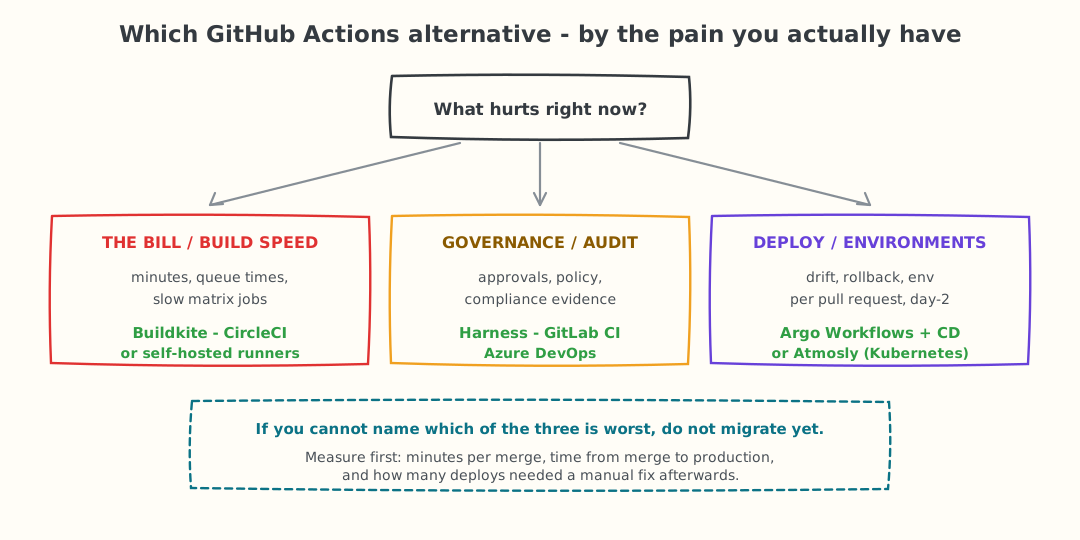
If you cannot name which of the three walls is worst, do not migrate yet — measure first.
Three numbers tell you where to shop:
- CI minutes per merge. High and rising means wall one — Buildkite, CircleCI, or self-hosted runners on your existing Actions setup.
- Time from merge to production. If most of it is after the build finishes, it is wall two or three, and a faster CI tool will not move it.
- Deploys that needed a manual fix afterwards. Anything above the occasional one is a reconciliation problem — GitOps, not CI.
When to stay on GitHub Actions
Most teams evaluating alternatives should stay, and fix in place instead. Stay if:
- Your repositories are on GitHub and the team likes the workflow. Having CI in the same interface as code review is a genuine productivity feature that no external tool replicates.
- The bill is the only complaint. Self-hosted runners on your own compute remove most of the meter without changing anything else. Try that before a migration.
- The problem is workflow hygiene. Much of what teams blame on Actions is fixable: use reusable workflows and composite actions instead of copy-pasted YAML, cache dependencies properly, use path filters so unrelated changes do not trigger full matrix builds, and pin third-party actions to a commit SHA.
- Your delivery gap can be closed underneath. Adding Argo CD or an execution layer beneath Actions solves walls two and three without touching CI at all — a much smaller change than migrating pipelines.
Migrating from GitHub Actions: what to expect
If you do move, the shape of the work is predictable.
Straightforward. Build and test commands are shell — they run anywhere. Docker builds and registry pushes translate directly. Artifact handling is solved everywhere on this list.
Where it gets slow. Marketplace actions are the hidden dependency: every third-party action in your workflows is functionality you now have to reimplement, and teams routinely underestimate how many they use. Run an audit of every uses: line before you commit to a date. Repository and environment secrets have no export path and are re-created by hand. Environment protection rules and required reviewers encode approval policy that has to be re-expressed. And OIDC federation to your cloud provider must be reconfigured for the new system's identity model.
Two rules worth following: run both systems green in parallel on one repository for at least a week, and migrate one service end to end — build, test, deploy, rollback — before scaling out. The first service surfaces every assumption you did not know you had.
Key takeaways
- Diagnose the wall first. Meter, environments, or no CD — only the first is fixed by changing CI tool.
- Self-hosted runners are the cheapest fix for a GitHub Actions bill, and require no migration.
- Buildkite inverts the cost model by charging for coordination while you supply compute.
- GitLab CI and Azure Pipelines win on platform consolidation and governance, not on pipeline syntax.
- Argo Workflows plus Argo CD is the strongest open-source answer to the delivery gap, if you have a platform team.
- Marketplace actions are the real migration cost — audit every
uses:line before committing to a timeline. - You can keep Actions and add a delivery layer underneath, which is a far smaller change than a CI migration.
If your workloads run on Kubernetes and the pain sits after the build rather than in it, look at your own cluster before believing any vendor's table — including ours: start the free read-only audit, or compare Atmosly and GitHub Actions side by side.