Introduction
If Kubernetes is the engine of modern infrastructure, GitOps is the transmission system that keeps it running smoothly. The concept using a Git repository as the single source of truth for your infrastructure and application state has revolutionized how we deploy software. It brings the version control, code review, and audit trails of software development to operations.
As we navigate 2026, the GitOps landscape has consolidated around two CNCF-graduated heavyweights: ArgoCD and Flux. Together, they command the vast majority of the market. But for a Platform Engineering team trying to choose between them, the decision is agonizing. Both are excellent. Both are open source. Both sync Git to K8s.
So, what's the difference? Why do some massive enterprises swear by ArgoCD's UI while others defend Flux's minimalistic "Unix philosophy" to the death? The ArgoCD vs Flux question comes up in almost every platform engineering kickoff, and the answer depends far more on your team structure than on any single feature.
The ArgoCD vs Flux question comes up in almost every platform engineering kickoff, and the answer depends far more on your team structure than on any single feature.
In this exhaustive 3,000-word guide, we will go beyond the surface-level feature lists. We will tear down their architectures, examine their security models, walk through disaster recovery scenarios, and explore how they integrate with next-gen platform engineering tools like Atmosly.
Part 1: The Philosophy & Architecture
ArgoCD: The "Management Plane" Approach
ArgoCD was born out of Intuit (the makers of TurboTax) and was designed from day one to be a tool for developers. Its philosophy is that deployment information should be visible, accessible, and easy to understand.
The Centralized Hub Model: ArgoCD is typically deployed in a "hub-and-spoke" topology. You install a central ArgoCD instance in a management cluster. This instance then connects to 5, 10, or 100 remote clusters (the spokes). It pushes configuration to them (or monitors them). Implication: This provides a fantastic "Single Pane of Glass" where you can see the status of every app in every cluster in one web UI. However, it also means your management cluster holds the "keys to the kingdom" credentials for all your production clusters.
Flux: The "Cluster-Native" Approach
Flux, created by Weaveworks (the company that coined the term "GitOps"), takes a different stance. Its philosophy is closer to Kubernetes itself: highly decoupled, controller-based, and invisible.
The Distributed Agent Model: Flux is typically installed independently on each cluster. Cluster A pulls its config from Git. Cluster B pulls its config from Git. They don't know about each other. There is no central "Flux Server" governing them all. Implication: This is architecturally simpler and often more secure. Cluster A doesn't need credentials for Cluster B. If one cluster is compromised, the others are safe. But, you lose the centralized visibility out of the box.
Part 2: Deep Feature Comparison
1. The User Interface (UI) Factor
This is usually the deciding factor for teams with many developers. In most Argo CD vs Flux evaluations, the UI discussion happens first and often ends the debate before architecture is even considered.
ArgoCD has a world-class UI. It visualizes the Kubernetes object hierarchy beautifully. A developer can log in, click their application, and see the Service, Ingress, Deployment, and Pods in a tree view. They can see live logs. They can click a "Sync" button to force a deployment. It makes Kubernetes approachable.
Flux (v2) is CLI-first. While there are experimental UIs and third-party dashboards (like Weave GitOps), the core experience is via the `flux` command-line tool. For a pure Ops team, this is fine. For a team trying to enable self-service for 500 Java developers, asking them to check `kubectl get kustomization` to debug a failed deploy is a hard sell.
2. Multi-Tenancy & Security
ArgoCD: Since it's a centralized portal, it needs robust multi-tenancy. ArgoCD has a built-in RBAC system (stored in ConfigMaps or CSVs) that maps OIDC groups to permissions. You can say "The 'Frontend Team' can sync apps in the 'frontend' project but only view apps in the 'backend' project."
Flux: Flux relies on Kubernetes native RBAC. To restrict a user, you use Kubernetes `RoleBindings` to prevent them from editing the `GitRepository` or `Kustomization` CRDs in certain namespaces.
This is more "Kubernetes-native" but can be harder to audit across 50 clusters compared to Argo's central config. On the security side of Flux vs ArgoCD, the trade-off is centralized auditability versus a smaller blast radius per cluster.
3. Handling Helm and Kustomize
Both tools support Helm and Kustomize, but differently. This is where the ArgoCD vs FluxCD comparison gets more technical than a UI screenshot can show.
Flux's Helm Controller is a masterpiece of engineering. It creates a `HelmRelease` CRD. It serves as a full Helm operator it can handle dependency upgrades, test hooks, and rollbacks natively using Helm libraries. It treats Helm charts as first-class citizens.
ArgoCD renders Helm charts internally (using `helm template`) and applies the result. This is simpler and faster but sometimes lacks the nuance of a full Helm lifecycle management (though it has improved significantly). ArgoCD excels at Kustomize, allowing for very clean base/overlay structures.
Part 3: Disaster Recovery (DR) Scenarios
What happens when your cluster burns down? Disaster recovery is one of the least discussed but most revealing angles in any Flux vs ArgoCD comparison.
With Flux: You provision a new cluster. You run the `flux bootstrap` command pointing to your Git repo. Flux installs itself, connects to the repo, and immediately starts applying all the manifests. Within minutes, the cluster hydrates itself to match the Git state. It is arguably the fastest path to recovery.
With ArgoCD: If you lost the target cluster, it's easy: you just point ArgoCD to the new cluster URL. However, if you lost the management cluster (where ArgoCD runs), it's harder. You need to restore ArgoCD itself first from a backup, ensuring it has all the cluster credentials and Application definitions, before it can start restoring the other clusters.
Part 4: The Developer Experience Gap
Here is the uncomfortable truth about GitOps: Writing Kubernetes manifests is hard.
Whether you use ArgoCD or Flux, you are expecting your developers to commit valid YAML to Git. You are expecting them to understand `Ingress` annotations, `HPA` metrics, and `PodDisruptionBudgets`.
GitOps tools solve the delivery problem (getting YAML from Git to K8s), but they don't solve the definition problem (creating the right YAML in the first place). This is where deployments fail not because Flux broke, but because a developer indented line 42 wrong.
The Solution: Atmosly as the Platform Layer
This is where Atmosly fits into the architecture. Atmosly sits upstream of your GitOps tool.
1. Abstracting the YAML Complexity
Instead of asking a developer to write a 500-line Helm values file, Atmosly provides a simplified UI or CLI. The developer says: "I need a Node.js service, exposed on port 80, with a database."
Atmosly takes this high-level intent and generates the rigorous, best-practice Kubernetes manifests (Helm or Kustomize). It then commits these to the Git repository that ArgoCD or Flux is watching.
2. The "Verification" Feedback Loop
ArgoCD shows you "Synced." But "Synced" doesn't mean "Working." You can successfully sync a pod that crashes immediately.
Atmosly closes the loop. It integrates with the observability layer. After the GitOps tool syncs the change, Atmosly watches the rollout. If error rates spike or latency increases, Atmosly can trigger a rollback or alert the developer with context: "Your deployment synced successfully, but caused a 50% increase in 5xx errors. Check the database connection pool."
3. Cost-Aware Deployments
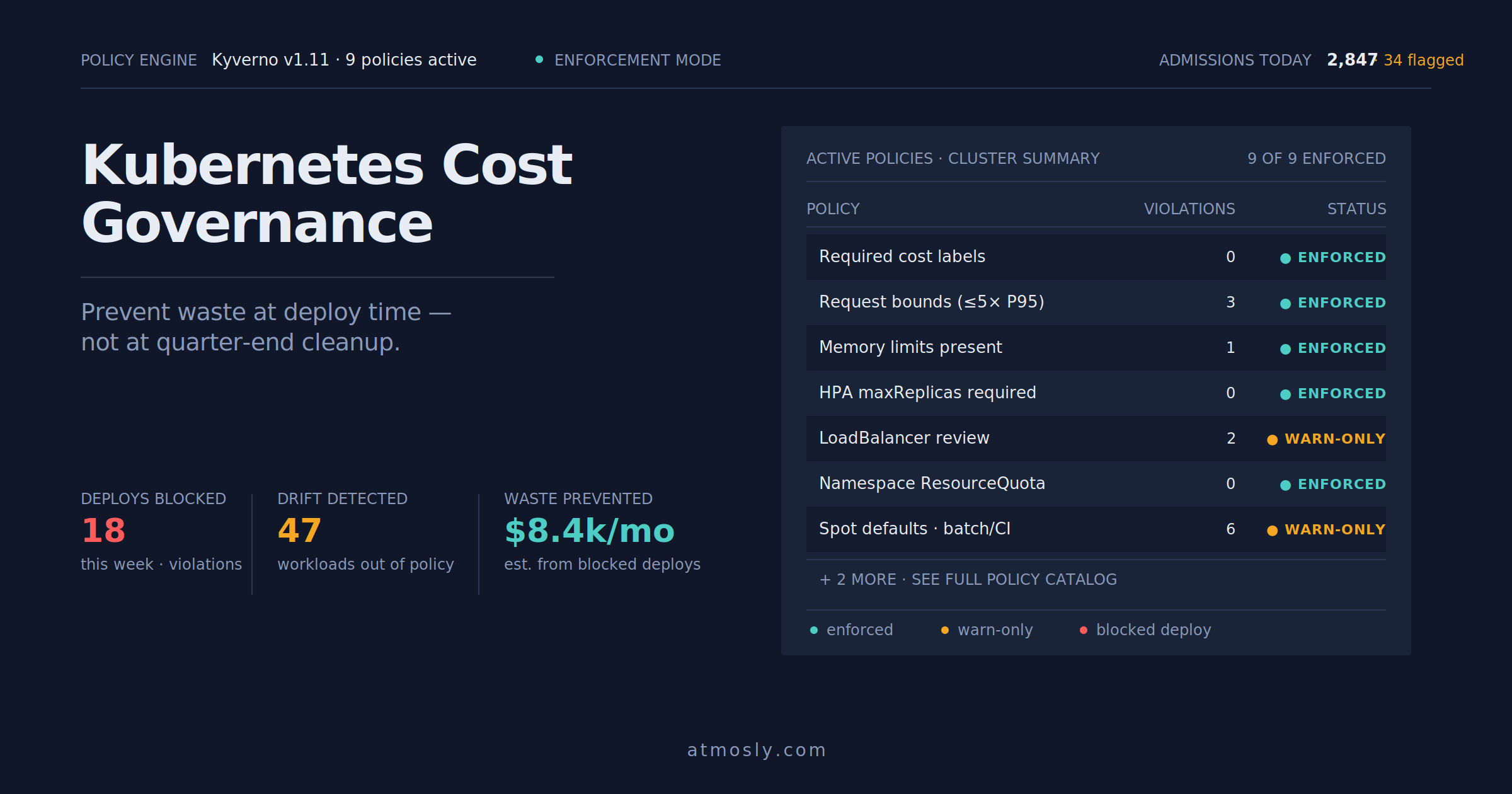
GitOps tools are blind to cost. They will happily deploy a deployment asking for 100 CPUs. Atmosly can enforce policies before the commit hits Git. "This deployment exceeds the budget for the 'staging' environment. Approval required."
Verdict: The Decision Matrix
| Feature | ArgoCD | Flux v2 |
|---|---|---|
| Architecture | Centralized Management Plane | Distributed Controller |
| Primary Interface | Web UI (GUI) | CLI & API |
| Multi-Cluster | Hub-and-Spoke (Push/Pull) | Independent Agents (Pull Only) |
| Setup Complexity | Medium (Needs DB/Redis) | Low (GitOps Toolkit) |
| Developer Friendliness | High (Visual feedback) | Low (Requires K8s knowledge) |
| Best For... | Platform teams serving many devs | Ops teams wanting pure automation |
Conclusion
There is no "wrong" choice in the ArgoCD vs Flux debate. Both are mature, battle-tested tools that power some of the largest companies in the world.
- Choose ArgoCD if you want a rich visual experience for your developers and a centralized place to manage all your applications. It is the best choice for organizations where "Developer Experience" is a top priority.
- Choose Flux if you want a lightweight, secure, set-it-and-forget-it tool that adheres strictly to Kubernetes patterns. It is the best choice for Edge computing, massive scale (thousands of clusters), or strict security environments where clusters cannot accept incoming connections.
However, remember that GitOps is just the transport mechanism. To build a true Internal Developer Platform (IDP), you need to pair your GitOps engine with a platform like Atmosly. By combining the execution power of Argo/Flux with the intelligence and abstraction of Atmosly, you achieve the holy grail: self-service for developers, control for ops, and reliability for the business.
Try Atmosly Free Build Your First Service in 60 Seconds